How Sharks Breathe: Swimming, Pumping and Spiracles
3 min read
Last Updated on November 8, 2026 by Otis Mako
A shark has no lungs and no way to gulp air. Every breath it takes is water pulled across its gills, and the only real question is how the water gets there. Sharks have found two answers, and which one a species uses shapes how it rests and how well it copes with a warming sea.
Gills do the work in both cases. Water goes in through the mouth or a small opening on the head, passes over the gill tissue, where oxygen moves into the blood, and leaves through the gill slits on the side of the body. The difference is what moves the water.
Breathing while swimming: ram ventilation
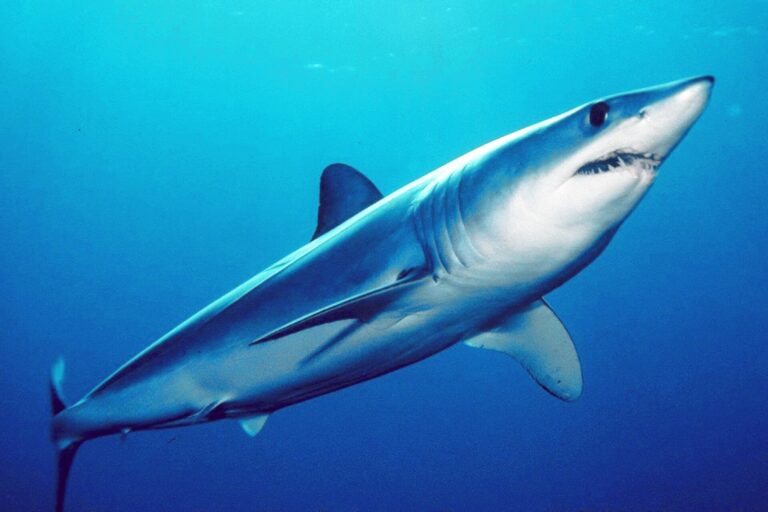
Some sharks let their own movement do the pumping. They swim with the mouth slightly open and the water is forced over the gills. The Florida Museum of Natural History describes it this way: oxygen-rich water flows through the gills during movement, which allows the shark to breathe.
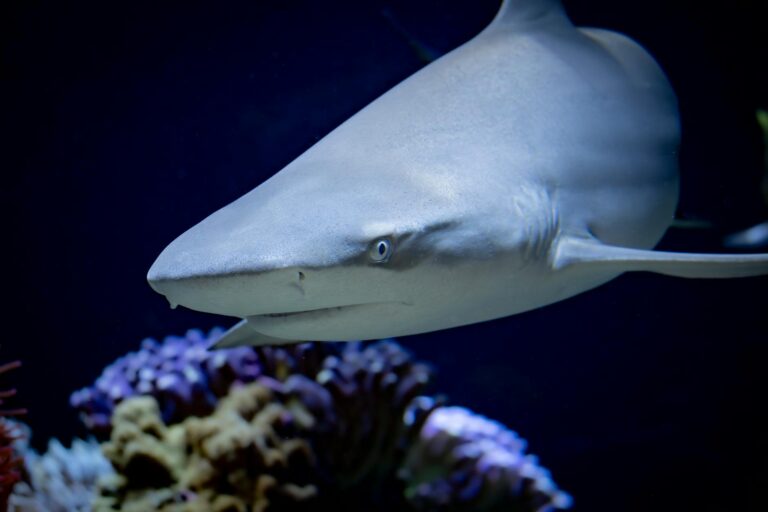
The name for this is ram ventilation, and a species that depends on it completely is an obligate ram ventilator. According to Wikipedia’s entry on the spiracle, requiem sharks and hammerhead sharks are among them, and they have lost their spiracles. The requiem family also includes the bull shark and the sandbar shark, though the sources I read only name the sandbar shark as an obligate ram ventilator.
The popular idea that every shark must keep swimming to breathe holds for this group. It does not hold for sharks as a whole, as the next section shows.
Breathing while still: buccal pumping and the spiracle
Other sharks can push water over the gills without moving forward. They expand and squeeze the mouth cavity, known as buccal pumping. Many of them add a spiracle, a small hole behind each eye that opens into the mouth. The Florida Museum says that some sharks, such as the nurse shark, have spiracles that force water across their gills, allowing for stationary rest.
On bottom dwellers the spiracle sits high on the head. Wikipedia’s summary notes that this lets the animal breathe even while it is mostly buried under sediment, so it can draw in water from above and leave the gill slits to push it out. A spiracle on a ray works the same way, and it is the reason a ray can lie half buried in sand and still breathe.
The spiracle also hides a small mystery. In sharks and rays it carries a small gill-like structure called a pseudobranch. It receives blood that has already been oxygenated by the true gills, and what it is for is still not known. One idea is that it supplies oxygen-rich blood to the eye.
Why the difference matters for sleep
Because of this split, the question of whether sharks sleep has no single answer. The Florida Museum notes that sharks do not sleep the way humans do, but have active and restful periods. Our own post on whether sharks sleep goes through what is known. A nurse shark can rest without moving. A species that relies on ram ventilation has to keep water moving, so its rest looks different.
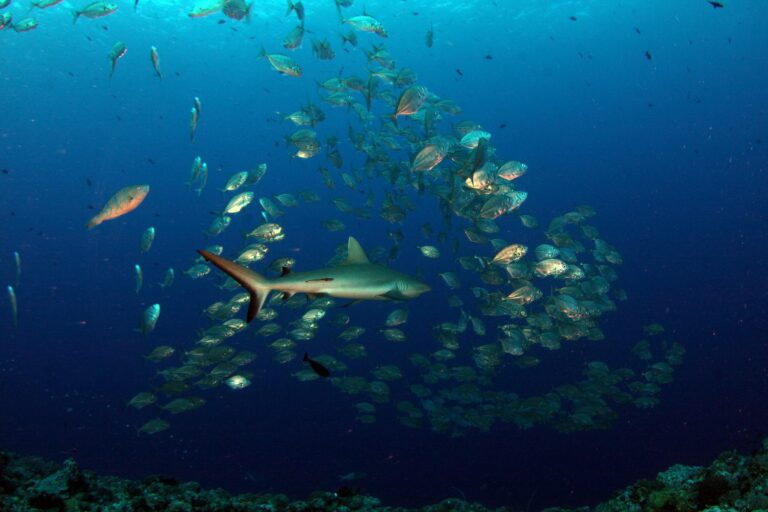
Even that line is blurring. In 2024 Bullock, Foster and Lea reported the first observations of resting in the gray reef shark, a species usually treated as an obligate ram ventilator. At several sites in Seychelles they found sharks resting under reef ledges, unresponsive to divers. The authors say the findings update the understanding of the species’ respiratory mode. Their report is a set of field observations, so it shows that the behaviour happens, not how often.
A hot, low-oxygen sea is a problem for swimmers
Ram ventilation links a shark’s oxygen supply to its swimming, and that has a cost. Crear and colleagues (2019) studied juvenile sandbar sharks, an obligate ram-ventilating species that uses Chesapeake Bay as a nursery ground until about 10 years of age. They tested 12 young sharks, 79.5 to 113.5 cm long, in warm and low-oxygen water.
Their overall performance fell substantially at 32 degrees C, or when dissolved oxygen dropped below 3.5 milligrams per litre, about 51 percent saturation across the 24 to 32 degree range. At 32 degrees in normal oxygen, some sharks even stopped swimming for periods from a few seconds to more than an hour.
The authors expect that as warm, low-oxygen water spreads in the bay, the nursery habitat available to sandbar sharks will shrink. That fits the wider picture in our post on climate change and sharks.
What we do not know
The gray reef shark report shows how a few field observations can change the label a species carries. The function of the pseudobranch is also open.
If you have watched a shark rest or breathe in an unusual way, add what you saw in the comments.
Sources
- Florida Museum of Natural History, Sharks FAQ
- Wikipedia, Spiracle (vertebrates)
- Crear et al. 2019, Conservation Physiology, The impacts of warming and hypoxia on the performance of an obligate ram ventilator
- Bullock, Foster and Lea 2024, Journal of Fish Biology, Just keep swimming? Observations of resting behavior in gray reef sharks
Got a shark photo of your own? Send it to us and we may post it here and on our Facebook page, with your name on it. Share your shark photo