Shark Skin Is Made of Teeth: Dermal Denticles Explained
4 min read
Last Updated on October 29, 2026 by Otis Mako
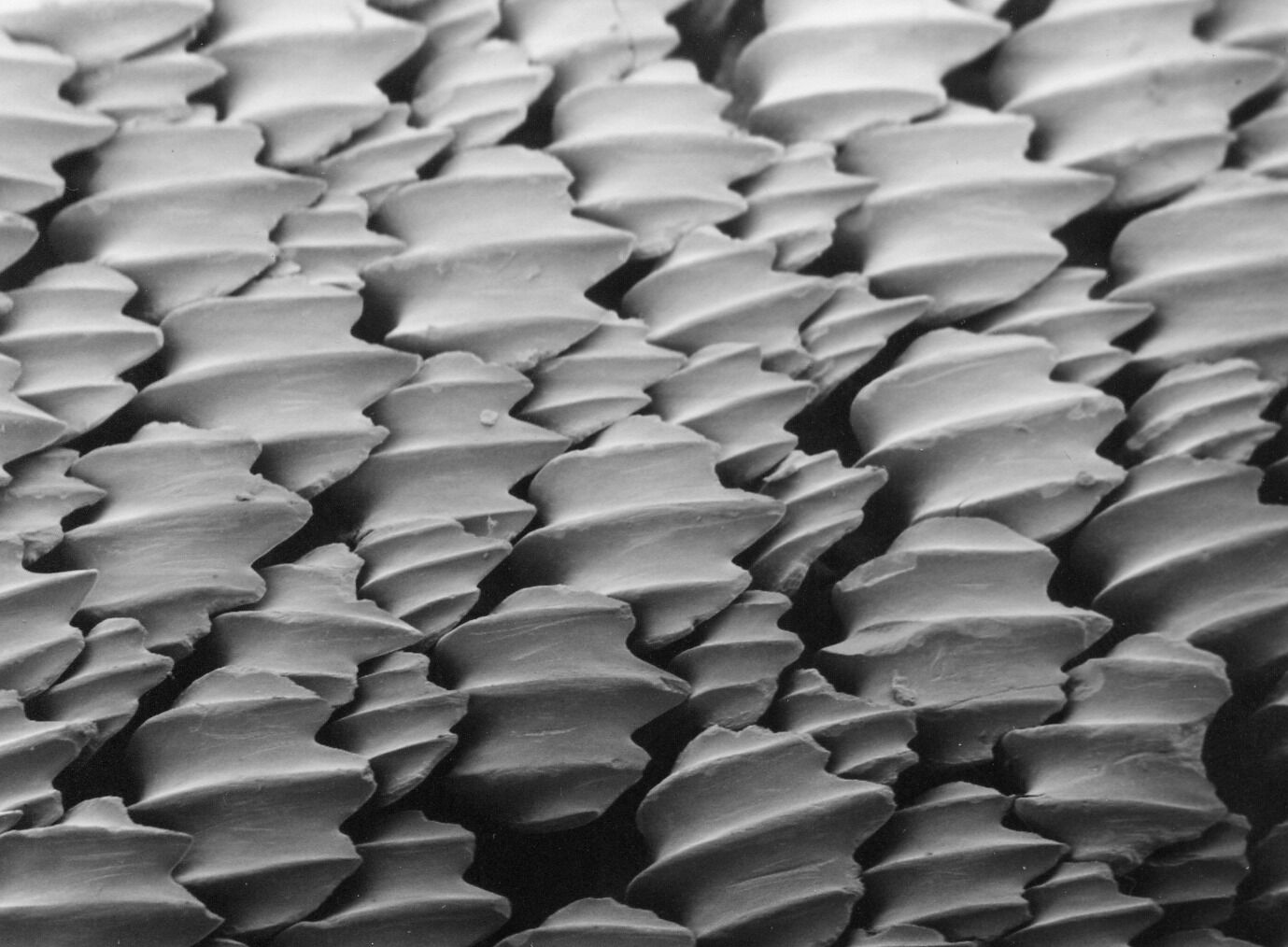
Run a hand along a shark from head to tail and the skin feels smooth. Run it back the other way and it feels like sandpaper. That difference comes from millions of tiny structures called dermal denticles, which the Shark Trust describes as tiny teeth that point backwards over the body.
They look simple from a distance. Under a microscope they turn out to be one of the most varied features on a shark, and a 2026 study in Nature Communications sorted that variety into ten groups.
Skin made of teeth
The word denticle translates to “small tooth”, and that is close to literal. According to Wikipedia’s entry on placoid scales, each denticle has a central pulp cavity supplied with blood vessels, a cone of dentine around it, and a rectangular base plate that rests in the skin. The outer layer is a hard enamel-like coating.
The Nature Communications authors say the same thing in more technical language: teeth and dermal denticles are homologous organs, both built from a dentine cone covered by highly mineralised enameloid with a bony base. They also point out that denticle-like structures show up on the skin of an extinct jawless vertebrate called Astraspis as early as the Ordovician, about 450 million years ago. That fits the age of the oldest shark-like fossils covered in our timeline of how sharks evolved.
Only sharks and some rays are entirely covered by denticles, the study notes. Most bony fish carry other scale types instead, such as cycloid, ctenoid or ganoid scales.
Why the skin helps a shark swim
The best-known job of the denticles is drag reduction. The Shark Trust says they point backwards and reduce surface drag, which helps the shark swim faster. The Wikipedia entry adds the mechanism: the spines are flattened by water moving forward over the body, and they create tiny vortices that reduce drag and turbulence.
People copied the idea. The Shark Trust notes that swimming costume makers replicated the skin’s hydrodynamic efficiency, and the suits were so effective they were labelled “technology doping” and banned from Olympic competition.
Drag is not the whole story. The Nature Communications paper says the ridged design of some fast-swimming sharks also works against fouling, so less settles and grows on the skin. It adds that researchers are now looking at how the denticles of deep-water sharks take part in bioluminescence.
Ten kinds of denticle
The research team took 2,193 scanning electron microscope images of skin from 204 individual sharks, covering 53 body locations on 132 living shark species. A deep learning model grouped the images without human labels, and the team settled on ten denticle groups.
Seven of the ten groups have ridges on the crown. The other three are smooth, spiky or what the authors call highly structured. The same shark can carry more than one kind. The paper says denticles on different parts of one body, such as the snout, the flank and the tail tip, can vary as much as denticles between species.
The groups follow family lines to a degree:
- Lantern sharks (Etmopteridae) carry spiky denticles only.
- Gulper sharks (Centrophoridae) mostly carry the highly structured type.
- Mackerel sharks, including the shortfin mako, carry a mix of ridged types.
- Ground sharks (Carcharhiniformes) are broadly represented by all seven ridged groups.
The study compares the mako with the blackbelly lanternshark as two extremes in its fluid simulations, describing the mako as highly efficient and the lanternshark as a poor swimmer. Our mako shark deep dive covers the fast end of that comparison. The slower end includes the deep-water species in our ninja lanternshark profile.
A few surprises
One result challenges a common assumption. People often expect reef-dwelling and bottom-dwelling sharks to wear tougher denticles to resist scraping. Among carpet sharks, which are mostly reef-associated and benthic, the authors found denticles with low damage resistance, which runs against that idea.
The paper also links denticle shape to habitat. In shallow water, above 200 metres, sharks tend to evolve from non-ridged to ridged denticles. In the deep sea the team found no clear direction. And the ground sharks, which show the widest range of ridged types, went through an increase in diversification around 170 million years ago. The authors call the link between ridges and that burst of new species a potential correlation, not proof. A statistical test comparing ridged and non-ridged groups did not find a significant difference in diversification rate, so treat the idea as open.
The authors’ own summary is that denticle ridges are highly variable and offer a spectrum of functions beyond drag reduction.
What we still do not know
The study sampled sexually mature sharks only, because denticle shape changes as a shark ages. Sources also disagree on how skin keeps up with growth. The Shark Trust says sharks shed denticles and replace them with larger ones, while the Wikipedia entry says the scales cannot grow, and more are added as the animal gets bigger. I would not state either as settled until I find a primary study that answers it.
The paper’s authors also say that the drag simulations used only one or two models per group, which rules out strong statistics, so the drag comparisons are descriptive. It is a good map of the variety, and a starting point for the function questions.
Next time you see a close-up photo of a shark, look at the skin as well as the teeth. If you know a study or a story about shark skin, add it in the comments.
Sources
- Dahl et al., “Diverse mechanical properties, composition, and performance of shark dermal denticles”, Nature Communications, 2026
- Shark Trust, Shark Anatomy
- Wikipedia, Placoid scale
Photo: Pascal Deynat/Odontobase, CC BY-SA 3.0, via commons.wikimedia.org.
Got a shark photo of your own? Send it to us and we may post it here and on our Facebook page, with your name on it. Share your shark photo