How Scientists Work Out How Old a Shark Is
4 min read
Last Updated on November 12, 2026 by Otis Mako
A shark has no birth certificate and no candles to count. Nobody knows how old a wild shark is unless a researcher works it out from the body itself. The answer matters more than it sounds, because managing how many sharks can be caught safely depends on knowing how fast they grow and how long they live.
The range is huge. The Florida Museum of Natural History lists the smooth dogfish at a maximum of about 16 years and the porbeagle at up to 46. It says whale sharks may live over 100 years and that the Greenland shark is estimated to live more than 400. Here is how researchers get to numbers like those, and why they keep checking their own methods.
Counting bands in the backbone
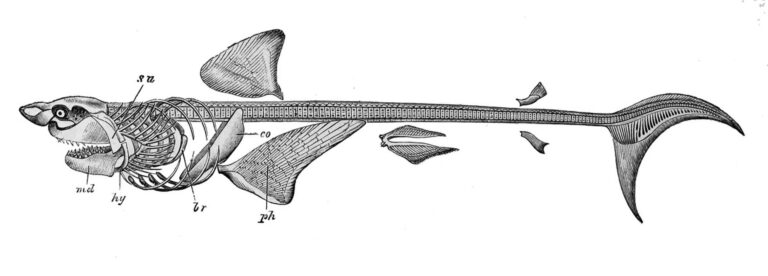
Sharks have cartilage skeletons, but their vertebrae still carry a record. The standard method is to count the paired bands laid down in them, a bit like tree rings. A 2014 study of white sharks in PLoS ONE puts it plainly: sharks are typically aged by counting growth bands sequentially deposited in the vertebrae.
The method has one big assumption. Each band pair has to mean one year. If a shark lays down a band pair every year, the count is its age. If it lays down more or fewer, the count is wrong, and nothing in the vertebra tells you which.
Even the preparation matters. In a 2026 comparison on three skate species, eight age readers from Dutch, Belgian and Italian institutions counted bands on vertebrae prepared in different ways. For fish aged 0 to 9 years, whole, unstained vertebrae from the front of the spine gave the most consistent counts. The authors note that the best preparation tends to be species specific, so there is no single recipe for every shark or skate.
Checking that a band means a year
The classic test is to mark the shark. Researchers inject a captured shark with oxytetracycline, which leaves a marker in the vertebra. The shark is released. If it is caught again later, they count the band pairs laid down after the oxytetracycline line and compare that with the time it spent free.
A 2018 study in Proceedings of the Royal Society B did this with shortfin makos, common threshers and blue sharks in the eastern North Pacific. Time at liberty ran from 215 days to 6 years. The authors also found that the amount of manganese in the vertebra rose and fell in step with the validated band pairs, which hints at a second way to count years.
A 2024 paper in the Journal of Fish Biology tested 14 juvenile common threshers marked between 1998 and 2013 and recaptured after 1.08 to 3.81 years. One band pair a year would give a slope of 1.0. The measured slopes were 0.84 to 0.95. That is close enough to support the old assumption for young threshers and far enough to need more work, which is what the authors say.
This is the honest state of shark ageing. For some species and life stages the one-band-a-year rule holds up. For others it is still being tested.
When the bands run out: the bomb pulse
Counting only works if the bands mean what researchers think they mean, and that is hard to prove for the oldest animals. Radiocarbon offers an independent check.
Atmospheric testing of thermonuclear devices put extra carbon 14 into the ocean, and marine animals took it up. Researchers call the result the bomb pulse, and the Science paper describes it as a time marker of the early 1960s. Compare a shark’s carbon 14 level with reference records and you can place that tissue in time.
The white shark study used this on vertebrae from four female and four male sharks from the northwestern Atlantic. It produced the first radiocarbon age estimates for adult white sharks. The largest female, at 526 cm fork length, was up to 40 years old. The largest male, at 493 cm, was up to 73. The authors say this dramatically extends the known longevity of white sharks and raises concerns that populations are more sensitive to human caused deaths than previously thought. Our own great white deep dive covers what that means for the species.
The Greenland shark and its eye lenses
The record comes from a different tissue. In a 2016 paper in Science, researchers dated the eye lens nuclei of 28 female Greenland sharks between 81 and 502 cm long. Only the smallest sharks, 220 cm or less, showed the bomb pulse. That means the larger animals were already alive before the early 1960s.
From the sharks that carried no bomb signal, the team estimated ages. The team put age at sexual maturity at no less than 156 years, give or take 22. The largest animal, 502 cm long, came out at 392 years, with a range of plus or minus 120. The minimum life span for the species was at least 272 years.
Notice the plus or minus. A figure like 392 years is a midpoint of a probability range, not a count. The paper calls the Greenland shark the longest lived vertebrate known, and says the slow growth and late maturity raise concerns for conservation. A shark that may not mature for over a century has little room to bounce back from losses. We cover the animal itself in our Greenland shark profile.
Why the number matters
Age sets the pace of a population. The white shark authors flag this directly: if sharks live longer than thought, they are more sensitive to being killed by people. Getting age wrong leads to bad limits.
It also explains why you will see different lifespans for the same species in different books. An older figure might come from band counts that were never validated. A newer one might use radiocarbon, as in the white shark and Greenland shark work above. When a number looks too neat, ask how it was measured.
For the great white, the story is still moving. The 2014 radiocarbon work dramatically extended earlier estimates, and later work may shift them again. If you have read a lifespan figure for your favourite shark and wonder where it came from, tell us what you found in the comments.
Sources
- Nielsen et al., Eye lens radiocarbon reveals centuries of longevity in the Greenland shark, Science, 2016
- Vertebral bomb radiocarbon suggests extreme longevity in white sharks, PLoS ONE, 2014
- Manganese and barium in shark vertebrae reflect age and upwelling histories, Proceedings of the Royal Society B, 2018
- Vertebral band pair deposition rate in the juvenile common thresher shark, Journal of Fish Biology, 2024
- Vertebral preparation techniques for Northeast Atlantic skates, PLoS ONE, 2026
- Shark FAQ, Florida Museum of Natural History
Photo: Jonathan Couch, Public domain, via commons.wikimedia.org.
Got a shark photo of your own? Send it to us and we may post it here and on our Facebook page, with your name on it. Share your shark photo