Climate Change and Sharks: Range Shifts, Acidification, Coral Loss
7 min read
Last Updated on May 19, 2026 by Otis Mako
Climate change is reshaping shark biology through warming-driven range shifts, ocean acidification weakening tooth and denticle structure, and the collapse of coral reefs that many species depend on for nurseries. Climate change is reshaping shark biology faster than at any point in the lineage’s 450 million year history. Warming pushes sharks poleward, acidification weakens teeth and denticles, and coral collapse strips reef sharks of their nurseries. Some species will benefit; many more will not.
Part of our guide: Shark Conservation.
Range shifts: sharks moving poleward
Every shark species has a temperature window in which it can hunt, mate, and digest food efficiently. As global ocean temperatures rise (around 1 C above the 1900 baseline as of 2026, with surface waters in some regions warmer still), those windows are shifting toward the poles. Bull sharks have moved progressively further up the US east coast over the past 40 years and now appear regularly in waters off New Jersey and New York that historically held no bull sharks. Tiger sharks are now seen seasonally as far north as Cape Cod.
On the other end, cold-water specialists like the porbeagle and the Greenland shark are being squeezed into a narrower band of viable habitat. Mediterranean great whites, already a small isolated population, are sensitive to summer surface warming because their nursery areas overlap with the warmest patches. Range shifts are good news for some northern fisheries (more sharks to study) but bad news for southern ones (fewer sharks where they used to be).
Ocean acidification and shark teeth
Oceans absorb around 30 percent of human CO2 emissions, which lowers seawater pH. Surface ocean pH has dropped from around 8.2 (pre-industrial) to 8.1 (2026), and is projected to fall to 7.8 or 7.7 by 2100 under current emission paths. The chemistry change affects animals that build calcium carbonate shells most directly: corals, molluscs, plankton. Sharks are made of cartilage, not bone, but they still have tooth enamel and skin denticles that are affected.
Lab studies on small sharks (catsharks, epaulette sharks) exposed to acidified seawater for several months have shown corrosion of tooth enamel, reduced denticle density, and altered behaviour (slower hunting response, reduced predator-avoidance). A 2019 study from Stellenbosch University documented visible enamel pitting in puffadder shysharks raised in pH 7.5 seawater. The findings are early but consistent: chronic acidification weakens the very structures sharks rely on for feeding and defence.
Coral reef collapse and reef sharks
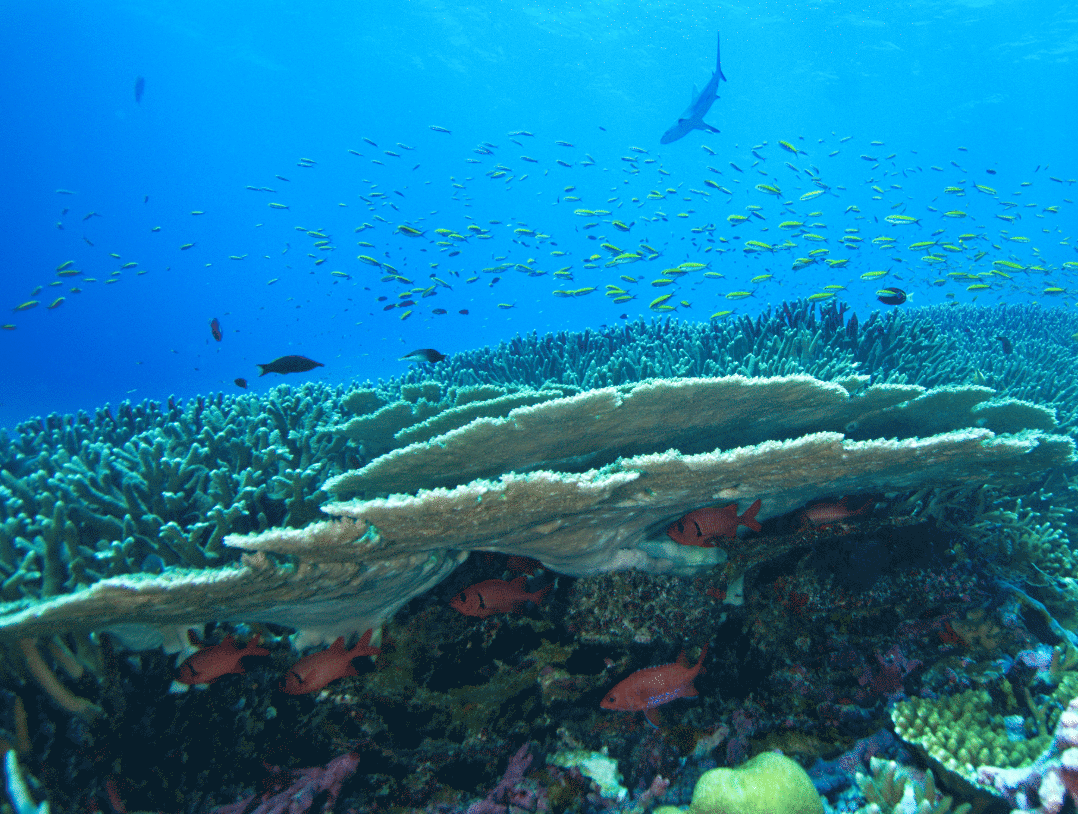
Around 25 percent of marine species spend some part of their life cycle on coral reefs. Reef sharks (Caribbean reef, blacktip reef, whitetip reef, grey reef) use coral systems for both nursery habitat and adult hunting grounds. Coral bleaching events driven by warming surface waters have already reduced live coral cover on the Great Barrier Reef by around 50 percent since 1985, and similar declines have occurred in the Caribbean and Indian Oceans.
Population studies of reef sharks show a clear correlation with live coral cover. The Global FinPrint study (2020) surveyed 371 reefs across 58 countries and found that 19 percent of reefs no longer support any reef shark population at all. Climate-driven bleaching is one of the major factors, alongside fishing pressure. Reef shark populations have collapsed by 60 percent or more in many regions in the past 50 years.
Prey distribution shifts
Sharks are not the only animals shifting range with warming. Their prey is moving too, often faster. Cape fur seals are extending breeding colonies further south on the African coast, which means false bay great white sharks have less seasonal prey concentration. Pacific salmon are returning to spawning rivers earlier and at different depths, which affects salmon shark feeding success.
Mismatch is a real worry. If sharks shift range at one speed and their prey shift at a different speed, the hunter and the hunted can end up in different parts of the ocean. Northeast Atlantic blue sharks have been observed in changing depth distributions consistent with chasing their mackerel and squid prey deeper as surface waters warm. The energy cost of those depth shifts may already be reducing reproductive output.
Storm intensity and nursery damage
Warmer ocean surfaces fuel stronger hurricanes and cyclones. Many shark species use shallow coastal nurseries (mangroves, estuaries, lagoons) for the first 1 to 4 years of life. Severe storms can scour these nurseries, displacing pups into open water where survival rates drop sharply.
Bull shark nurseries in Florida and the Caribbean took multiple hits from major hurricanes in the 2017 to 2024 period (Irma, Maria, Dorian, Beryl). Tagged juveniles were displaced kilometres from their normal home ranges, and recapture rates dropped in storm-affected years. The damage to mangrove forests in particular is hard to reverse: mangroves take decades to regrow once destroyed.
Hypoxia and dead zones
Warm water holds less oxygen. As surface temperatures rise, dissolved oxygen concentrations drop, particularly in already-stressed coastal zones with agricultural runoff and pollution. The Gulf of Mexico, the Baltic Sea, and the Arabian Sea all have growing seasonal dead zones, in which oxygen levels fall too low for most fish to survive. Sharks are oxygen-demanding (most species need 5 to 6 mg/L dissolved oxygen) and avoid dead zones, which effectively shrinks the habitat available to them.
Bottom-feeding sharks (nurse sharks, wobbegongs) are most directly affected because dead zones tend to be most severe near the seabed. Hypoxia is now considered one of the top three climate-driven threats to coastal sharks, alongside warming and acidification.
Which species win, which species lose
Climate winners (probably): bull sharks, tiger sharks, blue sharks, blacktips. These are generalist species with broad temperature tolerances, varied diets, and the ability to follow prey across changing habitats.
Climate losers (probably): porbeagle, Greenland shark, great white (in the Mediterranean), reef sharks broadly (Caribbean reef, grey reef, whitetip reef), basking shark in the warmer end of its range. Cold-water specialists and reef-dependent species face the biggest squeeze.
Uncertain: many large oceanic species (mako, hammerheads, oceanic whitetip) are already severely depleted by fishing, which complicates separating fishing effects from climate effects in the data. The picture clears each year as more migration data comes in.
What helps
Beyond the general climate response, several actions directly help sharks. Mangrove restoration in nursery areas. Marine protected areas that include both adult ranges and nursery habitat. Fisheries-management quotas that account for climate-driven range shifts. Better dive industry codes for shark interactions that minimise stress on individual animals in increasingly marginal habitats.
The Global FinPrint program (saveourseas.com) and the Shark Trust are leading multi-decade monitoring projects that will tell us how the response unfolds. Public engagement with these programs matters because shark conservation policy follows public attention.
Related reading
For shark fans browsing for something to take home, see our store collections of shark books.
See the Save Our Seas Foundation. See the IUCN Red List.
Frequently asked questions
How is climate change affecting sharks?
Several ways. Warming surface waters drive range shifts toward the poles, with bull sharks and tiger sharks appearing in waters they did not historically frequent. Ocean acidification weakens tooth enamel and skin denticles in experimental studies. Coral reef collapse strips reef-dependent species of nursery habitat. Stronger storms damage shallow coastal nurseries. And hypoxic dead zones shrink the habitat available to oxygen-demanding species.
Are sharks moving north because of climate change?
Yes. Bull sharks have moved progressively further up the US east coast over the past 40 years and now appear regularly off New Jersey and New York. Tiger sharks are seen seasonally as far north as Cape Cod. Mediterranean great white nursery areas are being squeezed by warming. The pattern is consistent across multiple species: each shark has a temperature window and that window is shifting toward the poles.
Does ocean acidification hurt sharks?
Yes. Lab studies on catsharks and epaulette sharks exposed to acidified seawater have shown corrosion of tooth enamel, reduced denticle density, slower hunting response, and reduced predator-avoidance behaviour. The effects are early-stage findings but consistent across studies. Surface ocean pH has dropped from 8.2 pre-industrial to 8.1 today and is projected to fall further this century.
Are reef sharks affected by coral bleaching?
Yes. The Global FinPrint study (2020) surveyed 371 reefs across 58 countries and found that 19 percent of reefs no longer support any reef shark population at all. Caribbean reef sharks, grey reef sharks, whitetip reef sharks, and blacktip reef sharks all show population declines that correlate with declines in live coral cover. Climate-driven bleaching is one of the main pressures.
Which shark species will be most affected by climate change?
Cold-water specialists and reef-dependent species are most at risk. Porbeagle, Greenland shark, Mediterranean great white, and most reef sharks face the biggest pressure. Generalist species with broad temperature tolerance, like bull sharks, tiger sharks, and blue sharks, will probably do relatively well.
How do warming oceans change shark prey?
Prey species are shifting range and timing of migration, sometimes faster than sharks can follow. Salmon are returning to rivers earlier. Mackerel and squid are moving deeper. Cape fur seal colonies are extending south. The result is mismatch between sharks and their food, which raises energy costs and reduces reproductive output.
What can be done to help sharks adapt to climate change?
Mangrove restoration in nursery areas. Marine protected areas that cover both adult ranges and nursery habitat. Fishing quotas that account for climate-driven range shifts. Long-term monitoring programs to track changes (Global FinPrint, the Shark Trust). And general climate mitigation through emissions reductions: the slower the warming, the better the chance for shark species to adapt.
Are dead zones bad for sharks?
Yes. Warm water holds less dissolved oxygen. Coastal dead zones with low oxygen concentrations have grown larger and more frequent. Sharks need 5 to 6 mg/L dissolved oxygen and avoid dead zones, effectively shrinking their habitat. Bottom-feeding species like nurse sharks and wobbegongs are most affected.
By Graziano Whiting. Last updated 13 May 2026.
Got a shark photo of your own? Send it to us and we may post it here and on our Facebook page, with your name on it. Share your shark photo