
How Sharks Use Their 6 Senses to Hunt
7 min read
Last Updated on May 14, 2026 by Otis Mako
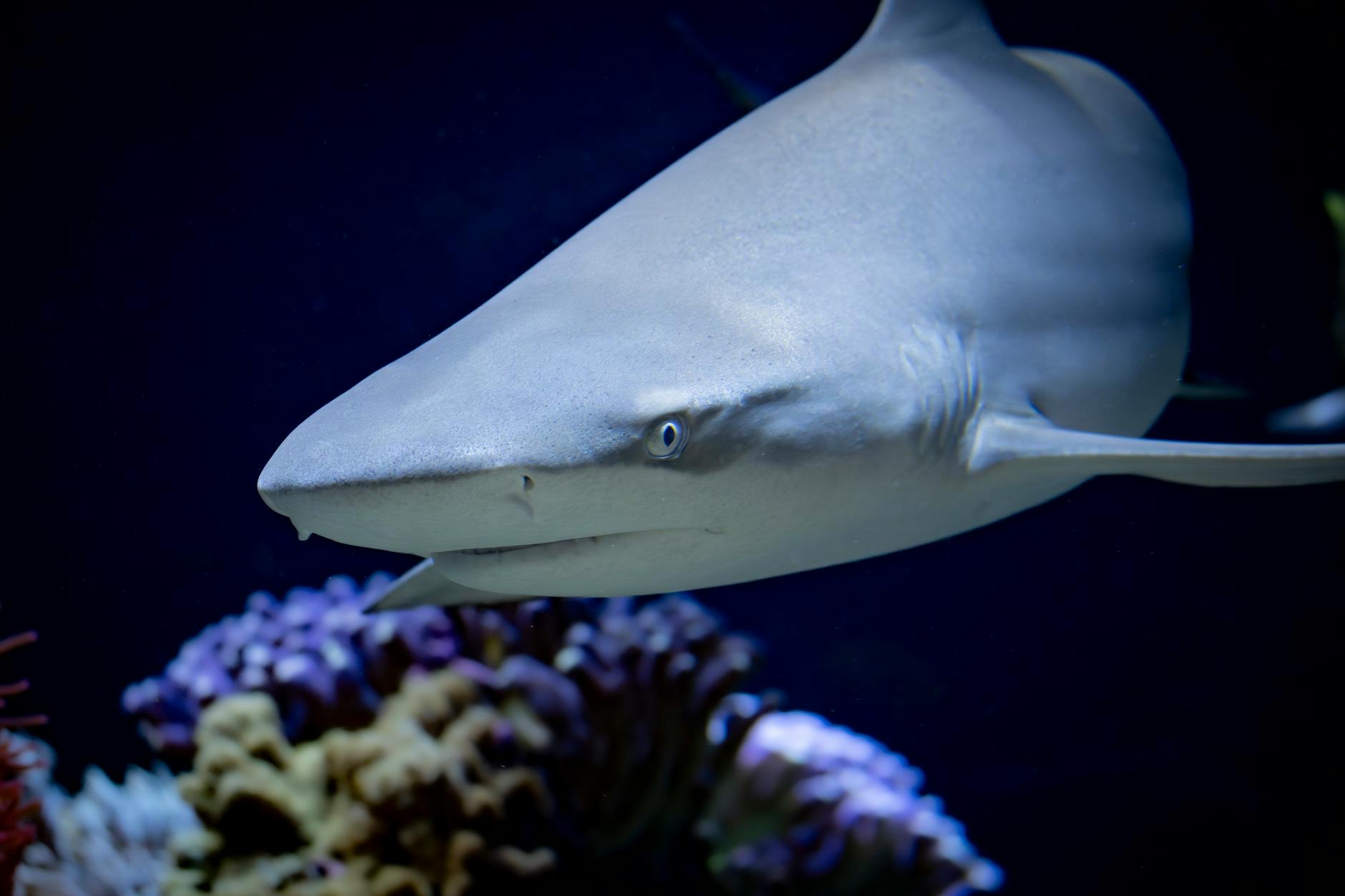
Sharks rely on six distinct senses to hunt, in a layered sequence from long range (smell, hearing) to close range (electroreception), with each sense optimised for a different distance and prey type. Sharks have six senses, not the five that humans rely on. They layer them: smell and hearing for long range detection, vision and lateral line for mid range tracking, taste and electroreception for the final strike. Together they make sharks one of the most refined hunting platforms in the animal kingdom.
Part of our guide: Shark Species.
1. Smell: chemical traces over long distances
Smell is the long range sense. Sharks have paired nostrils on the underside of the snout that connect to a large olfactory bulb in the brain. They can detect prey blood and tissue chemicals at parts-per-billion concentrations in seawater, and they triangulate the direction of a scent trail by comparing the time difference between the left and right nostril, similar to how humans locate sound with two ears.
The often-quoted figure of detecting a drop of blood in an Olympic swimming pool is exaggerated. The realistic detection threshold for the great white shark is around one part per ten billion, which is impressive but not magical. A scent plume in a 5 km/h current can be tracked back to source from around 1 km away, depending on conditions.
2. Hearing: low frequency targeting
Sharks hear very well at the low end of the spectrum, particularly the 10 to 800 Hz range. Distressed or wounded fish produce low frequency thumping sounds that travel a long way underwater, and sharks use this signature to home in on injured prey from up to 250 m away.
The inner ear is a fluid-filled labyrinth, similar in design to that of all vertebrates, but with sensory hair cells tuned for low frequencies. Sharks do not have external ear openings; sound travels through the head tissue directly to the inner ear, which is why they are so sensitive to the body cavity vibrations of a struggling fish.
3. Lateral line: pressure waves in water
The lateral line is a row of pressure-sensing pores running along each side of the body from head to tail. It detects tiny water displacements caused by swimming prey, currents, or obstacles. Effectively it gives the shark a sense of touch at a distance.
Each pore connects to a fluid-filled canal lined with sensory hair cells. When water flows past, the hair cells deflect and fire neurons. The system is sensitive enough to feel a single fish swimming nearby at distances of several metres, even in zero visibility water. Lateral line is the bridge between hearing (long range, low frequency) and vision (line of sight).
4. Vision: better than you think
Shark vision is much better than the old myth of “sharks can’t see well”. Most species have eyes adapted to dim light, with a reflective layer behind the retina (the tapetum lucidum) that bounces light back through the photoreceptor cells, doubling sensitivity. Cats use the same trick.
Most sharks are colour blind (a 2011 study showed they have only one cone type) but they see motion and contrast very well. The lemon shark has demonstrated visual acuity that rivals a domestic cat. Bull sharks and tiger sharks have a less reflective layer because they hunt in turbid water where vision matters less. Sharks that hunt by sight (mako, blue shark) have larger eyes and more cone cells.
5. Taste: the final check before swallowing
Sharks have taste buds in the mouth and throat that activate during the bite. The famous test bite, where a great white grabs a surfer and releases, is partly explained by taste: the shark uses its initial bite to sample whether the object is fatty enough to be worth eating. Humans have around 8 to 12 percent body fat, which is much less than a seal at 30 to 40 percent. Sharks taste the difference and let go.
Taste also tells the shark whether prey is fresh, rotten, or contains harmful chemicals. A shark that gets a taste of a stingray barb often releases the ray immediately, even when fully equipped to swallow it. The taste system is the final quality check before food crosses the throat.
6. Electroreception: the shark superpower
Electroreception is the headline shark sense. Sharks detect the tiny electric fields generated by living tissue (muscle contractions, nerve firing, even the heartbeat of a buried prey animal) using pores called ampullae of Lorenzini on the snout and head. The system can pick up fields as weak as 5 nanovolts per centimetre.
That sensitivity matters in the final approach. A great white moving toward a seal closes its eyes (using a nictitating membrane or rolling them back) just before contact, because vision is useless at 5 cm and lateral line is too coarse for precision strike. Electroreception is the system that guides the bite from 30 cm to mouth contact.
Practical implications of electroreception:
- Hammerhead sharks have far more ampullae across a much wider head, giving them broader sweeps for hidden stingrays.
- Goblin sharks rely almost entirely on electroreception, since vision is useless at deep sea depths.
- Sharks can detect the electrical fields of metal objects (including pier railings and propellers), which is why sharks occasionally bite boat hulls.
- Anti-shark devices like the Shark Shield emit pulsed electrical fields that overwhelm the ampullae, repelling sharks at close range.
How the six senses layer in real hunting
A typical shark hunt uses the senses in a layered sequence. At 1 km, smell picks up a scent trail and the shark turns toward source. At 250 m, hearing picks out distressed-prey thumping in the same direction. At 30 m, lateral line and vision start working in tandem to identify the actual fish or seal making the disturbance. At 1 m, vision and electroreception take over. At 5 cm and below, the shark closes its eyes and uses electroreception to guide the final strike. Then taste makes the call on whether to swallow.
This layered approach is why sharks have been such successful predators for 450 million years. No single sense carries the whole load. Each one is optimised for a distance band and a prey type, and the redundancy means a shark with a damaged eye or impaired smell can still hunt. The system is what makes sharks the apex predators they are, not the teeth.
What the senses cannot do
There are limits. Sharks are poor at long range visual tracking; their world is mostly chemical and electrical. They are weak at fine spatial discrimination above water, which is why hand signals work poorly for shark-trained aquarium animals. They cannot taste at a distance like a snake, only at the bite. And the electroreception range is short (around 30 to 60 cm depending on field strength).
Together with relatively small brains (compared to mammals of the same size) these constraints shape what sharks do well. They are excellent hunters of nearby, large, soft-bodied prey. They are poor at finding small, scattered prey in clear water (which is why sharks rarely catch fast pelagic fish unless ambush opportunities exist). The sensory portfolio explains the hunting style.
Related reading
For shark fans browsing for something to take home, see our store collections of shark books.
See the Shark Trust. See the Florida Museum shark biology pages.
Frequently asked questions
How many senses do sharks have?
Six. The five that humans share (smell, hearing, vision, taste, touch via lateral line) plus electroreception via the ampullae of Lorenzini, which detects the tiny electric fields generated by living tissue. Each sense is optimised for a different distance, from long range smell to close range electroreception.
How far away can a shark smell blood?
Realistic detection ranges are a few hundred metres to around 1 km, depending on current, water mixing, and species. The often quoted “drop of blood in a swimming pool” is exaggerated. The actual sensitivity is around one part per ten billion for the great white shark.
Can sharks see colour?
Most sharks are colour blind. A 2011 study showed they have only one cone type, which means they see the world in shades of grey rather than full colour. They compensate with excellent motion and contrast detection, and many species have a reflective layer behind the retina that doubles low-light sensitivity.
What is the lateral line of a shark?
A row of pressure-sensing pores running along each side of the body from head to tail. Each pore connects to a fluid-filled canal lined with sensory hair cells. The system detects water displacements from swimming prey, currents, and obstacles, effectively giving the shark a sense of touch at a distance of several metres.
What are the ampullae of Lorenzini?
Small jelly-filled pores on the snout and head of sharks (and other cartilaginous fish) that detect electric fields. They sense the tiny electrical signals produced by the muscle contractions, nerve firing, and heartbeat of nearby living tissue. Sharks use them mainly for the final close-range strike, when vision becomes useless and prey is within 30 cm of the mouth.
Why do sharks close their eyes before biting?
Vision is useless at the final moment of a strike, when prey is within 5 cm of the mouth. Sharks roll their eyes back or use a nictitating membrane to protect them from prey thrashing. Electroreception via the ampullae of Lorenzini guides the final strike, not vision.
Can sharks hear well?
Yes, in the low frequency range. Sharks hear very well from around 10 to 800 Hz, which is the band where distressed and wounded fish produce thumping vibrations. Hearing range can extend up to 250 m or more in good conditions. Sharks have no external ear openings; sound travels through the head tissue directly to the inner ear.
Why do sharks sometimes bite boats and surfboards?
Sharks can detect the electric fields produced by metal objects (boat propellers, pier railings, surfboard hardware) and the smell of fish oils on fibreglass. The shark is probably investigating whether the object is edible. Test bites of inanimate objects are usually followed by release when taste confirms the object is not prey.
By Otis Mako. Last updated 13 May 2026.
Got a shark photo of your own? Send it to us and we may post it here and on our Facebook page, with your name on it. Share your shark photo



How fine-grained is electroreception in practice? Could a shark tell two buried fish apart by their signals alone, or does it just know something alive is down there?
Does the order change for sharks in murky water? I’d guess a bull shark leans on smell and the lateral line far more than its eyes.
I’d expect so. The eyes have little to work with in water that brown, so smell and the lateral line probably carry most of the load until the last few feet.