Species Profile: The Ninja Lanternshark
2 min read
Last Updated on July 27, 2026 by Otis Mako
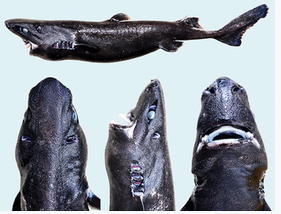
When four children, aged 8 to 14, were asked what they would name a newly discovered black shark that glows, they came back with ‘Super Ninja Lanternshark’. It is not hard to see why.
The fish is black as night, it moves unseen, and it glows. Japanese ninjas dress head to toe in black and move unseen, and a lantern gives off light, so the name does most of the describing for you. The ‘super’ was dropped, leaving the ninja lanternshark.
There is not much detail on this shark yet, but here is what we know so far.
1. Scientific Name
Etmopterus benchleyi. It is named after Peter Benchley, the shark-loving novelist who wrote “Jaws” and co-wrote the 1975 Steven Spielberg film adaptation.
2. Scientific Classification
- Kingdom: Animalia
- Phylum: Chordata
- Class: Chondrichthyes
- Order: Squaliformes
- Family: Etmopteridae
- Genus: Etmopterus
- Species: Etmopterus benchleyi
3. Physical Characteristics
This shark is pitch black. It has white markings around its mouth and eyes, with a dense concentration of dermal denticles around the eyes and gill openings. The shape of the mouth makes it look like it is wearing a tiny frown. The male grows to about 32.5 cm (12.8 in) and the female to 51.5 cm (20.3 in), so it is nowhere near the big end of the shark family.
This is a deep sea shark. Most deep sea sharks are dark brown or black so they blend into the darkness, which hides them from predators. Lanternsharks go further and carry bioluminescent organs, called photophores, that give off a pale green light.
That glow may help them attract mates, or mask their shadow so they are invisible to predatory fish looking up from below. It could also help a group stay together while swimming, and the light probably lures small invertebrates into snapping range.
4. Diet And Hunting Pattern
Its small size suggests it hunts small prey, shrimp and small fish.
The lower jaw has between 30 and 36 teeth. The top teeth look built for grasping while the bottom teeth do the cutting. Its pitch black colouring lets it get close before anything notices, which makes up for the size.
5. Distribution And Habitat
The species was discovered off the Pacific coast of Central America. A small group of marine biologists led by Vicky Vasquez of the Pacific Shark Research Center captured eight of these previously unknown sharks, swimming at depths between 2,624 ft (800 m) and 4,720 ft (1,440 m).
They appear to range from Nicaragua down through Costa Rica to Panama.
The ninja lanternshark is not the first luminescent shark found. Around forty other lanternshark species are known. What sets this one apart is that it is pitch black, and it is the only Etmopterus species known from the Pacific coast of Central America.
‘Lost shark’ research has picked up over the past twenty years, and roughly 20% of all shark species were described in that window alone. The big, famous sharks are a small fraction of the total. Most of the new finds are small deep-water species like this one, and researchers keep looking as funding allows.
Bring sharks home
Part of our guide: The Complete Shark Species Reference.
Love what you read? Browse our shark merchandise store for gear inspired by these incredible animals:
Every purchase supports more shark content on this site.
Got a shark photo of your own? Send it to us and we may post it here and on our Facebook page, with your name on it. Share your shark photo