Epaulette Shark: The Reef Shark That Walks and Shrugs Off Low Oxygen
5 min read
Last Updated on November 26, 2026 by Otis Mako
On a Great Barrier Reef flat at low tide, a small shark can use its paired fins to walk. Researchers report that it walks both in and out of water. This is the epaulette shark, and it is one of the strangest small sharks you can read about.
Two things make it unusual. It can walk, and it copes with night-time oxygen crashes that cause lasting brain damage in most vertebrates. Researchers who study it call it a tractable candidate species for conservation physiology. Here is what is known, and where the evidence stops.
What an epaulette shark looks like
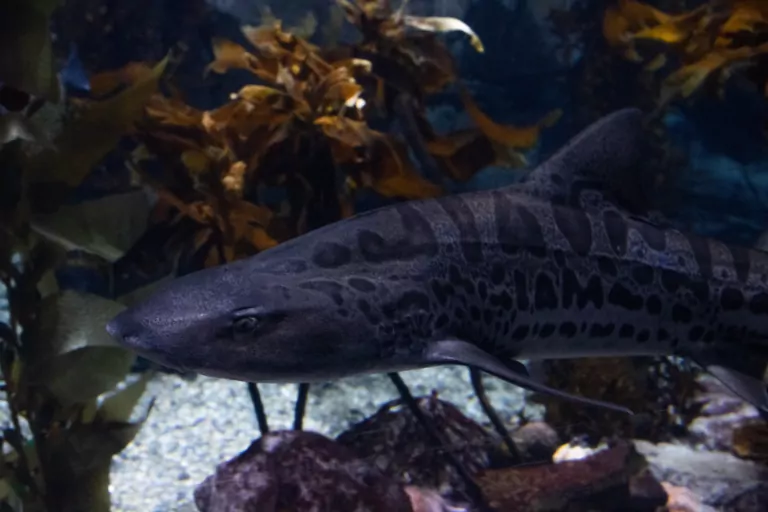
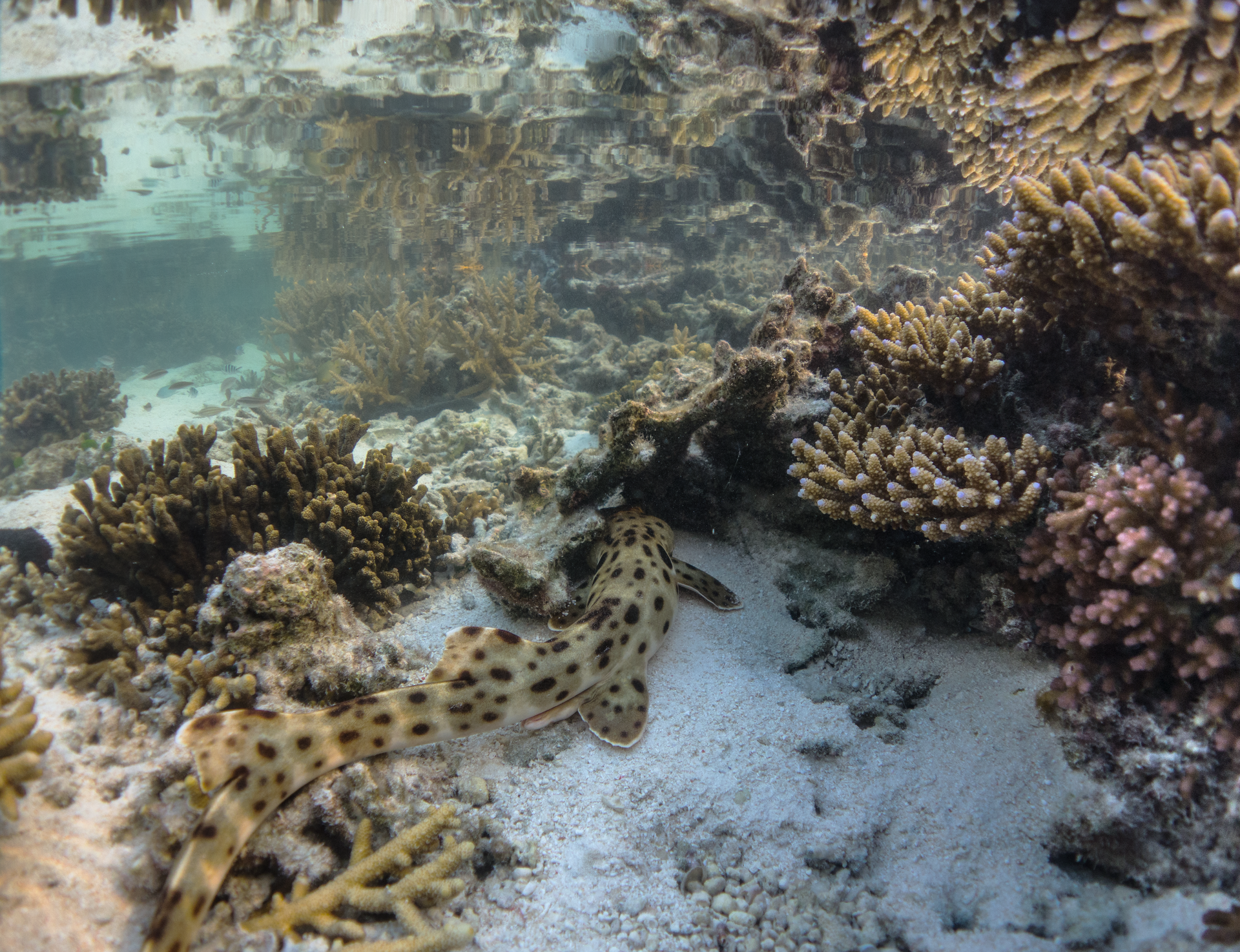
The name comes from the markings. The Australian Museum describes a large black ocellus, an eye-like spot with a marginal ring, above each pectoral fin, plus widely spaced black spots on the body. Military shoulder boards were called epaulettes, and the spot sits where one would be.
It is a slender, small shark. The Australian Museum gives male maturity at around 55 to 60 cm and female maturity at 55 to 64 cm, with a maximum of 107 cm. FishBase lists the same 107 cm maximum. Compared with a great white or a tiger shark, it is a pet-sized animal.
One identification tip from the museum: the related speckled carpet shark has small dark spots right behind the ocellus, and the epaulette shark does not.
Where it lives
The Australian Museum says the species is endemic to the Great Barrier Reef, from about the northern tip of Cape York Peninsula to the Capricorn Group at the southern end. FishBase gives a wider range for the species as a whole, covering New Guinea and northern Australia, and notes that records from Malaysia, Sumatra and the Solomon Islands are only possible. So the safest summary is this: the Great Barrier Reef is the core, and the edges of the range are less certain.
It is a bottom dweller in warm shallow water. FishBase gives a depth range of 0 to 50 m and notes that it is often found in tide pools. That habitat explains most of what follows.
A shark that walks
A 2022 paper in Integrative and Comparative Biology opens by describing the epaulette shark as a small, reef-dwelling, benthic shark that, using its paired fins, can walk, both in and out of water. The authors measured three aquatic gaits: slow-to-medium walking, fast walking and swimming.
That study looked at neonates and juveniles. Newly hatched sharks still carry a yolk sac, which gives them a bulbous belly. The authors expected body shape to change how the young sharks moved, and it did not. Fin rotation, bending of the body and tail beat were consistent between the two stages.
Why walk at all? The authors point to the reef itself. A small benthic predator has to maneuver into small crevices to avoid predators from above and below the surface. Fins that work like limbs would help in a place full of crevices. I should be clear that this is the authors’ reading of the likely benefit, not a measured result.
For another carpet shark that lives hugging the reef floor, the blog covers the wobbegong family, which belongs to the same order.
Surviving a night with almost no oxygen
Reef flats cut off from the open sea at low tide behave like closed bowls. A 2022 paper notes that as flats become isolated with the outgoing tide, the sharks face short periods of low oxygen, high CO2 and shifting temperature. A 2014 study in Conservation Physiology says the same: the shark may often meet low oxygen and raised CO2, especially during nocturnal low tides.
Most vertebrates suffer lasting brain damage when oxygen drops and then returns. The epaulette shark does not suffer significant brain injury. A 2023 paper in Biology Letters says it and the grey carpet shark repeatedly experience near anoxia and re-oxygenation in their habitats, and survive it at tropical temperatures without significant brain injuries.
FishBase summarises the strategy in one line: the shark can survive low oxygen by switching off non-essential brain functions, apparently an adaptation for hunting in tide pools with low oxygen.
The 2023 study compared the two species at the level of the mitochondria, the cell parts that burn fuel. Only the epaulette shark can suppress its metabolism, and its brain mitochondria made half as many reactive oxygen species as those of the grey carpet shark. Those molecules are what do the harm when oxygen floods back in. The paper calls the two sharks’ strategies contrasting, so there is more than one way to solve the problem.
What it eats and when
The Australian Museum lists worms, crabs, shrimp, amphipods and small fishes as prey. It says the shark uses smell and electroreception, the ability to detect weak electrical fields, to find them, and that it is more active at dusk and night. That fits the oxygen story: the shark is out hunting in the hours when the pools are at their worst. For how electroreception works in sharks in general, see our guide to how sharks use their senses to hunt.
Eggs and young
The Australian Museum says the epaulette shark lays eggs, each about 10 cm long and 4 cm wide. They hatch after about 130 days, and the young are around 15 cm long. FishBase adds that the eggs are laid in pairs. For the wider picture of how sharks reproduce, read our post on shark reproduction strategies.
Why climate researchers like it
A 2026 review in Conservation Physiology argues the epaulette shark is a good model because it is small, benthic, abundant on Great Barrier Reef flats, and amenable to captive breeding. The authors also call it tolerant of low oxygen and ocean acidification conditions.
The acidification result comes from the 2014 study. Sharks were held for at least 60 days at 390, 600 or 880 microatmospheres of CO2. Resting oxygen use and hypoxia sensitivity did not change. The authors suggest it may be tolerant of CO2 levels projected for the end of this century.
Warming is the weak spot. The 2026 review says embryos hatch earlier and smaller, aerobic scope narrows, metabolic costs rise, recovery is delayed, growth is impaired, and mortality risk increases at the upper thermal range. It also says trade-offs may appear when warming and low oxygen happen together.
The authors add a limit worth repeating. A site-attached reef shark will not show what open-ocean sharks face. The 2014 paper makes the same point, saying it is uncertain whether pelagic sharks will be equally tolerant. Our post on climate change and sharks covers the wider range of risks.
What is still unknown
The papers I read cover physiology in captive and field animals. I found no count of wild population size in them, and the museum and FishBase pages do not give one. The reasons behind walking are also a reading of the likely benefit, not a tested one. I would rather say that than guess.
If you have dived a reef flat at low tide and watched one of these sharks walk, add what you saw in the comments below.
Sources
- Australian Museum, Epaulette Shark factsheet
- FishBase, Hemiscyllium ocellatum summary
- Porter et al. 2022, Integrative and Comparative Biology, walking and swimming kinematics
- Devaux, Hickey and Renshaw 2023, Biology Letters, anoxia-tolerant sharks
- Heinrich et al. 2014, Conservation Physiology, tolerance to elevated CO2
- Dobszewicz et al. 2026, Conservation Physiology, a model for climate-ready shark conservation
Photo: Alexander Fordyce, CC BY-SA 4.0, via commons.wikimedia.org.
Got a shark photo of your own? Send it to us and we may post it here and on our Facebook page, with your name on it. Share your shark photo