
Whale Shark: Size, Diet, Range, and Why It Is the Biggest Fish
7 min read
Last Updated on November 8, 2026 by Otis Mako
The whale shark (Rhincodon typus) is the largest fish in the ocean, a filter-feeding shark that can reach 18 m and 20 tonnes, eating plankton, small fish, and squid in warm tropical seas worldwide. The whale shark (Rhincodon typus) is the largest living fish, a slow-moving plankton feeder reaching up to 18 m (59 ft) and 20 tonnes. It is harmless to humans, IUCN listed as Endangered, and supports a global ecotourism circuit from Mexico to the Philippines.
Part of our guide: Shark Species.
Key facts at a glance
| Scientific name | Rhincodon typus |
|---|---|
| Family | Rhincodontidae |
| Max length | Around 18 m (59 ft), with credible reports up to 20 m |
| Max weight | Around 20 tonnes (44,000 lb) |
| Diet | Plankton, krill, small fish, squid, fish eggs |
| Habitat | Tropical and warm temperate open oceans worldwide |
| Lifespan | Estimated 80 to 130 years |
| IUCN status | Endangered |
| Recorded unprovoked attacks on humans | 0 fatal, near zero records |
| First described | Andrew Smith, 1828, off South Africa |
How big does a whale shark really get
The biggest reliably measured whale shark was a 12.65 m (41.5 ft) animal caught in Pakistan in 1947, weighed at around 21.5 tonnes. Less verified reports place the maximum at closer to 18 m, with a 20 m individual occasionally mentioned in the older literature. The most credible upper estimate today is around 18 m (59 ft).
For scale, a school bus is 11 m. A great white shark caps out around 6 m. A blue whale, which is a mammal and not a fish, reaches 30 m. So the whale shark is roughly twice the length of the largest predatory shark and around 60 percent the length of the largest animal on the planet. It is the heavyweight of the fish world by a long way.
Most adults are 8 to 12 m. Females grow larger than males and tend to be more solitary, while males form loose feeding aggregations. Growth is slow: a 7 m juvenile may be 25 to 30 years old, which makes whale sharks particularly vulnerable to fishing pressure.
Diet: a giant that eats almost nothing
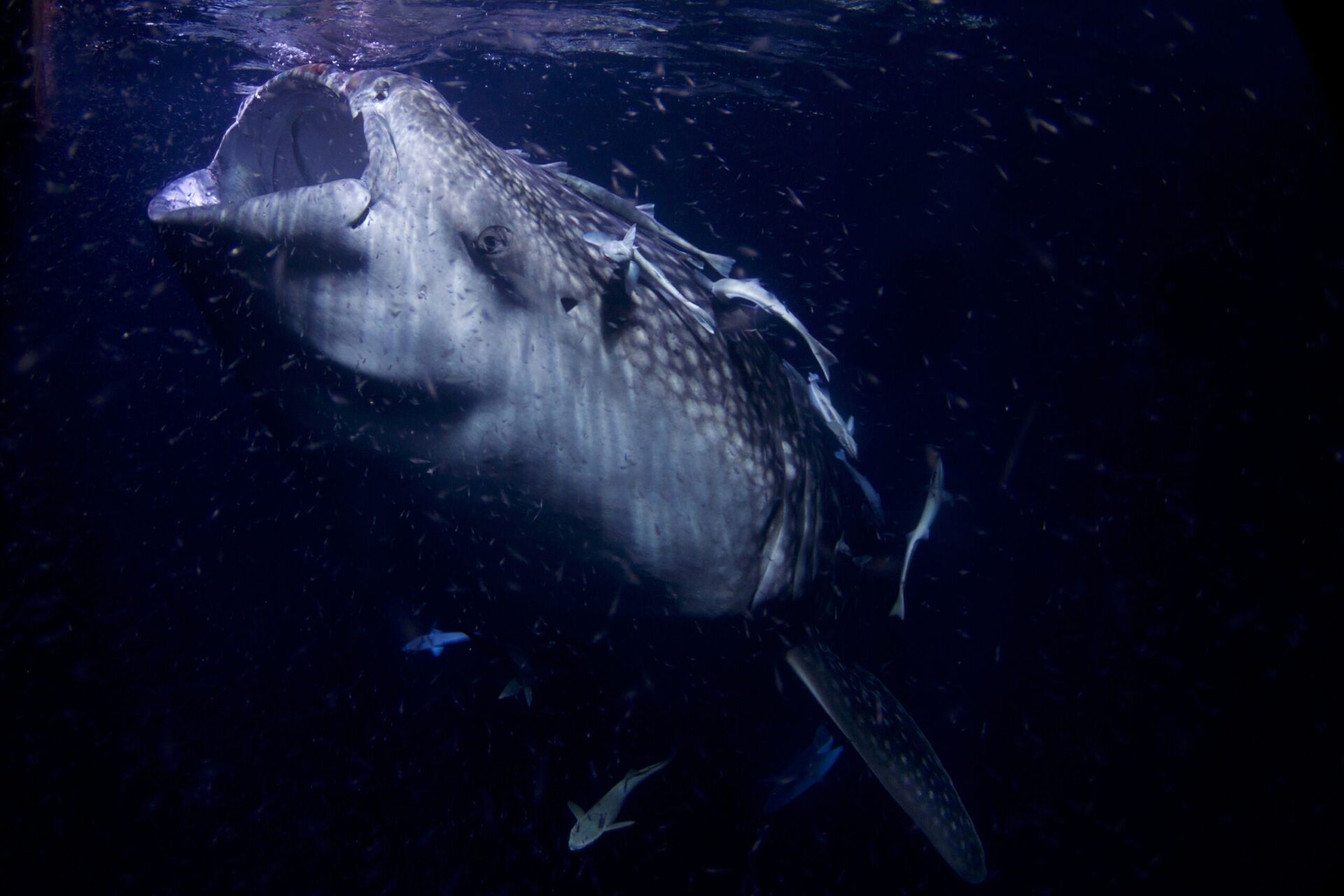
Whale sharks are filter feeders. They swim with mouths open, taking in around 6,000 litres of water per hour, and use rakers on their gills to strain out plankton, krill, small schooling fish, squid, and fish eggs. They do not chew. They do not target anything bigger than your palm.
Three feeding modes have been described in the field. Passive ram-feeding: cruise forward with mouth open. Active suction-feeding: hover vertically near the surface and gulp water, often around fish-spawning events. Coughing: occasional reverse flushes to clear the gill rakers of debris. Aggregations off Isla Mujeres in Mexico target tuna spawning events. Aggregations off Ningaloo in Western Australia target coral spawning.
Recorded prey items include:
- Copepods and other zooplankton
- Krill, especially during seasonal blooms
- Fish eggs from tuna, sardines, and other spawning schools
- Small bait fish like anchovies and silversides
- Squid and small crustaceans
Where to see whale sharks in the wild
Whale shark hotspots cluster in tropical and warm temperate waters. Each site has a clear seasonal window driven by plankton blooms or local spawning events. Booking ahead matters: the best operators run small-group, no-touch tours that follow national whale shark codes of conduct.
Top ecotourism sites and their seasons:
- Isla Holbox and Isla Mujeres, Mexico (June to September)
- Ningaloo Reef, Western Australia (March to August)
- Donsol and Oslob, Philippines (Donsol November to May, Oslob year-round but controversial because of food provisioning)
- Mafia Island and Zanzibar, Tanzania (October to March)
- Mozambique, Tofo Beach (October to April)
- Maldives, South Ari Atoll (year-round)
- Galapagos, Darwin Island (June to November, mostly adult females)
- Utila, Honduras (February to May, September to October)
Reproduction: still mostly a mystery
Whale sharks are ovoviviparous. Eggs develop inside the female and pups are born live. The only confirmed pregnant whale shark on record was caught off Taiwan in 1995, carrying around 300 embryos at various stages of development, which means females can store sperm and stagger pups. Pups are born at 40 to 60 cm long.
Where they are born, when they mate, and how often they breed are not well understood. Adult females rarely show up in aggregation sites. Researchers think pupping grounds may be in deeper open ocean, away from the coastal feeding sites where younger animals dominate. Genetic studies suggest two largely separate populations: Atlantic and Indo-Pacific, with very limited mixing.
Conservation status and threats
The whale shark is listed as Endangered by the IUCN, having been moved up from Vulnerable in 2016. The Indo-Pacific population has fallen by more than 60 percent in 75 years; the Atlantic population by around 30 percent. The species is on CITES Appendix II, which requires permits for international trade in any part of the animal.
The main pressures are direct fishing for the fin, meat, and liver oil (still legal in some jurisdictions), bycatch in tuna fisheries, ship strikes (whale sharks feed at the surface and do not always dive away), and tourism pressure at provisioned sites. The shift to non-provisioning, no-touch ecotourism, plus growing legal protection across South East Asia and the Philippines, is the main reason there is cautious optimism for the species.
Anatomy, lifespan, and the spot pattern
Whale sharks have a wide flat head, a terminal mouth that can open to 1.5 m, and 300 rows of tiny pointed teeth that do nothing useful. They have five large gill slits adapted for filter feeding, two dorsal fins, and a powerful asymmetric tail. Skin can be 10 cm thick.
Every whale shark has a unique spot pattern behind the gills, like a fingerprint. Astronomers helped researchers develop pattern-matching software (originally used to map stars) that allows global identification of individuals from a single side-on photo. The Wildbook for Whale Sharks holds over 13,000 identified animals as of 2026 and is the source of much of what we know about their movements.
Lifespan estimates were revised dramatically in 2020 when researchers used Cold War nuclear test fallout absorbed into the vertebrae of two specimens to band-count their ages. The result: at least 50 years for one fish, with theoretical maximums of 100 to 150 years.
Are whale sharks dangerous to humans
No. The International Shark Attack File records essentially no unprovoked attacks by whale sharks. They are slow, gentle, and have no interest in anything larger than a sardine. Divers regularly swim alongside them without incident.
The actual risks come from the human side: barotrauma from chasing whale sharks to depth, propeller injuries when boats follow them too closely, and disorientation when divers crowd a single animal. Reputable operators enforce a minimum distance of 3 m from the head and 4 m from the tail, no flash photography, and no touching.
Cultural value and ecotourism economics
A single whale shark is worth far more alive than dead. A 2013 study put the average annual value of a living whale shark at the Isla Holbox tourism site at over USD 100,000 in tour revenue, dwarfing the one-off value of its meat and fins (around USD 12,000 to USD 20,000 in the East Asian market at peak). That economic argument has driven the shift from fishery to ecotourism in countries like the Philippines, Mexico, and Mozambique.
In the Maldives, the whale shark features on currency and tourist guides. In the Philippines, the species is on the 100 peso note. In Mexico, the Yucatan whale shark aggregation underpins a multi-million dollar season for Cancun and Riviera Maya operators. Conservation works when the local economy aligns with keeping animals alive.
Related reading
For shark fans browsing for something to take home, see our store collections of shark toys, shark books.
See the IUCN Red List entry for the whale shark. See the Shark Trust.
Frequently asked questions
How big is the biggest whale shark ever recorded?
The largest reliably measured whale shark was caught off Pakistan in 1947 and measured 12.65 m (41.5 ft) with an estimated weight of around 21.5 tonnes. Some older literature claims individuals up to 18 to 20 m, but those reports are not well documented. Most credible scientists put the realistic maximum at around 18 m.
What do whale sharks eat?
Whale sharks are filter feeders. They eat plankton, krill, small fish, squid, and fish eggs. They strain food through gill rakers as they swim with their mouths open, processing around 6,000 litres of water an hour. They do not target anything larger than your palm, and they have no functional bite for prey their own size.
Are whale sharks dangerous to humans?
No. Whale sharks are filter feeders with no interest in animals larger than small fish or squid. The International Shark Attack File records essentially no unprovoked attacks. Divers regularly swim alongside them at sites in Mexico, the Philippines, and Australia. The risks come from human behaviour around them, not from the animal.
How long do whale sharks live?
Recent radiocarbon dating of vertebrae from two specimens, using Cold War nuclear fallout markers, suggests individual whale sharks can live at least 50 years, with a theoretical maximum of 100 to 150 years. Earlier estimates put their lifespan at 60 to 80 years. Slow growth and late maturity (around 25 to 30 years) are part of what makes the species vulnerable to fishing pressure.
Where can I see whale sharks in the wild?
The most reliable seasonal hotspots are Isla Holbox and Isla Mujeres in Mexico (June to September), Ningaloo Reef in Western Australia (March to August), Donsol in the Philippines (November to May), Mafia Island in Tanzania (October to March), and the South Ari Atoll in the Maldives (year round). Always book operators that follow no-touch and no-feeding codes of conduct.
Are whale sharks endangered?
Yes. The IUCN listed the whale shark as Endangered in 2016 after Indo-Pacific populations declined by more than 60 percent over three generations. The main threats are targeted fishing in some jurisdictions, bycatch, ship strikes, and tourism pressure at provisioned sites. The species is on CITES Appendix II.
Do whale sharks lay eggs or give live birth?
Whale sharks are ovoviviparous. Eggs develop inside the female and pups emerge live. The only confirmed pregnant whale shark, caught off Taiwan in 1995, carried around 300 embryos at various stages. Females appear to store sperm and stagger their broods, which is unusual among sharks. Pups are 40 to 60 cm at birth.
Why is the whale shark called a shark and not a whale?
Whale sharks are fish, not mammals. They have gills (not lungs), are cold blooded, and lay eggs internally. The whale part of the name refers to their size and filter feeding habit, which is similar to baleen whales like the blue whale. The shark part is taxonomic: Rhincodon typus is a member of the class Chondrichthyes (cartilaginous fish) and the order Orectolobiformes (carpet sharks).
By Otis Mako. Last updated 13 May 2026.
Got a shark photo of your own? Send it to us and we may post it here and on our Facebook page, with your name on it. Share your shark photo




Has anything bigger than the Pakistan shark from 1947 actually been measured since? People quote 18 m all the time and I never know how much to trust it.
Not that I know of. The 1947 fish is still the measurement I’d stand behind. Most of the bigger figures were guessed from boats, and a big animal beside a boat always looks bigger than it is.
Went to Donsol last March and what surprised me was how slowly they move. You slip off the boat and it just keeps cruising past like you aren’t there.
People hear plankton eater and assume it grows fast and breeds like any other fish. A 7 m animal being 25 years old should change how we think about fishing them.