
Hammerhead Shark Profile: Facts, Diet & Habitat Guide
10 min read
Last Updated on November 18, 2026 by Otis Mako
Part of our guide: The Complete Shark Species Reference.
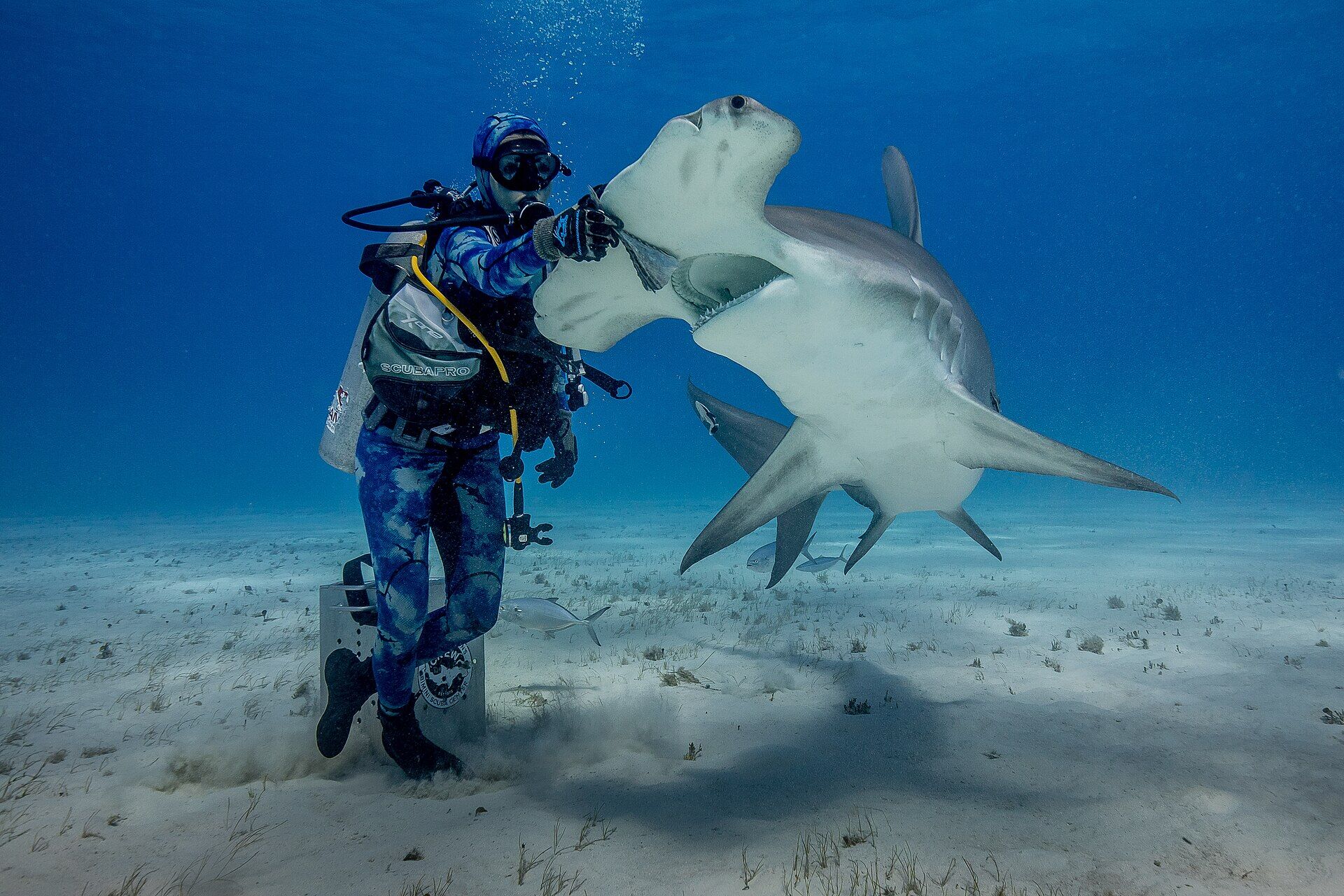
The hammerhead shark is a family of 9 closely related species (family Sphyrnidae) recognized by their flat, T-shaped heads, called cephalofoils, which give them a wider sensory field for finding prey buried under sand. They range from the 1 m bonnethead to the 6.1 m great hammerhead, and every species with enough data to assess is Vulnerable or worse, with six of the nine Critically Endangered.
Key facts at a glance
| Common name | Hammerhead shark |
|---|---|
| Family | Sphyrnidae |
| Number of species | 9 |
| Smallest species | Bonnethead, around 1 m (3.3 ft) |
| Largest species | Great hammerhead, up to 6.1 m (20 ft) |
| Weight range | 3 kg to 580 kg (6.6 to 1,280 lb) |
| Diet | Stingrays, bony fish, squid, octopus, crustaceans, smaller sharks |
| Habitat | Coastal and pelagic, tropical and warm-temperate oceans worldwide |
| Lifespan | 20 to 30 years in the wild |
| IUCN status (varies) | Vulnerable (smooth) to Critically Endangered (great, scalloped and four others); Carolina hammerhead Data Deficient |
| Recorded unprovoked attacks on humans | 17 total, 0 fatal (Florida Museum ISAF, all-time) |
What makes a hammerhead a hammerhead
The defining feature is the cephalofoil, the flattened, laterally expanded head that gives the family its name. Eyes sit at the outer tips, nostrils are spaced wide along the leading edge, and the underside is packed with electrosensory pores called ampullae of Lorenzini. Every shark has ampullae, but hammerheads carry far more of them, spread across a much wider sweep of skin.
That arrangement gives them three real advantages. They get near-360 degree binocular vision after a small head sweep. They cover more ground per second of swimming when scanning for buried prey. And their electrical sense, which detects the tiny muscle twitches of hidden rays, sweeps a strip of seabed instead of a single line. Researchers using high-speed video have watched great hammerheads pin southern stingrays to the sand with the side of the cephalofoil before circling back to bite, which is roughly the marine equivalent of a baseball bat with a built-in metal detector.
Why the head shape, in one sentence
Bigger sensory area, wider visual field, and a useful tool for pinning rays. Three jobs from one piece of anatomy.
All 9 hammerhead shark species, side by side
The family Sphyrnidae contains 9 recognized living species across 2 genera (Sphyrna and Eusphyra). They vary wildly in size, habitat, and threat level. Here is the full list.
| Species | Scientific name | Max length | Main range | IUCN status |
|---|---|---|---|---|
| Great hammerhead | Sphyrna mokarran | 6.1 m (20 ft) | Worldwide tropical | Critically Endangered |
| Scalloped hammerhead | Sphyrna lewini | 4.3 m (14 ft) | Worldwide tropical and warm temperate | Critically Endangered |
| Smooth hammerhead | Sphyrna zygaena | 4.0 m (13 ft) | Cooler temperate seas | Vulnerable |
| Carolina hammerhead | Sphyrna gilberti | 2.0 m (6.6 ft) | Western Atlantic | Data Deficient |
| Scoophead | Sphyrna media | 1.5 m (4.9 ft) | Eastern Pacific and Caribbean | Critically Endangered |
| Scalloped bonnethead | Sphyrna corona | 0.9 m (3 ft) | Eastern Pacific | Critically Endangered |
| Bonnethead | Sphyrna tiburo | 1.5 m (4.9 ft) | Atlantic and eastern Pacific Americas | Endangered |
| Smalleye hammerhead (golden hammerhead) | Sphyrna tudes | 1.5 m (4.9 ft) | Western Atlantic, South America | Critically Endangered |
| Winghead shark | Eusphyra blochii | 1.9 m (6.2 ft) | Indo-West Pacific | Critically Endangered |
A 10th species, the mallethead shark, has been informally referenced in older literature, but modern taxonomy folds it into the scoophead group. The winghead is the outlier of the family with a cephalofoil nearly half its body length, the most exaggerated head shape of any shark.
The shark species identifier tells the great, scalloped and smooth hammerheads apart by head shape and fins, and compares them with 32 other sharks.
Range and habitat
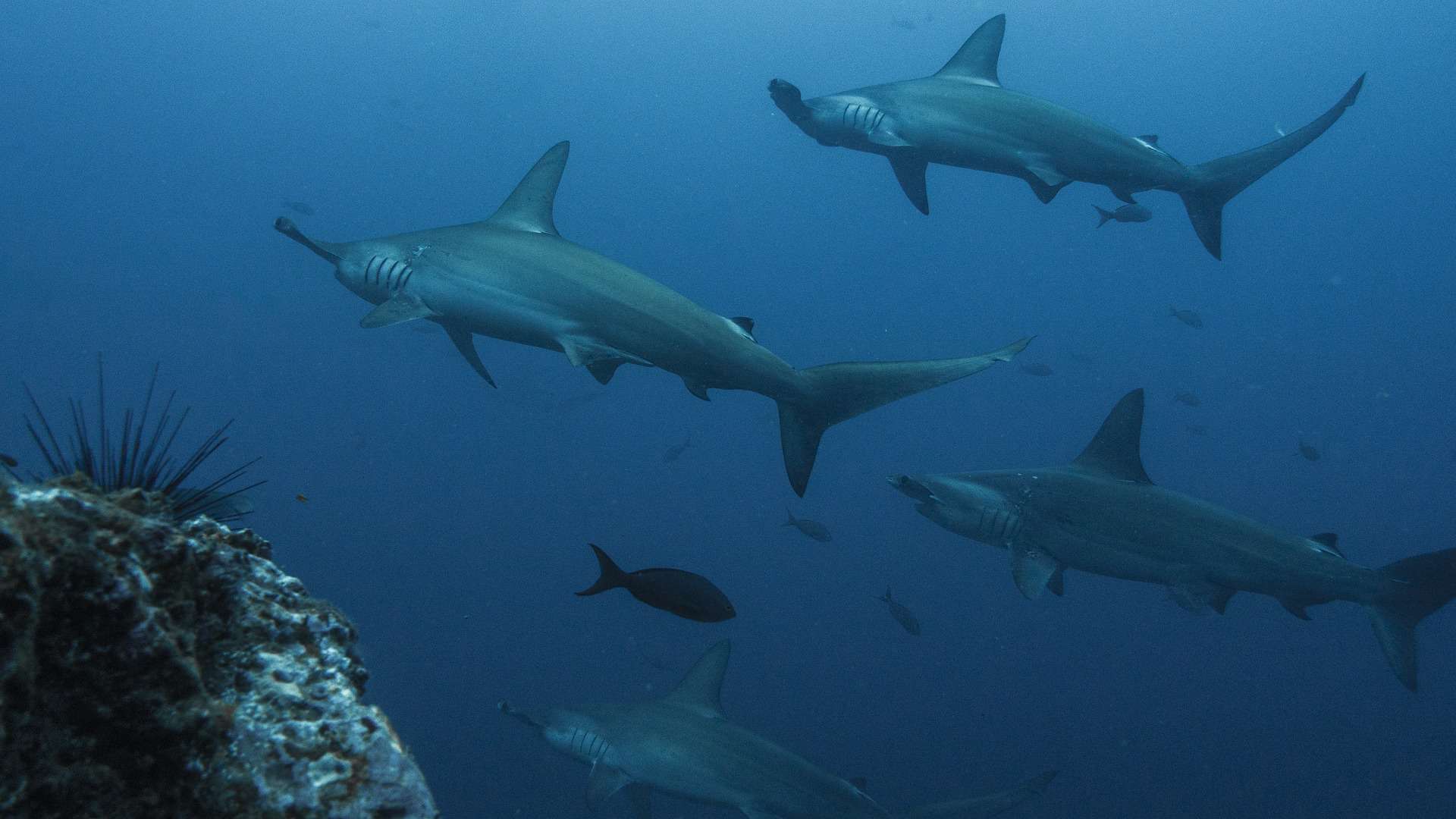
Hammerheads are found in every tropical and warm-temperate ocean. You will see them along continental shelves, around offshore seamounts, near coral reefs, and over sandy shallows where rays bury themselves. The great and scalloped hammerheads are the wide-rangers. Scalloped hammerheads are famous for forming schools of 100 or more individuals over seamounts in the Galapagos, the Sea of Cortez, and Cocos Island in Costa Rica. Those gatherings happen during the day. The same fish disperse alone to hunt at night.
Where they live, by species
- Coastal hunters: bonnethead, scalloped bonnethead, scoophead, Carolina, smalleye. Stay close to shore, often in less than 25 m of water.
- Open-ocean swimmers: great, scalloped, smooth hammerheads. Cross entire ocean basins. The great hammerhead has been tracked from the Bahamas to the mid-Atlantic ridge.
- Cool-water specialist: smooth hammerhead. Tolerates colder water than its relatives, ranging into temperate seas off South Africa, southern Australia, and the western United Kingdom in summer.
Diet and hunting
Most hammerhead species specialize in stingrays. The great hammerhead is the textbook example. Its long, asymmetric teeth slice through the cartilaginous wing of a ray, and its body can absorb a stingray barb to the face without much fuss. Necropsies of great hammerheads have turned up dozens of barbs lodged in the head, lips, and jaw, sometimes ancient and calcified over.
Smaller hammerheads eat what fits. Bonnetheads are partial to blue crabs in the Gulf of Mexico, and a 2018 study in the journal Proceedings of the Royal Society B showed that bonnetheads digest seagrass as well as some marine herbivores, the first known omnivorous shark species. The smalleye hammerhead has tannin-rich golden skin from eating shrimp pigments and small bony fish. The winghead is built to corral squid and small schooling fish with its disproportionately wide head.
Typical hammerhead prey list
- Stingrays (the favorite of great, scalloped, and smooth hammerheads)
- Bony fish: groupers, mackerel, sardines, herring
- Cephalopods: squid and octopus
- Crustaceans: blue crab, shrimp, lobster
- Smaller sharks, including juvenile blacktips and other hammerheads
- Sea snakes (recorded in scalloped hammerhead stomachs)
- Seagrass (bonnethead only, supplementary)
Reproduction and lifecycle
Hammerheads are viviparous, meaning females carry developing embryos internally and give birth to live young, connected through a placenta-like yolk sac. Litters range from around 6 pups for the bonnethead to more than 40 for the great hammerhead. Gestation runs 9 to 12 months, depending on species, and most hammerheads give birth in shallow coastal nurseries where their pups stay for the first year or two.
One famous wrinkle: in 2007, biologists at the Henry Doorly Zoo in Nebraska documented the first known case of parthenogenesis (virgin birth) in a shark, in a captive bonnethead. The pup was a genetic clone of the mother, with no paternal contribution. Subsequent cases have been documented in zebra sharks, smoothhound sharks, and white spotted bamboo sharks, but the bonnethead got there first.
Behavior and intelligence
Hammerheads are some of the more behaviorally complex sharks. Scalloped hammerheads form daytime aggregations of hundreds of females off seamounts in the eastern Pacific, then disperse alone at night to hunt. Researchers think the daytime schools are a mating-readiness display: dominant females patrol the center of the school, displaying with body shakes and torque flips, while smaller individuals stay on the edges. Mating itself happens at the school.
Great hammerheads are solitary apex hunters. They swim with a pronounced sideways roll, alternating which pectoral fin is uppermost. A 2016 study in Nature Communications measured this roll at around 75 percent of swimming time and showed it cut their drag and oxygen cost by reducing the surface area dragged through water. So the roll is not a quirk. It is a fuel saving.
Are hammerhead sharks dangerous to humans?
The honest answer is: very rarely. The Florida Museum's International Shark Attack File records 17 unprovoked attacks attributed to hammerheads across all species and all of recorded history, with zero fatalities. By comparison, white sharks account for over 350 unprovoked attacks and 50-plus fatalities. Tiger sharks and bull sharks each account for over 100 attacks with multiple fatalities.
Hammerheads are large, fast, well-equipped predators, and they should be respected. They are not, however, the dangerous animal that pop culture sometimes makes them out to be. Most divers report scalloped hammerheads as skittish and easily spooked. Great hammerheads are bolder around bait but rarely show interest in unbaited humans.
Conservation status and threats
The three large open-ocean hammerheads (great, scalloped, smooth) are in serious trouble. Their fins fetch high prices in the East Asian shark fin trade because the long fin rays make a premium soup ingredient. Add bycatch in longline and gillnet fisheries, and you have populations that have collapsed by 80 to 90 percent in some regions over the last 30 years. The great hammerhead and scalloped hammerhead are both listed as Critically Endangered on the IUCN Red List. The smooth hammerhead is Vulnerable.
Smaller species fare slightly better but face the same pressures. The bonnethead, once considered abundant in the Gulf of Mexico and US East Coast, was reclassified to Endangered in a 2019 assessment after surveys showed steep regional declines. CITES Appendix II protection (in force since 2014) covers great, scalloped, and smooth hammerheads, requiring permits and traceability for any international fin trade.
What helps
- Buying seafood from fisheries that publish bycatch data
- Refusing shark fin products, even in restaurants that frame them as traditional
- Supporting shark sanctuary designations (Bahamas, Maldives, French Polynesia, others)
- Reporting illegal fin trade to local authorities or to Shark Trust
Fun and surprising hammerhead facts
- Hammerheads can tan. Scalloped hammerheads kept in shallow water develop darker pigmentation on the upper body, the same melanin response humans have to sunlight.
- The smalleye hammerhead is gold because of carotenoids absorbed from its shrimp-heavy diet, similar to how flamingos turn pink.
- Newborn pups have rolled-back cephalofoils that unfold during birth to ease passage through the birth canal.
- Great hammerheads have been tracked migrating over 1,200 km in a single season.
- The scalloped hammerhead is one of the few sharks known to dive below 900 m, into the mesopelagic, on regular foraging trips.
How to spot a hammerhead in the wild
The reliable bucket-list dive for scalloped hammerheads is the eastern Pacific seamount circuit: Cocos Island in Costa Rica, Malpelo in Colombia, and the Galapagos archipelago in Ecuador. Liveaboard trips between June and November put divers in a strong position to see schools of 50 to 200 fish. For great hammerheads, the winter season in Bimini, Bahamas, is the most reliable place on the planet, with shark dive operators using a sustainable bait protocol that has supported scientific tagging since 2011.
Closer to shore, bonnetheads are commonly seen by snorkelers along the southeastern United States in summer, in water as shallow as 1 m. They are small, harmless, and a great first hammerhead sighting. If you want to read about tagging programs that monitor these populations, our piece on shark tagging and the risks involved goes into how researchers attach trackers without harming the animal.
Related species and further reading
- Bull shark species profile
- Blue shark species profile
- Bigeye thresher shark
- Shark names and beliefs in different cultures
- Shark attack videos
If you love hammerheads enough to bring one home, our friends at the store have a hammerhead-friendly selection of shark toys and shark books, with plenty of identification guides covering the full Sphyrnidae family.
Frequently asked questions
Why do hammerhead sharks have hammer-shaped heads?
The flattened, T-shaped head, called a cephalofoil, gives hammerheads three real advantages. It spreads their electrosensory organs (ampullae of Lorenzini) across a much wider patch of skin, which helps them detect prey buried under sand. It places their eyes at the outer tips, giving them near-360 degree vision after a small head sweep. And it doubles as a tool: great hammerheads use the underside of the head to pin stingrays to the seabed before circling back to feed. The shape evolved at least 20 million years ago and has been refined by natural selection across 9 species.
How many species of hammerhead shark are there?
There are 9 recognized living species in the family Sphyrnidae. In order of size they are the great hammerhead, scalloped hammerhead, smooth hammerhead, winghead, Carolina hammerhead, smalleye (golden) hammerhead, bonnethead, scoophead, and scalloped bonnethead. They split across 2 genera: Sphyrna contains 8 species, and the winghead sits alone in Eusphyra. Sizes range from the 1 m bonnethead to the 6.1 m great hammerhead, and habitats range from coastal mangroves to open ocean.
Are hammerhead sharks dangerous to humans?
Rarely. The Florida Museum's International Shark Attack File records 17 unprovoked attacks attributed to hammerheads across all species and all of recorded history, with 0 fatalities. Compare that to over 350 attacks and 50-plus fatalities from white sharks. Most hammerheads are skittish around unbaited divers, and many sightings end with the shark turning away on its own. They are large, capable predators and should be respected, but they are far down the danger list compared to bull sharks, tiger sharks, and white sharks.
What do hammerhead sharks eat?
Stingrays are the headline prey. The great hammerhead is a stingray specialist whose teeth and head shape are built for the job, and necropsies routinely turn up dozens of old, calcified stingray barbs lodged in their faces. Hammerheads also eat bony fish (groupers, mackerel, sardines), squid, octopus, crustaceans, smaller sharks, and sea snakes. The bonnethead is unique: a 2018 study showed it can digest seagrass, making it the first known omnivorous shark.
How big does a great hammerhead get?
The largest reliably measured great hammerheads reach 6.1 m (20 ft) in length and around 580 kg (1,280 lb) in weight, though most adults are 3 to 4 m. The current IGFA all-tackle world record sits at 580 kg (1,280 lb), caught off Florida in 2006. Females tend to be larger than males, and the species has a slow growth rate that contributes to its Critically Endangered status: a 4 m fish may be 20 to 30 years old, and a population takes decades to recover from heavy fishing pressure.
Where can I see hammerhead sharks in the wild?
The bucket-list destination for scalloped hammerheads is the eastern Pacific seamount circuit: Cocos Island (Costa Rica), Malpelo (Colombia), and the Galapagos (Ecuador), where divers can see schools of 50 to 200 fish from June to November. Bimini in the Bahamas is the most reliable spot on Earth for great hammerheads, with a regulated winter shark dive that has supported scientific tagging since 2011. For a smaller, easier sighting, bonnetheads cruise the shallows of the southeastern US coast in summer, often visible from shore.
Why are hammerhead sharks endangered?
The big three (great, scalloped, smooth) have collapsed under fishing pressure. Their long fin rays make them a premium ingredient in the East Asian shark fin trade, and they are also caught as bycatch in longline and gillnet fisheries. Hammerheads are unusually vulnerable because they are slow to mature, give birth in shallow coastal nurseries that are easy to fish out, and tend to die quickly when hooked due to stress. Populations have fallen 80 to 90 percent in some regions over 30 years. CITES Appendix II protection (since 2014) requires permits for any international fin trade, but enforcement is uneven.
Do hammerhead sharks lay eggs or give live birth?
Hammerheads give birth to live young. They are viviparous, meaning embryos develop inside the mother and are nourished through a placenta-like yolk sac connection, similar to mammalian gestation. Litters range from about 6 pups in bonnetheads to more than 40 in great hammerheads, after a 9 to 12 month gestation. Newborn pups have rolled-back cephalofoils that unfold during birth to ease passage through the birth canal. A captive bonnethead at the Henry Doorly Zoo also recorded the first documented case of parthenogenesis (virgin birth) in a shark, in 2007.
Updated 18 November 2026: updated the winghead shark from Endangered to Critically Endangered (assessed 2024) and corrected the status range: no hammerhead is Least Concern. Source: IUCN Red List version 2025-2, as quoted by FishBase.
Got a shark photo of your own? Send it to us and we may post it here and on our Facebook page, with your name on it. Share your shark photo

Great description and information.
My nephew asked why the head is that shape and I told him it was for steering. Was I completely wrong, or does it help with turning too?
Not completely wrong. The head does give some lift and helps with tight turns, but I think the bigger payoff is spreading the sensors wide to find buried rays.
Always pictured hammerheads as the scary ones from cartoons, so hearing they are skittish around divers surprised me. Would love to see a school over a seamount one day.