
Wobbegong Sharks: All 12 Species in the Carpet Shark Family
6 min read
Last Updated on November 24, 2026 by Otis Mako
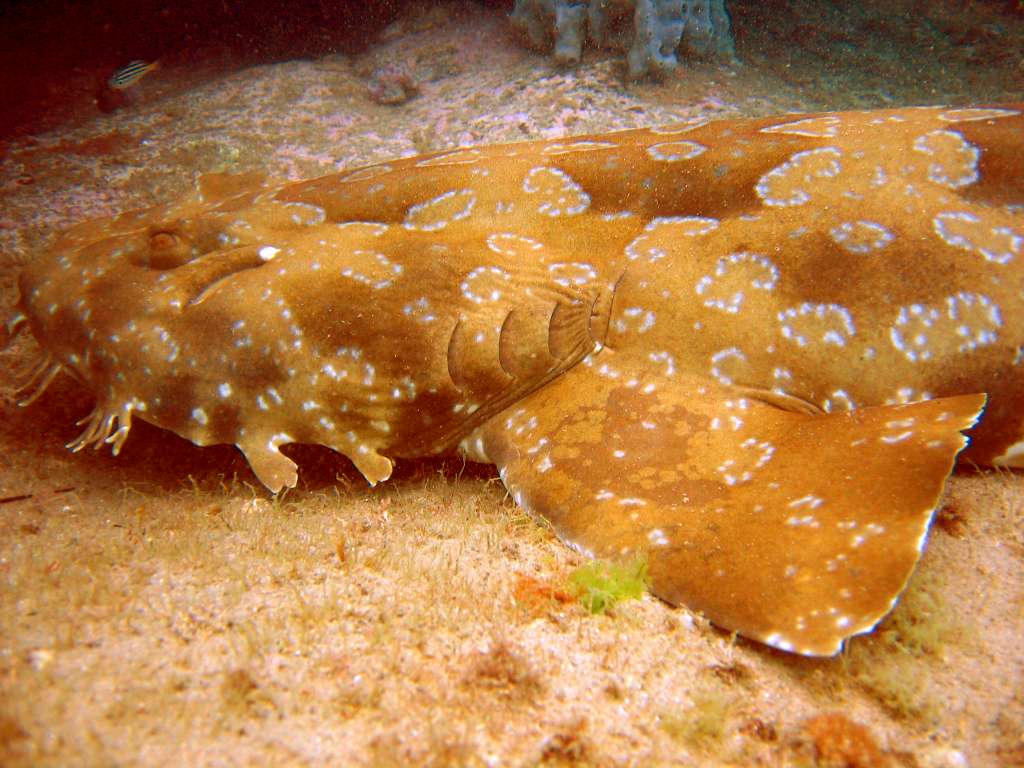
Wobbegongs are a 12-species family (Orectolobidae) of flattened, camouflaged carpet sharks that ambush prey on the seabed across Australian and South East Asian reefs. Wobbegongs are the carpet shark family Orectolobidae: 12 species of flattened, bottom-dwelling sharks famous for elaborate skin patterns and dermal beards that make them nearly invisible on reefs. They range from the tiny dwarf spotted wobbegong (Orectolobus parvimaculatus) to the 3 m banded wobbegong, and most live in Australian waters.
Part of our guide: Shark Species.
Key facts at a glance
| Family | Orectolobidae |
|---|---|
| Number of species | 12 recognized |
| Smallest | Dwarf spotted wobbegong, around 0.7 m |
| Largest | Banded wobbegong, around 3 m |
| Diet | Bottom-dwelling fish, octopus, crustaceans, occasional smaller sharks |
| Habitat | Reefs, kelp beds, rocky bottoms; Australia, Indonesia, Papua New Guinea, Japan |
| Camouflage | Variegated skin pattern plus a fringe of dermal lobes around the head |
| Lifespan | Estimated 25 to 30 years |
| IUCN status range | Least Concern to Near Threatened depending on species |
The 12 wobbegong species
The family Orectolobidae has 12 recognized species across three genera (Eucrossorhinus, Orectolobus, Sutorectus). Most are Australian endemics; a handful range into Indonesia, Papua New Guinea, southern Japan, and the western Pacific. All share the flattened body, mottled skin, and dermal lobes that define the group.
The full family list:
- Tasselled wobbegong (Eucrossorhinus dasypogon): northern Australia, Indonesia, PNG. Reefs at 5 to 50 m.
- Spotted wobbegong (Orectolobus maculatus): southern Australia. The most familiar species.
- Banded wobbegong (Orectolobus halei): south-eastern Australia. Reaches 3 m, the largest.
- Ornate wobbegong (Orectolobus ornatus): northern New South Wales to Queensland.
- Western wobbegong (Orectolobus hutchinsi): south-west Australia.
- Floral banded wobbegong (Orectolobus floridus): southern Australia.
- Northern wobbegong (Orectolobus wardi): tropical northern Australia.
- Japanese wobbegong (Orectolobus japonicus): southern Japan, South China Sea.
- Indonesian wobbegong (Orectolobus leptolineatus): Indonesia, Philippines.
- Dwarf spotted wobbegong (Orectolobus parvimaculatus): south-west Australia.
- Network wobbegong (Orectolobus reticulatus): northern Australia.
- Cobbler wobbegong (Sutorectus tentaculatus): southern Australia.
How the camouflage works
Wobbegong camouflage rests on three layers. The base layer is the variegated skin pattern: blotches and saddles that break up the silhouette against algae and rubble. The middle layer is the body shape itself: flat, pancake-like, lying flush with the seabed. The top layer is the dermal fringe, a beard of skin lobes around the mouth and chin that copies the texture of seaweed.
The result is a shark that vanishes against the reef. Octopuses, small reef fish, and even larger sharks walk straight into a hidden wobbegong’s strike zone. The tasselled wobbegong adds a behavioural trick: it twitches its tail to attract small fish toward the head, which is exactly the kind of lure-style behaviour seen in anglerfish.
Hunting style
Wobbegongs are pure ambush predators. They sit motionless for hours, sometimes days, on the same patch of reef, and strike with a sudden snap that completes in around 100 milliseconds. The teeth are long, fang-like, and angled inward, perfect for impaling fish that pass too close.
They eat reef fish (gobies, wrasse, surgeonfish), octopus and small squid, crustaceans, and the occasional small shark. Tasselled wobbegongs have been filmed eating bamboo sharks and even smaller wobbegongs from competing territories. It is one of the few documented cases of intra-family predation in sharks.
Are wobbegongs dangerous?
Most wobbegong bites on humans happen when a diver or snorkeler steps on or accidentally touches a hidden animal. The shark interprets the contact as a strike opportunity and bites once, hard. The teeth do not let go quickly: there are documented cases of divers spending 20 minutes pulling a wobbegong off their leg by levering the jaws apart.
The International Shark Attack File records around 50 wobbegong incidents, all but a handful of which are direct provocation (stepping, grabbing the tail, harassing during dives). No fatalities. The actual risk to a respectful diver who watches their feet is essentially zero.
Reproduction
Wobbegongs are ovoviviparous. Females carry developing eggs internally and give birth to live pups, typically 20 to 40 per litter (some species closer to 10, some up to 50). Pups are 20 to 25 cm at birth and immediately take up the family lifestyle: bottom dwelling, ambush hunting, hiding in coral rubble.
Females mature late (around 6 to 7 years) and tend to remain within small home ranges of a few square kilometres for life. That site fidelity means local populations recover slowly from over-fishing of any one reef.
Conservation status
Most wobbegong species are listed Least Concern by the IUCN. Of the 12 species, only the Indonesian wobbegong (Orectolobus leptolineatus) is Near Threatened (2020 assessment). The spotted and banded wobbegongs, once fished commercially in New South Wales for the popular flake (shark and chips) market, are both Least Concern (2015 assessments).
Targeted commercial wobbegong fishing has tapered off since the 1990s, but recreational catch and habitat impacts on reefs remain pressures. The biggest population concern is the loss of suitable reef habitat in coastal areas affected by warming, sedimentation, and trawl damage.
Seeing wobbegongs in the wild
South West Rocks (Fish Rock Cave) and Manly off Sydney are reliable spots for spotted wobbegongs in southern Australia. The Great Barrier Reef holds tasselled wobbegongs at sites like Holmes Reef and Osprey Reef. Northern Indonesia and southern Japan have local species accessible to divers in spring and summer.
The trick is to know what to look for. Wobbegongs are easy to swim over without noticing. Look for the shape of a fish-like outline under the algae, or for the tassels around the head. Once you spot one, you start seeing them on every dive.
Why wobbegongs matter to coral reef science
Wobbegongs are mid-sized reef predators that regulate populations of smaller reef fish, octopus, and crustaceans. Their long site fidelity makes them indicator species for reef health: when wobbegong density declines in a region, broader reef productivity often follows. Several Australian research projects track wobbegong populations as a proxy for reef state.
They are also one of the easier shark families to tag because they stay put. Acoustic tagging studies of spotted wobbegongs off Sydney showed individual sharks visiting the same boulder fields year after year. Long-term monitoring data of this kind is rare in shark biology and is partly why the wobbegong family is so well understood relative to its lower public profile.
Related reading
For shark fans browsing for something to take home, see our store collections of shark books.
See the IUCN Red List entry for the spotted wobbegong. See the Shark Trust.
Frequently asked questions
How many species of wobbegong shark are there?
There are 12 recognized species in the family Orectolobidae, across three genera (Eucrossorhinus, Orectolobus, Sutorectus). Most are Australian endemics. The biggest is the banded wobbegong at around 3 m and the smallest is the dwarf spotted wobbegong at around 70 cm.
Are wobbegong sharks dangerous?
Most wobbegong bites on humans are the result of stepping on or touching a hidden animal. The shark mistakes the contact for prey and bites once, hard. The International Shark Attack File records around 50 wobbegong incidents with no fatalities, and almost all involve a clear provoking action. The risk to a careful diver is essentially zero.
What is a wobbegong’s camouflage made of?
Wobbegongs have a three layer camouflage. The variegated skin pattern breaks up their silhouette, the flattened body shape removes the shark outline, and a fringe of dermal lobes around the head mimics seaweed. The tasselled wobbegong even uses its tail as a lure, twitching to attract small fish into striking range.
What do wobbegong sharks eat?
Wobbegongs eat bottom-dwelling reef fish (gobies, wrasse, surgeonfish), octopus, squid, crustaceans, and occasionally smaller sharks, including other wobbegongs in some documented cases. They are ambush predators that strike in around 100 milliseconds.
Where do wobbegongs live?
Most wobbegongs live in Australian waters. A few species range into Indonesia, Papua New Guinea, southern Japan, and the South China Sea. Habitats include coral reefs, rocky reefs, kelp beds, and sea grass meadows at depths from 1 to 100 m.
How big do wobbegong sharks get?
The largest, the banded wobbegong, reaches around 3 m. The spotted wobbegong reaches 2.5 m. Most other species are 1.5 m or smaller. The dwarf spotted wobbegong, the smallest, tops out around 70 cm.
How long do wobbegong sharks live?
Estimated 25 to 30 years for most species. Females mature late (around 6 to 7 years) and tend to remain within small home ranges of a few square kilometres for life, which makes local populations slow to recover from heavy fishing pressure.
Are wobbegong sharks endangered?
Most species are listed Least Concern by the IUCN. Only one, the Indonesian wobbegong, is Near Threatened (2020 assessment). The spotted and banded wobbegongs of New South Wales, once fished for the Australian flake market, are Least Concern. Targeted fishing has eased since the 1990s, but reef habitat loss is an ongoing pressure.
By Otis Mako. Last updated 18 November 2026.
Updated 18 November 2026: corrected the IUCN statuses: of the 12 wobbegong species, only the Indonesian wobbegong is Near Threatened and none is Vulnerable. Source: IUCN Red List version 2025-2, as quoted by FishBase.
Got a shark photo of your own? Send it to us and we may post it here and on our Facebook page, with your name on it. Share your shark photo


On a muck dive in Indonesia the guide had to point right at the beard before either of us could pick a tasselled wobbegong out of the rubble. My buddy had been hovering a foot above it the whole time.
What makes the tasselled and the cobbler different enough to get a genus each, when the other ten all sit in Orectolobus? From photos they all look like the same rug to me.