
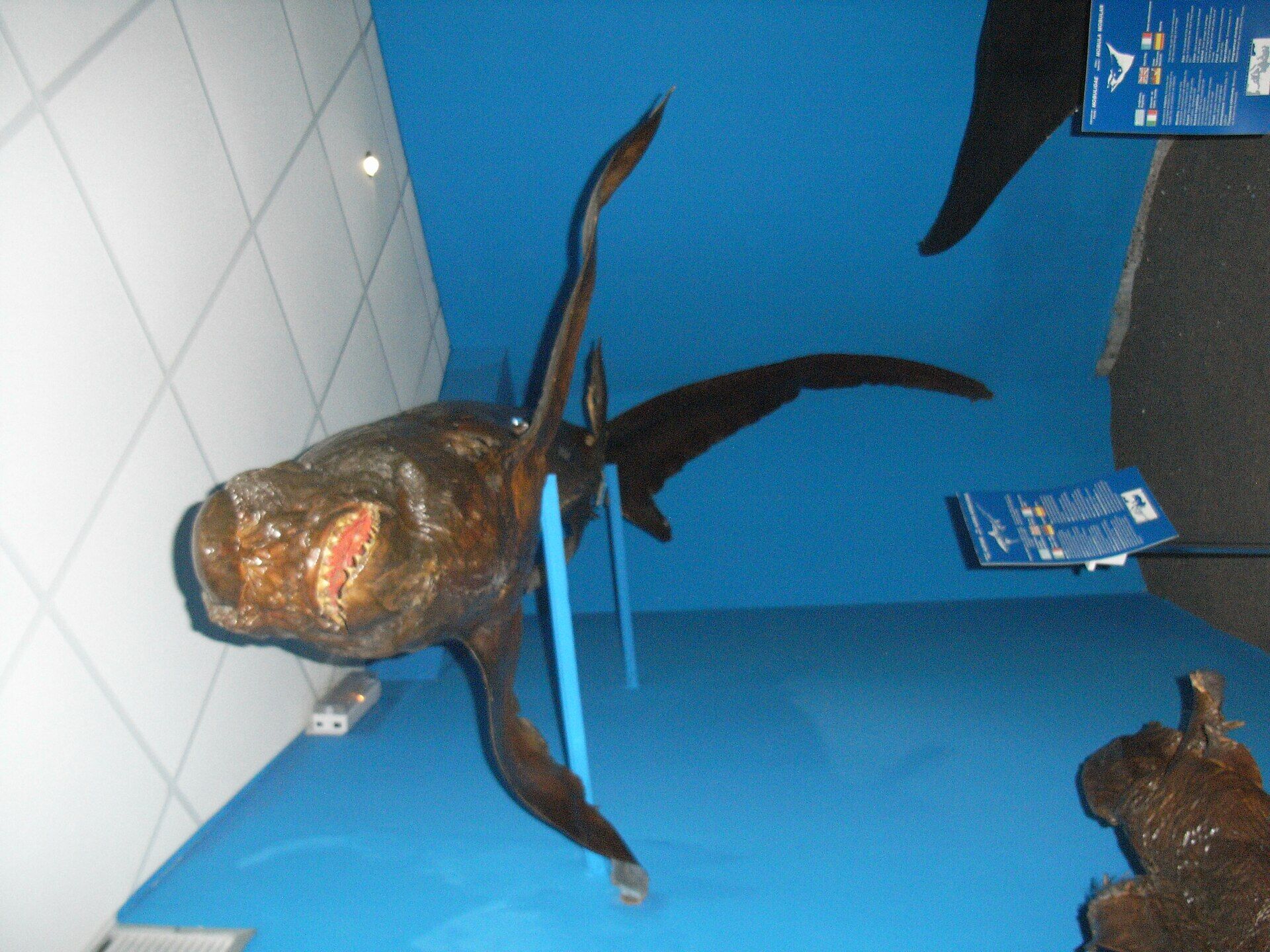
Bigeye Thresher Shark: The Tail-Whipping Deep Diver With Eyes Built for the Twilight Zone
10 min read
Last Updated on May 25, 2026 by Otis Mako
The bigeye thresher shark (Alopias superciliosus) is a long, slender open-ocean shark reaching about 4.9 m in length, with eyes the size of grapefruits and a tail nearly as long as the rest of its body. It uses that whip-like tail to stun schools of fish in a single overhead strike, and it dives to more than 700 m on a daily cycle to chase prey through the mesopelagic. Listed as Vulnerable on the IUCN Red List, it is one of three thresher species and the deepest-diving of the family.
Key facts at a glance
| Common name | Bigeye thresher shark |
|---|---|
| Scientific name | Alopias superciliosus |
| Family | Alopiidae (thresher sharks) |
| Max length | Up to 4.9 m (16 ft), tail accounts for about half |
| Max weight | Around 363 kg (800 lb) |
| Diet | Schooling bony fish, squid, mackerel, hake, lanternfish |
| Habitat | Open ocean and continental slope, surface to 700 m+ |
| Range | Tropical and warm-temperate oceans worldwide |
| Lifespan | Around 20 years (estimated) |
| IUCN status | Vulnerable (2018 assessment) |
| Recorded unprovoked attacks on humans | 0 (Florida Museum ISAF, all-time) |
What makes a bigeye thresher a bigeye thresher
Two features set this shark apart from every other open-ocean predator. The first is the eyes. They are enormous, often exceeding 10 cm across, and they sit in deep sockets that rotate upward. The shark spends part of its day in dim mesopelagic water, so its retinas are packed with rod cells and tapetum-backed reflectors for low-light hunting. A horizontal groove runs along the top of the head, accommodating those upward-rotating eyes when the shark is scanning for prey silhouetted against down-welling light.
The second is the tail. The upper lobe of the caudal fin is as long as the rest of the body, giving the bigeye thresher its trademark whip silhouette. That tail is not for swimming speed alone. It is a weapon. High-speed video taken off the coast of the Philippines and Egypt has shown thresher sharks accelerating into a school of sardines and snapping the tail overhead like a striking cobra, stunning multiple fish in a single hit. The shark then circles back to pick up the dazed prey at leisure.
The three thresher species, side by side
| Species | Scientific name | Max length | Eye size | Max depth | IUCN status |
|---|---|---|---|---|---|
| Bigeye thresher | Alopias superciliosus | 4.9 m (16 ft) | Up to 10 cm+ | Around 700 m | Vulnerable |
| Common thresher | Alopias vulpinus | 6.1 m (20 ft) | Around 5 cm | Around 550 m | Vulnerable |
| Pelagic thresher | Alopias pelagicus | 3.3 m (10.8 ft) | Around 5 cm | Around 300 m | Endangered |
The bigeye is the middle-sized thresher by body length but easily the largest-eyed and the deepest diving. A fourth species was once proposed off the coast of Baja California, but genetic work in the early 2000s folded that population back into the common thresher.
Range and habitat
Bigeye threshers live in every tropical and warm-temperate ocean. They are most often recorded off the eastern United States, the Mediterranean, the western Pacific around Taiwan and the Philippines, the eastern Pacific off Mexico and California, and the Indian Ocean off Mozambique and Australia. They prefer the open ocean and the upper continental slope, rarely venturing onto shallow shelves.
Satellite-tagging studies published by NOAA Fisheries between 2010 and 2018 have mapped a daily vertical migration. The shark spends nights between 50 and 200 m, feeding on schooling fish near the surface mixing layer. At dawn it descends to depths between 300 and 700 m, riding the deep scattering layer (a dense band of squid and lanternfish that follows the same daily pattern). Tagged individuals have made dives to 723 m, the deepest recorded for any thresher.
Built for two worlds
Living across a 700 m temperature gradient is no small feat. Like other lamniform sharks (the same order as great whites and makos), bigeye threshers are partially endothermic. They have a counter-current heat exchanger that keeps the muscles, brain, and eyes a few degrees above ambient water temperature. That advantage matters most on deep dives where surrounding water can drop below 6 C. A warm brain and warm eyes mean a sharp, fast-thinking shark in cold, dark water where most predators slow down.
Diet and hunting
Bigeye threshers are specialist hunters of schooling prey. Stomach content surveys, most notably those published by Spanish and Taiwanese fisheries researchers in the 2000s, consistently turn up mackerel, hake, herring, sardine, lanternfish, and squid. The proportions shift with location: Mediterranean bigeyes lean heavily on hake, North Atlantic bigeyes on mackerel, Pacific bigeyes on lanternfish.
The hunting technique is the headline. A 2013 paper in PLOS ONE by Simon Oliver and colleagues used high-speed video at Pescador Island in the Philippines to film pelagic threshers (the bigeye's smaller cousin) striking sardine schools. The footage showed the shark accelerating into the school, then snapping its tail overhead in an arc that took less than a third of a second. The tail tip moved at peak speeds above 80 km per hour and produced cavitation bubbles in the water. Stunned and disoriented sardines fell out of the school, and the shark turned to pick them up.
Bigeye threshers use the same technique, with the longer body and longer tail giving them a wider reach. Anglers who target the species report sharks that strike a hooked baitfish from above with the tail before approaching the bait again from the side, which is consistent with the published hunting model.
Reproduction and lifecycle
Bigeye threshers are ovoviviparous with oophagy, a long word for an unusual reproductive strategy. Females produce internal eggs, which hatch inside the uterus. The hatched embryos then feed on unfertilized eggs released by the mother, a practice called oophagy. Some lamniform sharks (sand tigers, for example) take this further and practice intrauterine cannibalism, where larger embryos eat smaller siblings. Bigeye threshers stick to egg-feeding, which is gentler but still leaves the species with very small litters: typically 2 to 4 pups per pregnancy.
Gestation lasts around 12 months, and pups are born at a remarkable 100 to 140 cm in length, already proportioned with the long upper tail lobe. Sexual maturity arrives late: males around 10 years old, females around 12 to 13. Combined with the small litters, that slow life history is the main reason the species cannot tolerate heavy fishing pressure, and is the central evidence behind the IUCN Vulnerable listing.
Behavior and intelligence
Bigeye threshers are largely solitary. They do not form persistent schools, although tag data shows that several individuals will sometimes converge on a productive fishing ground over a few days, then disperse again. They appear to be active hunters around the clock, not strictly nocturnal or diurnal, with feeding bouts timed to the daily vertical migration of their prey.
The species is shy of boats and divers. Encounters in the open ocean are rare and almost always brief: a glimpse, a flash of the long tail, and the shark is gone. Pelagic threshers can be reliably seen at the Monad Shoal cleaning station off Malapascua Island in the Philippines, where they hang in slow circles while wrasses pick parasites off their skin. Bigeye threshers are seen at the same cleaning stations occasionally but far less frequently, since they prefer deeper water.
Are bigeye thresher sharks dangerous to humans?
No. The Florida Museum's International Shark Attack File records zero unprovoked attacks attributed to any thresher species across all of recorded history. The teeth are small and inward-pointing, suited to gripping slippery fish rather than tearing flesh. Encounters with divers, on the few occasions they happen, are passive on the shark's side. The only documented thresher injuries come from longline crews handling hooked animals on deck, where the tail (still long and powerful) can deliver a serious whip.
If you are diving the Philippines and want to see one, Monad Shoal at dawn is the place. The cleaning station is well-known and well-regulated, with a strict no-touch protocol enforced by local dive operators.
Conservation status and threats
The bigeye thresher is listed as Vulnerable on the IUCN Red List, with the 2018 assessment estimating population declines of 30 to 49 percent over three generations. Three pressures drive the decline.
- Bycatch in longline fisheries. Bigeye threshers are caught incidentally on pelagic longlines set for tuna and swordfish. The species is particularly vulnerable because it occupies the same depth range that longline gear targets, and because hooked individuals often die before being landed.
- Shark fin trade. Like most pelagic sharks, the bigeye is targeted for its large fins, which fetch premium prices in the East Asian fin market.
- Slow life history. Late maturity, small litters, and long generation times mean that even moderate fishing pressure can drive populations below replacement.
CITES Appendix II protections, in force since 2017, now cover all three thresher species and require permits and traceability for any international fin trade. NOAA Fisheries lists the bigeye thresher as a prohibited species in the US Atlantic pelagic longline fishery: vessels must release any caught individuals alive where possible.
What helps
- Buying tuna and swordfish from fisheries certified by independent bodies that publish bycatch data (MSC, Friend of the Sea, or equivalent)
- Refusing shark fin products, including in restaurants that describe them as traditional
- Reporting illegal fin trade to local authorities or to Shark Trust
- Supporting research and tagging programs that fill gaps in our understanding of bigeye thresher population trends
Fun and surprising bigeye thresher facts
- The bigeye thresher's eye-to-body ratio is the largest of any pelagic shark, with eye diameters reaching 10 cm in mature adults.
- A horizontal groove on top of the skull lets the eyes rotate upward, an adaptation for spotting prey silhouetted above against down-welling light.
- Bigeye threshers can leap entirely out of the water during a hunt, with the tail acting as a counterweight. A 2014 NOAA observer report off Cape Cod recorded an adult clearing the surface by more than 2 m.
- Tagged individuals have migrated more than 5,000 km in a single year, crossing entire ocean basins.
- The species is part of the lamniform clade alongside great whites, makos, salmon sharks, and sand tigers, sharing partial endothermy and a slow reproductive strategy with all of them.
Where bigeye threshers fit in the wider thresher family
The three living thresher species share the trademark elongated upper caudal lobe and the tail-whipping hunt, but each has carved out a slightly different niche. The common thresher hunts in surface waters of cooler temperate seas, the pelagic thresher works the mid-depth tropical open ocean, and the bigeye thresher takes the deepest, dimmest column for itself. For more on related deep-water specialists, see our profile of the cookiecutter shark, a much smaller deep-ocean shark with a very different hunting style.
Related species and further reading
- Hammerhead shark species guide
- Blue shark species profile
- Cookiecutter shark
- Tasselled wobbegong shark
- Shark tagging and the risks involved
If a tail-whipping pelagic hunter has caught your imagination, our friends at the store stock a thoughtful selection of shark books covering the lamniform family in depth, plus shark toys with several thresher figurines for collectors and kids.
What is special about the bigeye thresher shark?
Two things. First, the eyes: they are huge (over 10 cm across in adults) and sit in upward-rotating sockets, letting the shark hunt in dim mesopelagic water and spot prey silhouetted against down-welling light. Second, the tail: the upper lobe is as long as the rest of the body, and the shark uses it as a whip to stun schools of fish in a single overhead strike. High-speed video has clocked the tail tip at over 80 km per hour during a hunting strike. The bigeye is also the deepest-diving thresher, with tagged individuals recorded at 723 m.
How big do bigeye thresher sharks get?
Adult bigeye threshers reach up to 4.9 m (16 ft) in total length, with about half of that being the elongated upper caudal lobe. Body weight tops out around 363 kg (800 lb). Females are generally larger than males. Newborn pups arrive at a sizeable 100 to 140 cm, already proportioned with the long tail, which they begin using to herd small prey within their first weeks of life.
How does a bigeye thresher hunt with its tail?
The shark accelerates into a school of fish (sardines, mackerel, lanternfish), then snaps the long upper tail lobe overhead in an arc that lasts less than a third of a second. The tail tip can exceed 80 km per hour at the peak of the strike, producing cavitation bubbles in the water and a shockwave that stuns multiple fish in one hit. The shark then circles back at slower speed to pick up the disoriented prey. The technique was first documented on camera in 2013 by Simon Oliver and colleagues, using slow-motion video of pelagic threshers at Pescador Island in the Philippines.
How deep can bigeye thresher sharks dive?
Bigeye threshers regularly dive between 300 and 700 m during the day, following the deep scattering layer of squid and lanternfish that migrates vertically each day. The deepest recorded dive from NOAA satellite tags sits at 723 m, the deepest of any thresher species. The species can tolerate water temperatures below 6 C thanks to a partial endothermic heat-exchange system shared with other lamniform sharks (great whites, makos, sand tigers).
Are bigeye thresher sharks dangerous to humans?
No. The Florida Museum's International Shark Attack File records zero unprovoked attacks attributed to any of the three thresher species, including the bigeye, in all of recorded history. The teeth are small and inward-pointing, suited to gripping schooling fish, not large prey. The shark is also shy and tends to avoid boats and divers. The only documented thresher injuries are to longline crews handling hooked sharks on deck, where the powerful tail can deliver a serious whip.
Where do bigeye thresher sharks live?
Bigeye threshers are found in every tropical and warm-temperate ocean. The species is reported most often off the eastern United States, the Mediterranean Sea, the western Pacific around Taiwan and the Philippines, the eastern Pacific off Mexico and California, and the Indian Ocean off Mozambique and Australia. They prefer the open ocean and the upper continental slope, rarely venturing onto shallow continental shelves, and they make daily vertical migrations between near-surface waters at night and 300 to 700 m during the day.
Why is the bigeye thresher shark vulnerable?
The IUCN Red List 2018 assessment estimates a 30 to 49 percent population decline over three generations. Three pressures combine: bycatch in pelagic longline fisheries set for tuna and swordfish (the species occupies the same depth range as the gear), the East Asian shark fin trade (large fins fetch premium prices), and the species's slow life history (late maturity, small litters of 2 to 4 pups, long generation times). CITES Appendix II protections have been in force since 2017, requiring permits for any international fin trade, but enforcement is uneven.
How is the bigeye thresher different from the common thresher?
The two species differ in size, eye size, depth range, and habitat. The common thresher reaches 6.1 m and lives in cooler temperate surface waters, hunting in the top 550 m. The bigeye reaches 4.9 m but has much larger eyes and a deeper depth range, with recorded dives to 723 m, and prefers tropical and warm-temperate open ocean. Both share the tail-whipping hunting technique and ovoviviparous-with-oophagy reproduction. Genetically, they split from a common ancestor around 30 million years ago. A third species, the pelagic thresher, is smaller (3.3 m) and works the mid-depth tropical column.
By Carey Baird. Last updated 14 May 2026. Estimated reading time: 10 minutes.
Got a shark photo of your own? Send it to us and we may post it here and on our Facebook page, with your name on it. Share your shark photo


It’s so sad when animals are killled for recreation.