
Sandbar Shark: The Heavily Fished, Slow-Growing Requiem Shark Now Listed as Vulnerable
11 min read
Last Updated on November 18, 2026 by Otis Mako
The sandbar shark (Carcharhinus plumbeus) is a stout, broad-finned requiem shark found in temperate and tropical coastal waters worldwide, instantly recognizable by an unusually tall first dorsal fin and a heavy, almost barrel-like body. Slow to mature, slow to reproduce, and historically targeted by fin and meat fisheries from the Atlantic to the Pacific, it lost 80 to 90 percent of its population by the late 20th century and is now IUCN Endangered (assessed 2020), with rebuilding underway under tight US management.
Key facts at a glance
| Common name | Sandbar shark |
|---|---|
| Scientific name | Carcharhinus plumbeus |
| Family | Carcharhinidae (requiem sharks) |
| Order | Carcharhiniformes |
| Max length | Up to 2.5 m (8.2 ft) |
| Max weight | Up to 118 kg (260 lb) |
| Typical adult length | 1.8 to 2.2 m |
| Diet | Bony fish, small sharks, rays, squid, octopus, crustaceans |
| Habitat | Temperate and tropical coasts, bays, estuaries, 20 to 200 m depth |
| Range | Global. All major temperate and tropical oceans except the eastern Pacific. |
| Lifespan | 30 to 35 years in the wild |
| Age at maturity | 13 to 16 years |
| IUCN status | Endangered (assessed 2020) |
| Recorded unprovoked attacks on humans | 2 total, 0 fatal (Florida Museum ISAF, all-time) |
What a sandbar shark looks like
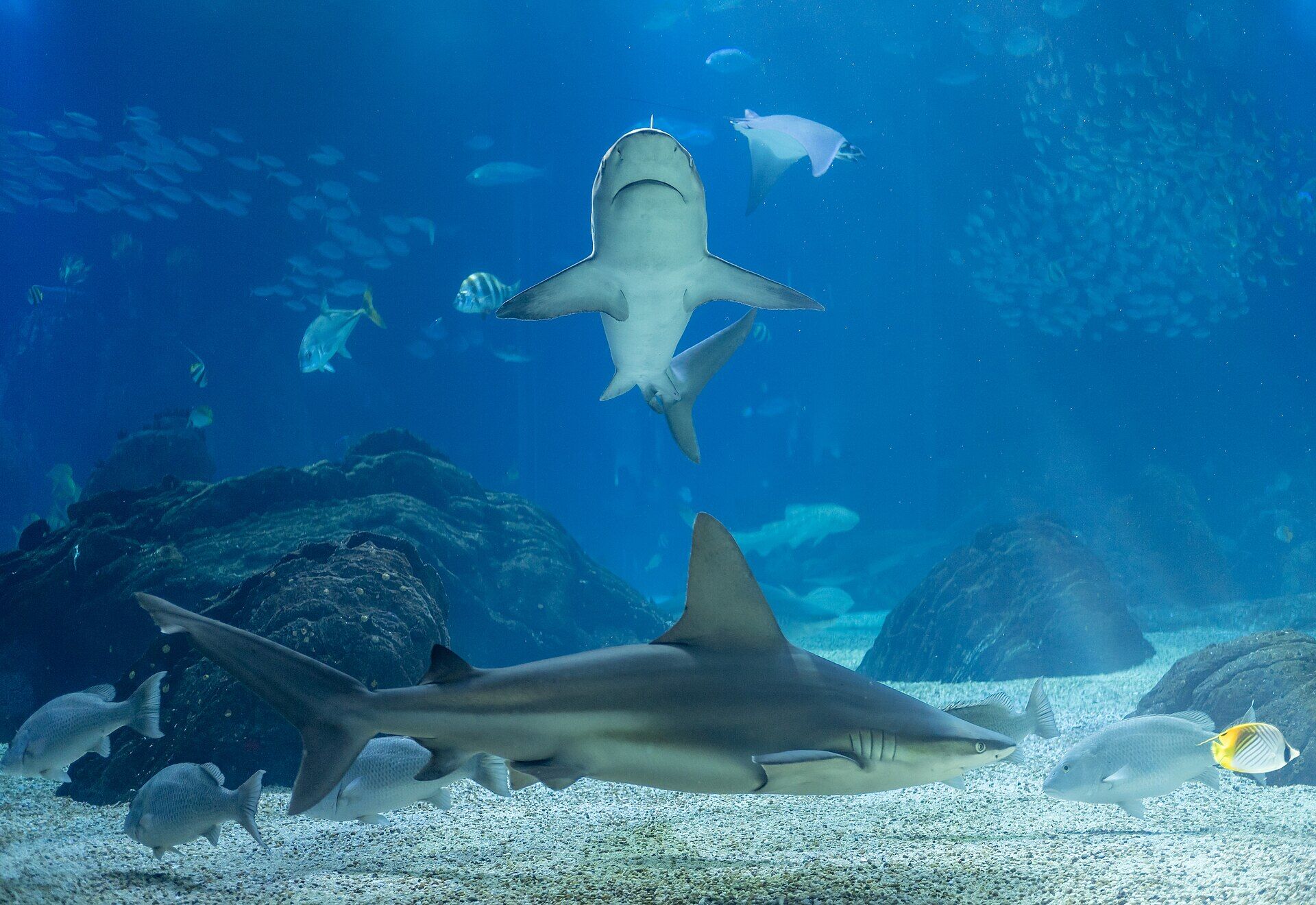
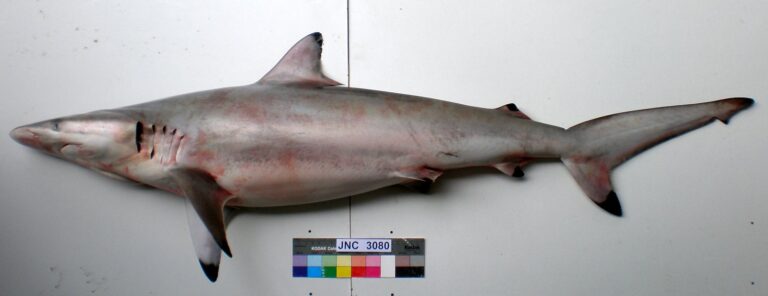
The sandbar shark has one of the most distinctive silhouettes of any requiem shark. Its body is stout and heavy through the middle, with a broad pectoral fin and a tall, triangular first dorsal fin that starts above the very front of the pectoral fin’s base. This dorsal-fin profile is the easiest field ID for the species and is the reason sandbar sharks are sometimes called “thickskin” or “brown shark” in commercial fisheries. The body is bronze-gray to brown above and white below, with no obvious fin markings.
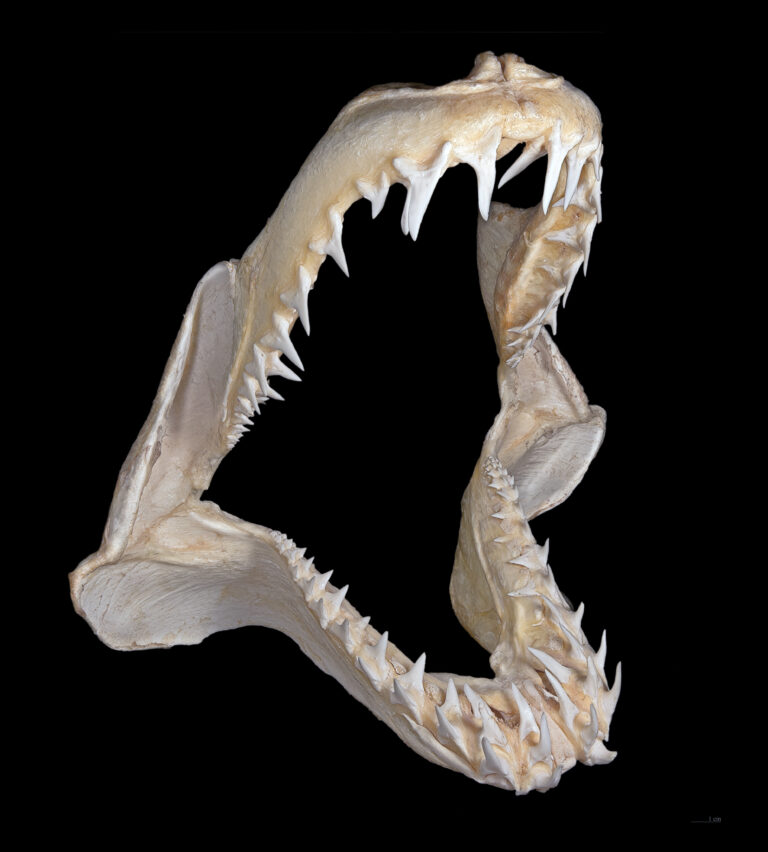
Compared to the closely related dusky shark, the sandbar has a shorter snout, more triangular and more strongly serrated upper teeth, and a markedly taller first dorsal. Adults reach up to 2.5 m and around 118 kg, though most are 1.8 to 2.2 m. Females grow larger than males. The species shows little visible age-related color change and adults look essentially the same as the older juveniles, just larger.
How to identify a sandbar shark
- First dorsal: Very tall, triangular, starts above the very front of the pectoral base. The most reliable field mark.
- Body shape: Stout and heavy, almost barrel-shaped through the middle.
- Snout: Short and rounded.
- Pectoral fins: Broad and long, used for slow steady cruising along the bottom.
- Color: Bronze-gray to brown above, white below, no fin markings.
- Size: Adults typically 1.8 to 2.2 m, max around 2.5 m.
Range and habitat
Sandbar sharks have one of the broadest distributions of any coastal shark. They occur in all major temperate and tropical oceans except the eastern Pacific, where they are notably absent. Strongholds include the western Atlantic from Massachusetts to southern Brazil, the eastern Atlantic from Portugal to South Africa, the Mediterranean, the Indian Ocean coast from East Africa to Australia, and the western Pacific from Japan to northern Australia. They also occur in the central Atlantic around the Azores and Cape Verde.
The species is fundamentally a continental-shelf animal. Adults cruise the seabed at 20 to 200 m depth, with the bulk of the population in 30 to 80 m. Juveniles use shallow coastal nurseries, especially Chesapeake Bay (USA), Delaware Bay, the Carolina sounds, and the Gulf of Mexico in the western Atlantic, and various Indian Ocean estuaries in the east. Pregnant females migrate hundreds of kilometers to deliver pups in these warm shallow nurseries, then leave to repeat the cycle.
Famous nurseries
- Chesapeake Bay, USA: The most studied nursery in the world. Pups arrive each June and stay through summer before migrating south. Researchers from Virginia Institute of Marine Science have tagged tens of thousands of juveniles.
- Delaware Bay, USA: A secondary nursery on the same migration route.
- Outer Banks of North Carolina: Subadult overwintering grounds, especially the Pamlico and Albemarle sounds.
- Gulf of Mexico: Western Florida and Texas estuaries.
- Mediterranean: Egyptian and Tunisian inshore waters, although populations are now sharply reduced.
- Western Australia: Coastal estuaries from Shark Bay to the Northwest Cape.
Migration: thousand-kilometer round trips
Sandbar sharks in the western North Atlantic are strong migrants. Adults overwinter off the southeastern US coast and migrate north to mid-Atlantic and New England waters each summer. Tagging studies by NOAA and Virginia Institute of Marine Science have documented round-trip distances of 3,000 km or more for individual females. Migration timing is tightly linked to water temperature, with the threshold around 18 degrees Celsius.
Pregnant females show natal philopatry: they return to the bay or estuary where they were born to deliver their own pups. This site fidelity is one reason the species took such a hard hit from coastal overfishing in the 1980s. If you remove the breeders from one nursery, that whole estuary’s contribution to the population is lost, with no clear recolonization from neighboring nurseries because the females don’t switch. Recovery from a depleted nursery can take generations.
Diet and hunting
Sandbar sharks are opportunistic mid-trophic-level predators. The diet is dominated by bony fish (menhaden, mackerel, croaker, eels, sea robins) and supplemented with smaller sharks and rays, squid, octopus, and crustaceans. Hunting is mostly visual and tactile, with the shark cruising the seabed at 1 to 2 km/h, scanning sand and rubble for activity. Unlike fast pelagic species, sandbar sharks rarely chase prey. They sweep and grab.
Juveniles eat smaller prey: shrimp, small crabs, and small bony fish in shallow nurseries. As they grow, the diet shifts upward in size. Adult sandbar sharks regularly take smaller requiem sharks (juvenile blacknose, juvenile blacktip, smoothhound species) and ray species (cownose ray, butterfly ray, southern stingray). The species rarely takes seabirds or mammals.
Typical sandbar shark prey
- Bony fish: menhaden, mackerel, croaker, eels, sea robins, flounder
- Smaller sharks: juvenile blacknose, juvenile blacktip, smoothhound species
- Rays: cownose, butterfly, southern stingray
- Cephalopods: squid, octopus, cuttlefish
- Crustaceans: blue crab, mantis shrimp, lobster (occasionally)
Reproduction and the slow-life-history trap
Sandbar sharks are viviparous with a placental yolk-sac connection. Gestation lasts 9 to 12 months. Litters are small: 1 to 14 pups per pregnancy, with an average of 7 to 9. Females reproduce every 2 to 3 years rather than every year. Pups are 56 to 75 cm at birth, born in summer in shallow protected nurseries.
The life history is exceptionally slow even by shark standards. Females mature at 13 to 16 years and around 1.5 m in length. Males mature at 12 to 15 years. Lifespan in the wild reaches 30 to 35 years. Total lifetime reproductive output is modest: a 30-year-old female may have produced just 30 to 60 pups across her entire life. This is the central problem in sandbar shark conservation. The species’ demographic recovery rate after heavy fishing is roughly half that of the average requiem shark. When you remove a large female, you remove decades of breeding potential and the rebuilding clock starts at 13 to 16 years, not 1 to 2.
Are sandbar sharks dangerous to humans?
Very rarely. The Florida Museum’s International Shark Attack File records just 2 unprovoked attacks attributed to sandbar sharks across all of recorded history, with zero fatalities. By comparison, white sharks account for over 350 attacks and tiger sharks for over 100. Sandbar sharks are large, capable predators, but they spend most of their lives at 30 to 80 m of depth and rarely enter the bather zone except in juvenile nursery estuaries, where the smaller pups present no realistic danger.
Spearfishermen and longline anglers occasionally have hooked sandbar sharks behave aggressively when stressed, but this falls under provoked interactions and not unprovoked attacks. Most sandbar sharks ignore divers and move away when approached. For broader context on shark danger, see our pages on shark attack videos and ISAF statistics and the closely-related bull shark species profile.
Fisheries history: collapse and slow rebuild
The sandbar shark was once one of the most heavily fished sharks in the world. In the US Atlantic, it accounted for around 60 percent of the commercial large coastal shark catch through the 1980s. The fishery targeted the species for meat (sold as “thickskin” or “brown shark steak”) and for fins (long, broad pectoral fins commanded high export prices). Recreational angling for sandbar sharks was also widespread along the eastern US coast.
By 2005, US Atlantic stock assessments showed an 80 percent decline from the 1970s baseline. NOAA Fisheries responded with the 2008 Atlantic Highly Migratory Species Amendment 2, which closed directed commercial fishing for sandbar sharks except for a small research program, banned recreational retention, and imposed strict bycatch limits. The Mediterranean stock, less protected, collapsed to near-zero by the early 2000s and has not recovered. Indian Ocean and Western Pacific stocks fare better but face continued bycatch in tuna and swordfish longlines.
Where it stands now
- IUCN global status: Endangered (assessed 2020)
- US Atlantic: Closed commercial fishery since 2008. Stock rebuilding ahead of schedule per NOAA 2024 assessment.
- Mediterranean: Critically depleted subpopulation. No recovery yet.
- Indo-Pacific: Mixed. Some Australian populations stable under quota management. Indian Ocean populations face heavy bycatch.
- CITES: Not listed, although the broader requiem shark family was added to Appendix II in 2022, including sandbar shark protections for fin trade documentation.
Conservation status and outlook
The IUCN classifies the sandbar shark globally as Endangered (2020 assessment). The species is recovering in the western North Atlantic thanks to the US 2008 closure, but the recovery is slow. NOAA’s most recent stock assessment (2024) suggests US Atlantic biomass has climbed from around 20 percent of the unfished biomass in 2005 to around 50 percent in 2024. Full rebuilding to maximum sustainable yield is expected around 2070, more than 60 years after the closure.
The slow rebuild is a textbook demonstration of the species’ life-history trap. Even with directed fishing closed, age-at-maturity around 14 years means just one cohort per decade reaches breeding age. Compare this to the blue shark, which matures at around 5 years and bounces back faster from comparable population hits.
What helps
- Maintained closure of directed US Atlantic fisheries
- Bycatch reduction in tuna and swordfish longlines worldwide
- Protection of nursery estuaries (Chesapeake Bay, Delaware Bay)
- CITES Appendix II compliance for any international fin trade
- Continued tagging programs that document migration and breeding-site fidelity
Where to see sandbar sharks
Sandbar sharks are not flashy divers like reef sharks, but they are reliably observable in several places. The Outer Banks of North Carolina offer summer diving where subadults aggregate at offshore wrecks at 25 to 35 m depth. Bermuda and the Bahamas have year-round adult populations on the deeper shelf edges. The Hawaiian Islands support a subspecies (Carcharhinus plumbeus) often seen at the Waikiki shark cage dives, where adults of 2 to 2.3 m cruise the surface around the cages.
Around the Mediterranean, encounters are now extremely rare because of the regional collapse. Egyptian Red Sea drift dives occasionally produce a sandbar sighting. In Australia, Shark Bay and Ningaloo Reef boat-based shark research trips offer occasional encounters with adults.
Related species and further reading
- Blue shark species profile
- Nervous shark species profile
- Bull shark species profile
- Leopard shark species profile
- Shark tagging and the risks involved
For deeper reading on fisheries, recovery science, and the sandbar shark’s place in the wider story of Atlantic shark management, our store stocks reference titles at non-fiction shark books and the broader shark books collection.
What is a sandbar shark?
The sandbar shark (Carcharhinus plumbeus) is a stout, broad-finned requiem shark found in temperate and tropical coastal waters worldwide except the eastern Pacific. It grows to around 2.5 m and 118 kg, has an unusually tall triangular first dorsal fin, and is sometimes called “thickskin” or “brown shark” in commercial fisheries. It eats bony fish, smaller sharks, rays, squid, and crustaceans, and lives mostly on the continental shelf at 30 to 80 m depth. Slow growth and a 13 to 16 year age at maturity make it vulnerable to overfishing, and the IUCN currently lists it as Endangered globally (2020 assessment).
Where do sandbar sharks live?
Sandbar sharks have one of the broadest distributions of any coastal shark. They occur in the western Atlantic from Massachusetts to southern Brazil, in the eastern Atlantic from Portugal to South Africa, in the Mediterranean (now severely depleted), throughout the Indian Ocean from East Africa to northern Australia, and in the western Pacific from Japan to northern Australia and Hawaii. They are notably absent from the eastern Pacific. Adults cruise the continental shelf at 30 to 80 m depth, while juveniles use shallow coastal nurseries such as Chesapeake Bay and Delaware Bay in the United States.
Are sandbar sharks dangerous to humans?
Rarely. The Florida Museum’s International Shark Attack File records just 2 unprovoked attacks attributed to sandbar sharks across all of recorded history, with 0 fatalities. By comparison, white sharks account for over 350 attacks and tiger sharks for over 100. Sandbar sharks are large capable predators, but they spend most of their lives at depth and rarely enter the bather zone. Most encounters with divers end with the shark moving calmly away. Spearfishermen handling hooked sandbar sharks occasionally see aggressive behavior, but that falls under provoked interactions rather than unprovoked attacks.
How big do sandbar sharks get?
The maximum recorded length is around 2.5 m (8.2 ft) and the maximum weight around 118 kg (260 lb). Most adults are smaller, between 1.8 and 2.2 m. Females grow larger than males. Pups are 56 to 75 cm at birth. Growth is very slow even by shark standards. Females mature at 13 to 16 years and around 1.5 m, and males at 12 to 15 years. Lifespan in the wild reaches 30 to 35 years. The species’ slow growth is the central problem in conservation, since a single mature female may take 14 years to replace.
What do sandbar sharks eat?
Sandbar sharks are opportunistic mid-trophic-level predators. Bony fish dominate the diet (menhaden, mackerel, croaker, eels, sea robins, flounder), supplemented by smaller sharks (juvenile blacknose, juvenile blacktip, smoothhound species), rays (cownose, butterfly, southern stingray), and cephalopods (squid, octopus). Juveniles in shallow nurseries take smaller prey: shrimp, small crabs, and small bony fish. Hunting style is slow, methodical seabed cruising at 1 to 2 km/h rather than active chase. They rarely take seabirds or mammals.
Are sandbar sharks endangered?
Yes. The IUCN currently lists the sandbar shark as Endangered globally (2020 assessment). Through the 1980s, the species accounted for around 60 percent of the US Atlantic commercial large coastal shark catch and was fished hard for meat (“thickskin steak”) and for high-value broad pectoral fins. By 2005, US Atlantic stock had declined around 80 percent from the 1970s baseline. NOAA Fisheries closed the directed commercial fishery in 2008 except for a small research program, and the stock has slowly rebuilt to around 50 percent of unfished biomass by 2024. The Mediterranean subpopulation is critically depleted. Indo-Pacific populations face heavy bycatch.
How does a sandbar shark differ from a dusky shark?
The two species look similar at a glance, but several features separate them. The sandbar shark has a much taller, more triangular first dorsal fin that starts above the very front of the pectoral fin’s base, while the dusky has a smaller, more raked-back dorsal that starts well behind. The sandbar shark has a shorter, more rounded snout. Its body is stouter and more heavily built, with broader pectorals. The sandbar’s upper teeth are more strongly triangular and serrated. Both species occur together in much of the western Atlantic and are both heavily protected in US Atlantic waters.
Why are sandbar sharks recovering so slowly?
Sandbar sharks have one of the slowest life histories of any large coastal shark. Females mature at 13 to 16 years, reproduce every 2 to 3 years (not every year), and produce small litters of 7 to 9 pups on average. A 30-year-old female may have produced just 30 to 60 pups in her entire life. They also show strong natal philopatry, returning to the bay or estuary where they were born to give birth. When fishing depletes a population, recovery is bottlenecked by the long maturity wait and by the fact that depleted nurseries do not get recolonized from neighboring estuaries. NOAA estimates full rebuilding of the US Atlantic stock will take until around 2070.
By Carey Baird. Last updated 18 November 2026. Estimated reading time: 11 minutes.
Updated 18 November 2026: updated the IUCN Red List status from Vulnerable to Endangered (assessed 2020). Source: IUCN Red List version 2025-2, as quoted by FishBase.
Got a shark photo of your own? Send it to us and we may post it here and on our Facebook page, with your name on it. Share your shark photo



Sad to learn that these sharks are a primary target of US fisheries. Hope they won’t go extinct.
Great information. Thanks for sharing.