
Species Profile: Greenland Shark
4 min read
Last Updated on November 18, 2026 by Otis Mako

The Greenland shark is the longest living vertebrate on the planet, and one of the least seen. It belongs to the “sleeper” sharks (sluggish, lumbering species) and is known for its varied coloration, thickset build, tiny fins, dissimilar teeth and near blindness. It also holds an entry in the Guinness Book of World Records, as the most poisonous shark in existence.
1. Scientific Name
Part of our guide: The Complete Shark Species Reference.

Somniosus microcephalus
2. Scientific Classification
- Kingdom: Animalia
- Phylum: Chordata
- Class: Chondrichthyes
- Order: Squaliformes
- Family: Somniosidae
- Genus: Somniosus
- Species: Somniosus microcephalus
3. Life Expectancy
They can live for over 400 years.
In 2016, scientists studied about 28 of these sharks over several months. Using carbon dating and growth-rate measurements, they put the oldest shark in the group at 392 years, plus or minus 120. The only other vertebrate that comes close is the bowhead whale, which lives a mere 211 years.
4. Average/Maximum Length
The Greenland shark is one of the largest living species of shark, with dimensions comparable to those of the great white shark. They grow to 6.4 m (21 ft.) and possibly up to 7.3 m (24 ft.)
Most Greenland sharks observed have been around 2.44 to 4.8 m (8.0 to 15.7 ft.) long with males being typically smaller than females. It rivals the Pacific sleeper shark as the largest species in the family Somniosidae.
5. Average/Maximum Weight
Average weight is 400 kg (880 lbs.) to 1,000 kg (2,200 lbs.) and possibly up to 1,400 kg (3,100 lbs.).
6. Maximum Swimming Speed
It swims at a relaxed 1.22 km/h (0.76 mph) and the fastest recorded speed is just 2.6 km/h (1.6 mph).
7. Danger To Humans
Though such a massive creature would have no problem attacking and eating a human, the extremely frigid and deep waters it inhabits makes any encounters with man very unlikely.
There is currently no single report of an attack on anyone.
8. Reproduction Details
They are ovoviviparous. Their embryo develops in eggs in the mother’s body till they hatch and are born alive. Their gestation period is unknown. Each litter would normally have about 10 pups measuring about 38 to 42 cm (15 to 17 inches) in length. Some researchers believe that this species reaches sexual maturity at about 100 to 150 years old.
9. Diet
Its hunting habits are unknown but remains found in their stomachs give us a clue on their diet and hunting pattern. They are peculiar for the parasitic copepods that dangle from their eyes, feeding on the cornea and blinding them. They appear to find food by smell, and the dangling eye parasites may act as lures that draw prey within reach.
This predator mostly eats a wide variety of fish and the recorded contents of their stomach include smaller sharks and eels. They have also been known to eat seals, but because these seals move at double the speed of the Greenland shark, biologists believe they ambush sleeping seals.
It is known as a scavenger and is drawn by the smell of decaying meat in the water. They will eat any animal that walks too close to the edge of icy waters or falls through ice and can fit in its mouth: including reindeer, polar bears, moose and even horses!
10. Alternative Names For The Greenland Shark
- The grey shark
- The gurry shark
- Eqalussuaq (to the Inuit)
11. Population And Conservation Status
That Guinness entry is for poison. The flesh smells and tastes like urine and is so toxic when consumed that it mimics the effects of extreme drunkenness and can be fatal. People found a way around this though and still hunted this shark in large quantities in the early 19th century. The meat was routinely dried and sold as food for humans and dogs. Combine that with the hunt for its liver oil in Norway, Iceland, and Greenland waters. Annually, catches could reach up to 32,000 Greenland sharks per year.
A species that reproduces this slowly cannot absorb catches on that scale.
Its population is thought to be so low presently that it has been listed as “Vulnerable” by the IUCN (2019 assessment). It may soon need direct intervention to protect and conserve its numbers.
Commercial fishing of the Greenland sharks has ceased since 1960, but the harmful effects of past catch linger on.
12. Ancestry And History
This shark is so elusive that there isn’t concrete evidence of its ancestry. They are related to the Pacific sleeper shark, and researchers generally believe they may date as far back as the Jurassic era.
13. Distribution And Habitat
Greenland sharks rarely travel long distances and migrate annually seeking depth and frigid waters. This shark is the only one that can withstand Arctic waters. It is an ectotherm, thriving in freezing conditions of about 2 °C and below. During warmer months they seek cold waters and will move deeper into the ocean to depths of up to 2,200 m (1.4 miles). Its low swim speed and tail-beat frequency compared to other fish of comparable size would explain its very slow metabolism and remarkable longevity. They can survive in such harsh environments because of a “natural antifreeze” in their body, a combination of urea and trimethylamine oxide (TMAO).
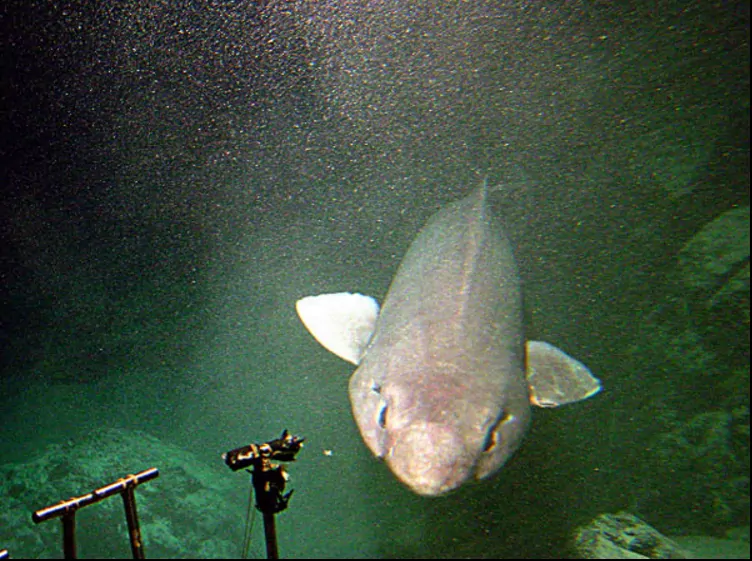
Scientists still know very little about this creature and it took almost 18 years to capture one on video. You may just be lucky to spot one in the waters around Greenland or spots in the North Atlantic near Iceland and the Arctic region. Other sightings include areas near the Gulf of Maine, and very rarely at the Gulf of Mexico or the Saguenay River in Quebec.
There is an old Inuit legend surrounding the urine-smelling flesh of this fish. It claims that an old woman washed her hair and rinsed it in urine before drying it off with a cloth. The cloth blew into the nearby ocean to become Skalugsuak, the first Greenland shark.
Updated 18 November 2026: updated the IUCN Red List status from Near Threatened to Vulnerable (assessed 2019). Source: IUCN Red List version 2025-2, as quoted by FishBase.
Got a shark photo of your own? Send it to us and we may post it here and on our Facebook page, with your name on it. Share your shark photo


Thank you for these interesting write-ups. This one in particular with all the mystery about these sharks.