Nervous Shark: The Small, Skittish Reef Shark of Northern Australia
10 min read
Last Updated on October 26, 2026 by Otis Mako

The nervous shark (Carcharhinus cautus) is a small, slender requiem shark of northern Australia, Papua New Guinea, and the Indo-West Pacific, named for its consistent habit of fleeing at any sign of disturbance. It grows to around 1.5 m, lives in shallow reef flats and mangrove estuaries, eats small fish and squid, and presents zero danger to humans. The IUCN lists it as Least Concern, and it is one of the more abundant small reef sharks in its range.
Key facts at a glance
| Common name | Nervous shark |
|---|---|
| Scientific name | Carcharhinus cautus |
| Family | Carcharhinidae (requiem sharks) |
| Order | Carcharhiniformes |
| Max length | Up to 1.5 m (4.9 ft) |
| Max weight | Up to 12 kg (26 lb) |
| Typical adult length | 1.0 to 1.2 m |
| Diet | Small bony fish, squid, octopus, shrimp, occasional sea snakes |
| Habitat | Shallow coastal reefs, mangrove estuaries, seagrass beds |
| Range | Northern Australia, Papua New Guinea, Solomon Islands, Indonesia |
| Depth | Surface to about 50 m, mostly less than 10 m |
| Lifespan | Around 12 to 15 years |
| IUCN status | Least Concern |
| Danger to humans | Zero recorded attacks. Harmless and shy. |
A naming note: The species name cautus is Latin for “cautious”, and that is the behavior that earned it the common name.
What a nervous shark looks like
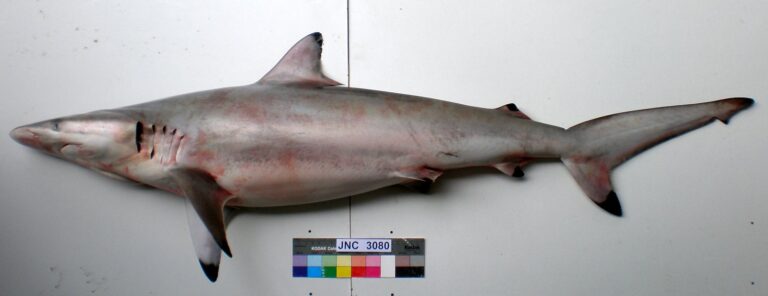
The nervous shark is a small, slim requiem shark with a moderately pointed snout, large oval eyes, and a body that is bronze-gray to brown above and white below. Its fins are tipped with subtle dusky-to-black edges, especially on the trailing edges of the pectoral, anal, and lower caudal lobes. The dorsal fins are unmarked, which separates it from the closely related blacktip reef shark whose first dorsal carries a prominent black tip.
The body shape is slender and the second dorsal fin is roughly half the height of the first, set well back near the tail. The teeth are small, serrated, and triangular in the upper jaw, with narrower lower teeth typical of small fish-eating requiem sharks. The total length of even a large adult rarely exceeds 1.5 m, and most adults are in the 1.0 to 1.2 m range.
How to identify a nervous shark
- Body color: Bronze-gray to brown above, white below.
- Fin tips: Subtle dusky to black trailing edges on pectorals, anal, and lower caudal. No black tip on the first dorsal.
- Snout: Moderately pointed.
- Eyes: Large and oval, well placed for the shallow, often turbid water it favors.
- Size: Slender, max 1.5 m, typical adult 1.0 to 1.2 m.
- Teeth: Small, triangular, serrated upper teeth typical of small requiem sharks.
Range and habitat
The nervous shark lives across the Indo-West Pacific, from northern Australia (Shark Bay west, north to the Northern Territory, east through the Great Barrier Reef) up to Papua New Guinea, the Solomon Islands, and across to Indonesia. It is a quintessential inshore species, sticking to shallow coastal reefs, sandy lagoons, mangrove estuaries, and seagrass beds. Most encounters occur in less than 10 m of water, although it has been recorded down to around 50 m.
Mangrove estuaries are particularly important to the species. Acoustic tracking studies in northern Australia have shown nervous sharks spending entire tidal cycles inside mangrove creek systems, using the rising tide to push deep into rooted areas where they pick off small fish and crustaceans, then retreating to the open mangrove edge on the falling tide. The species shares its habitat with juvenile bull sharks, lemon sharks, and pigeye sharks, all of which it consistently flees on sight.
Hotspots within the range
- Shark Bay, Western Australia: One of the best-studied populations. Researchers from Florida International University have tagged hundreds.
- Cleveland Bay, Queensland: Abundant in mangrove creeks around Townsville.
- Northern Territory, Australia: Common in the floodplain creeks of Kakadu and the Gulf of Carpentaria.
- Torres Strait, between Australia and Papua New Guinea: Frequent in the shallow seagrass and reef-flat zone.
- Bismarck Sea, Papua New Guinea: Less surveyed but well documented in subsistence fisheries.
Why “nervous”? The behavior behind the name
Anyone who has tried to dive with a nervous shark in its natural environment knows where the name comes from. The species flees consistently from boats, divers, snorkelers, and even shadows on the seabed. Researchers tagging nervous sharks in Shark Bay use light-grip handling techniques because the animals exhaust themselves quickly under stress. Acoustic-tag retrieval rates are unusually low for the species, since tagged sharks often abandon a favored creek for weeks after a single handling event.
This consistent timidity is thought to be an evolved response to predation. Nervous sharks share their range with much larger predators including tiger sharks, bull sharks, and saltwater crocodiles. A small, slow-growing requiem shark that delays in shallow water without an escape route does not survive long enough to breed. Selection for hair-trigger flight response has favored the cautious end of the personality distribution. The species name cautus reflects exactly this.
Diet and hunting
Nervous sharks are small-prey specialists. Stomach content analyses from northern Australian populations show small bony fish (mullet, hardyheads, herring, gobies, juvenile snapper) making up the bulk of the diet by mass, with cephalopods (especially small squid and inshore octopus) a strong second and crustaceans (shrimp, small crabs) third. Sea snakes appear in occasional stomachs, and the species is one of the few sharks regularly recorded eating sea snakes in northern Australia.
Hunting is opportunistic and visual. Nervous sharks cruise mangrove creek banks at high tide, ambush small fish at the edges of seagrass meadows, and follow tide-driven shrimp pulses out of mangroves into open lagoons. They have not been recorded participating in the cooperative feeding seen in some other small reef sharks, and they do not appear to compete strongly for resources with larger sharks because the diet overlap is limited.
Typical nervous shark prey
- Small bony fish: mullet, hardyheads, herring, gobies, juvenile snapper
- Squid and small octopus
- Shrimp and small crabs
- Sea snakes (occasionally, when an opportunity presents)
- Juvenile rays (rarely)
Reproduction and growth
Nervous sharks are viviparous with a placental connection, meaning the developing embryos feed through a placenta-like yolk sac, similar to most other requiem sharks. Gestation lasts about 10 months. Litter size is small: 1 to 6 pups per litter, with 3 to 5 the typical range. Newborn pups are 35 to 40 cm long. Reproduction takes place on a 1 to 2 year cycle, so the species’ total reproductive output across a 12 to 15 year lifespan is modest.
Females mature at around 6 to 7 years and around 90 cm in length. Males mature slightly earlier, at around 5 to 6 years and 85 cm. Pups born in mangrove creek nurseries stay close to their natal estuary for the first 2 to 3 years, before moving to nearby reefs as subadults. The combination of small litters, slow growth, and habitat dependence makes the species potentially vulnerable to estuarine habitat loss, although current populations are healthy enough that the IUCN considers it Least Concern.
Are nervous sharks dangerous to humans?
No. There are zero recorded unprovoked attacks attributed to the nervous shark in the Florida Museum’s International Shark Attack File, nor in any regional Australian record. The species is small, small-toothed, small-mouthed, and so consistently shy of human presence that even researchers handling it in tagging programs find it difficult to keep on the boat without elaborate handling procedures.
Snorkelers and divers who get a glimpse of a nervous shark typically see a slim gray shape moving fast in the opposite direction. The species is small enough to be a meal for many of the larger sharks and crocodiles in its range, and its evolved response to any large moving silhouette is flight. For context on shark danger overall, see our pages on shark attack videos and statistics and the closely related sandbar shark species profile.
Conservation status and threats
The IUCN lists the nervous shark as Least Concern. The species is caught as bycatch in northern Australian gillnet and longline fisheries targeting larger sharks and bony fish, but the catch volumes are low enough that no clear population decline has been documented. Australian fisheries management (Australian Fisheries Management Authority and state-level agencies) monitor catches under shark-action plans, and nervous shark take is reported through the small-shark category.
The main long-term threat is mangrove habitat loss across northern Australia and Papua New Guinea. Mangrove deforestation for prawn aquaculture, palm oil expansion, and coastal development reduces nursery habitat for many small inshore sharks, nervous sharks included. The species is also a frequent bycatch in Indonesian small-scale gillnet fisheries, where reporting is poor. Should regional pressure increase, the species’ slow reproductive output would limit how fast it could recover.
What helps the species
- Mangrove protection and restoration in northern Australia, Papua New Guinea, and Indonesia
- Bycatch reduction in inshore gillnet and longline fisheries
- Continued observer programs on commercial inshore fisheries
- Marine park designations that include mangrove creek systems (not just reefs)
- Sustainable prawn aquaculture standards that avoid mangrove clearing
Nervous sharks vs other small requiem sharks
Several small requiem sharks share the nervous shark’s range and are easily confused with it. Knowing the differences matters for identification, fisheries reporting, and dive logging.
- vs blacktip reef shark (Carcharhinus melanopterus): The blacktip reef shark has a prominent black tip on the first dorsal fin. The nervous shark does not.
- vs spot-tail shark (Carcharhinus sorrah): Spot-tail has a distinct black blotch at the tip of the lower caudal lobe and on the second dorsal. Nervous shark has only dusky trailing edges.
- vs Australian sharpnose shark (Rhizoprionodon taylori): The Australian sharpnose is even smaller (max 0.7 m), with a much more pointed snout.
- vs juvenile bull shark: Bull shark juveniles in the same nursery habitats have a much stockier body, blunter snout, and grow much larger.
- vs Caribbean reef shark: The nervous shark (Carcharhinus cautus) is not found in the Caribbean. The Caribbean reef shark (Carcharhinus perezii) is a different, larger species.
Where to see nervous sharks
Nervous sharks are notoriously hard to observe deliberately. The species’ defining trait, after all, is fleeing on sight. The best chances for a sighting are shallow snorkel trips over seagrass and reef flats in northern Australia, particularly in protected zones around Ningaloo Reef, the Dampier Archipelago, and the eastern Great Barrier Reef inner reef. Going at slack tide in flat water, drifting silently with a kayak or paddleboard, and avoiding outboard noise all improve odds.
Some researchers and dive operators occasionally see them on regular reef-flat dives in the Top End of the Northern Territory. Mangrove creek kayak tours around Cape York and Cairns occasionally produce sightings, although the timid sharks rarely linger. For a more reliable small-shark encounter, the related whitespotted bamboo shark is more cooperative.
Related species and further reading
- Sandbar shark species profile
- Whitespotted bamboo shark
- Leopard shark species profile
- Tasselled wobbegong
- Shark tagging: understanding the risks involved
If small reef sharks have caught your interest, the store stocks identification field guides and richer species reference titles at shark books, plus a friendly children’s range of shark toys covering the most commonly encountered reef species.
What is a nervous shark?
The nervous shark (Carcharhinus cautus) is a small slender requiem shark of the Indo-West Pacific, growing to around 1.5 m and named for its hair-trigger flight response. It lives in shallow coastal reefs, mangrove estuaries, and seagrass beds across northern Australia, Papua New Guinea, the Solomon Islands, and parts of Indonesia. It eats small bony fish, squid, octopus, shrimp, and occasionally sea snakes, presents zero danger to humans, and is listed by the IUCN as Least Concern. The species name cautus means “cautious” in Latin, and the behavior earned both the scientific name and the common name.
Why is it called a nervous shark?
The nervous shark consistently flees at any sign of disturbance: boats, divers, kayaks, even shadows on the seabed. Researchers tagging the species in Shark Bay, Western Australia use light-grip handling techniques because the animals exhaust themselves quickly under stress. Acoustic-tag retrieval rates are unusually low because tagged sharks often abandon a creek for weeks after one handling event. The behavior is thought to be an evolved response to predation: nervous sharks share their range with tiger sharks, bull sharks, and saltwater crocodiles, and only the most reflexively cautious individuals survive to breed.
Are nervous sharks dangerous to humans?
No. There are zero recorded unprovoked attacks attributed to the nervous shark anywhere in the world. The species is too small (max 1.5 m), has small teeth and a small mouth, and is so timid around humans that even researchers find it difficult to handle. Most divers who spot one see a slim gray shape moving rapidly in the opposite direction. The species is several rungs down the food chain from the apex predators in its range, and evolution has tuned it for flight from any large moving silhouette.
Where do nervous sharks live?
Nervous sharks live across the Indo-West Pacific. The core range is northern Australia, from Shark Bay in Western Australia, north through the Northern Territory, east through the Great Barrier Reef. They are also found in Papua New Guinea, the Solomon Islands, Indonesia, and the Torres Strait. The species sticks to shallow inshore water: coastal reefs, sandy lagoons, mangrove estuaries, and seagrass beds. Most encounters occur in less than 10 m of water. Mangrove creek systems are particularly important nursery habitat for the species.
What do nervous sharks eat?
Nervous sharks are small-prey specialists. Stomach content analyses show small bony fish (mullet, hardyheads, herring, gobies, juvenile snapper) make up the bulk of the diet, with squid and small octopus a strong second, and shrimp and small crabs third. Sea snakes appear in occasional stomachs, and the species is one of the few small sharks known to eat sea snakes regularly in northern Australia. Hunting is opportunistic and visual, often ambushing small fish at the edges of mangrove creeks and seagrass beds.
How big do nervous sharks get?
The maximum recorded length for a nervous shark is around 1.5 m (4.9 ft) and about 12 kg in weight. Most adults are smaller, in the 1.0 to 1.2 m range. Newborn pups are 35 to 40 cm long at birth. Females mature at around 6 to 7 years and 90 cm. Males mature slightly earlier, at 5 to 6 years and 85 cm. Lifespan is around 12 to 15 years in the wild. The species’ slow growth and small litters (1 to 6 pups every 1 to 2 years) make population recovery slow if it ever becomes overfished.
Are nervous sharks endangered?
No. The IUCN currently lists the nervous shark as Least Concern. The species is caught as bycatch in northern Australian gillnet and longline fisheries and in Indonesian small-scale gillnets, but catch volumes are low enough that no clear population decline has been documented. Australian fisheries management agencies monitor it under shark-action plans. The biggest long-term threat is mangrove habitat loss across northern Australia, Papua New Guinea, and Indonesia, since the species depends on mangrove creeks as nursery habitat.
How do you tell a nervous shark from a blacktip reef shark?
The simplest test is the first dorsal fin. The blacktip reef shark (Carcharhinus melanopterus) has a prominent, unmistakable black tip on the first dorsal fin, visible even from above the water. The nervous shark (Carcharhinus cautus) has at most dusky trailing edges on the pectoral, anal, and lower caudal fins, with no black marking on the first dorsal. Body shape is also a clue: nervous sharks are slimmer, with a slightly more pointed snout. Both species share parts of their range in northern Australia and Papua New Guinea.
By Carey Baird. Last updated 14 May 2026. Estimated reading time: 9 minutes.
Got a shark photo of your own? Send it to us and we may post it here and on our Facebook page, with your name on it. Share your shark photo