
Lemon Shark Profile: Facts, Diet, Habitat & Complete Guide
10 min read
Last Updated on May 14, 2026 by Otis Mako
Part of our guide: The Complete Shark Species Reference.
The lemon shark (Negaprion brevirostris) is a coastal predator famous for its yellow-brown skin, calm temperament around divers, social behavior, and a burst swimming speed of around 25 km/h (15 mph). It is one of the best-studied sharks in the world thanks to long-term research at the Bimini Biological Field Station in the Bahamas, where individual lemon sharks have been tracked across multiple generations.
Key facts at a glance
| Common name | Lemon shark |
|---|---|
| Scientific name | Negaprion brevirostris |
| Family | Carcharhinidae (requiem sharks) |
| Max length | Up to 3.4 m (11.2 ft) |
| Max weight | Up to 184 kg (405 lb) |
| Burst speed | Around 25 km/h (15 mph) |
| Lifespan | 25 to 30 years |
| Diet | Bony fish (mullet, jacks, catfish), crustaceans, smaller sharks, rays, seabirds |
| Habitat | Coastal Atlantic and eastern Pacific, mangrove estuaries, coral reefs, sandy flats |
| IUCN status | Vulnerable, population decreasing |
| Unprovoked attacks (ISAF, all-time) | 10, with 0 fatalities |
How fast is a lemon shark?
Lemon sharks have a measured burst swimming speed of roughly 25 km/h (15 mph), with a comfortable cruising speed of 2 to 4 km/h. They are not built for sustained high-speed chases like the mako or thresher. They are coastal ambush hunters, so the relevant speed is the burst from a standstill onto a startled fish. Lab studies at the Bimini Biological Field Station have measured strike-acceleration in adult lemon sharks at around 8 m/s squared, faster than a typical luxury sedan from a standstill.
For context, the white shark tops out around 56 km/h, the shortfin mako around 75 km/h, and the blue shark around 39 km/h. Lemon sharks are mid-pack for coastal sharks: faster than the slow nurse shark (12 km/h), about the same as the bull shark (around 25 km/h), and slower than open-ocean species. Their speed is enough for what they do: catch mullet, jacks, and catfish in shallow water.
Identification: how to recognize a lemon shark
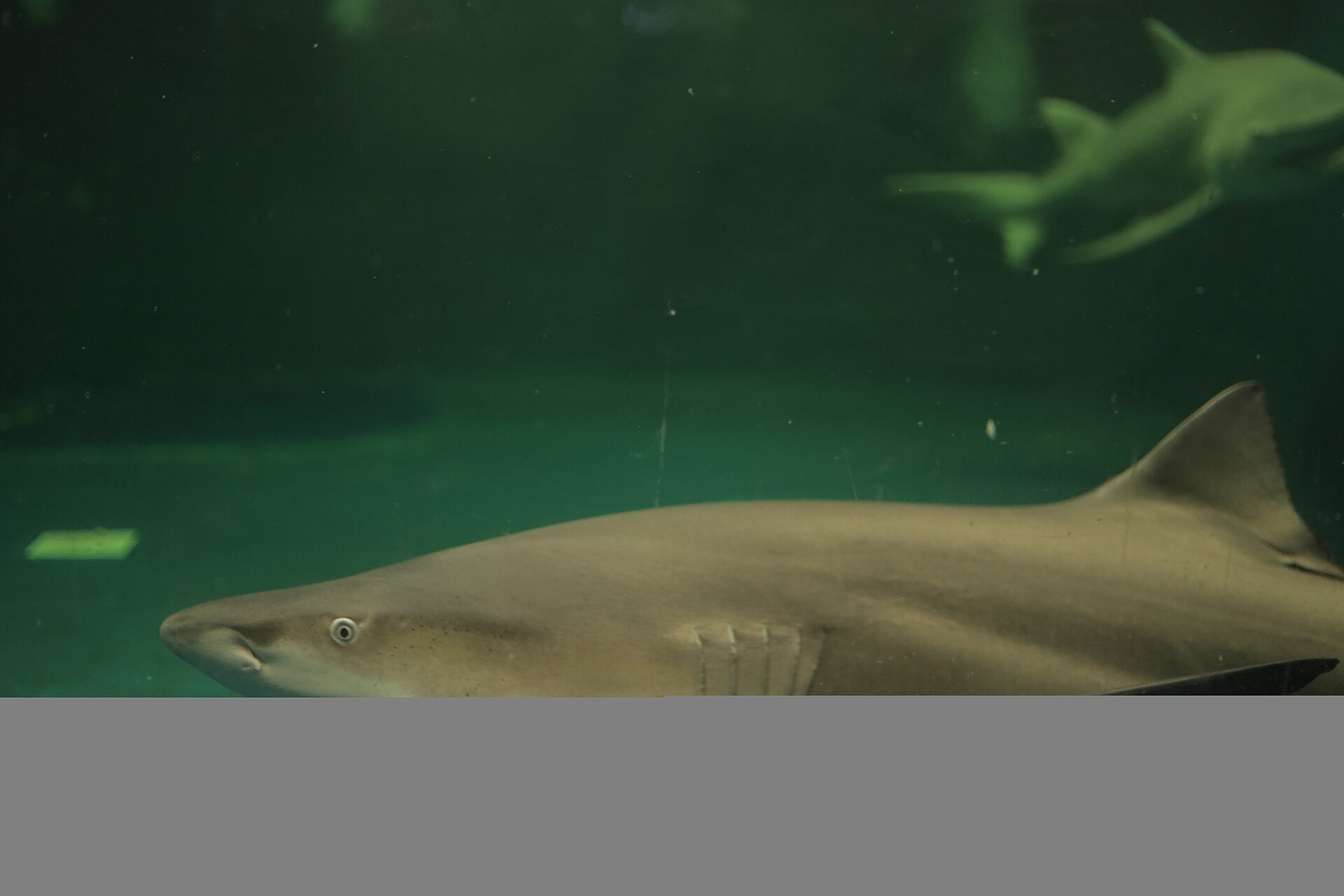
Lemon sharks are easy to identify once you have seen one. They have a distinctive yellow-brown coloration on the upper body that fades to off-white below. The name comes from this color, which functions as camouflage over the sandy bottoms and mangrove roots they typically hunt around. They have a short, blunt snout, a relatively flat head, and two dorsal fins that are almost the same size, which is a key field mark separating them from most requiem sharks (which have a much smaller second dorsal).
Field marks
- Yellow-brown back fading to pale belly (the source of the name)
- Short, broad, blunt snout
- Two dorsal fins almost equal in size (key feature)
- Stocky, medium-large build
- Eyes positioned high on the head, giving an upward-looking field of view
- No distinctive stripes, spots, or markings
The two equally-sized dorsal fins are the easiest distinguishing trait. Most requiem sharks (bull, blacktip, tiger, dusky) have a dramatic difference in size between the two dorsals. Lemon sharks, sicklefin lemon sharks (the Pacific cousin), and a few other Negaprion-genus sharks share the trait.
Range and habitat
Lemon sharks live in two main regions: the western Atlantic from New Jersey through Florida, the Gulf of Mexico, and the Caribbean down to southern Brazil, and the eastern Pacific from Baja California to Ecuador. A close relative, the sicklefin lemon shark (Negaprion acutidens), occupies the Indo-Pacific from East Africa to French Polynesia, sometimes treated as a separate species and sometimes as a regional variant.
Within their range, lemon sharks prefer:
- Mangrove estuaries: the classic lemon shark nursery, with newborn pups spending 2 to 3 years among mangrove roots
- Sandy flats and seagrass beds: the typical adult hunting ground in places like Bimini and the Florida Keys
- Coral reefs: especially around the edges where reef meets sand, common in the Bahamas and Belize
- Inshore continental shelf waters: rarely deeper than 90 m
Lemon sharks are surprisingly site-faithful. Long-term tagging at the Bimini Biological Field Station has shown that adult female lemon sharks return to the same Bimini mangrove channel to give birth, often the same channel where they themselves were born 15 to 20 years earlier. This natal homing behavior is rare among sharks and is one of the reasons lemon sharks are so vulnerable to habitat loss: if a nursery mangrove is destroyed, an entire matrilineal line loses its breeding site.
Diet and hunting
Lemon sharks are coastal ambush hunters. They cruise sandy flats and mangrove channels, using high-positioned eyes and excellent low-light vision to spot prey above. Their diet is dominated by:
- Bony fish: mullet, jacks, mojarra, snappers, grunts, ladyfish, catfish, sea trout
- Stingrays and skates
- Crustaceans: crabs, lobsters, shrimp
- Smaller sharks: occasionally juvenile bonnetheads and Atlantic sharpnose
- Squid and octopus
- Seabirds: cormorants and pelicans resting on the surface
Their teeth tell the story. Lemon sharks have narrow, smooth-edged, dagger-like teeth that are good for grabbing slippery fish and holding on, rather than the serrated cutting blades of a great white. They feed at dawn and dusk primarily, with peak activity in the hour just before sunrise.
Juvenile lemon sharks in mangrove nurseries focus on small fish, shrimp, and crabs. They are themselves prey for larger sharks (including adult lemon sharks, bull sharks, and great hammerheads), which is part of why mangrove roots are such valuable habitat. The dense root structure keeps big predators out.
Reproduction and lifecycle
Lemon sharks are viviparous (live-bearing with a placental connection). Mating happens in spring, gestation runs 10 to 12 months, and females give birth to litters of 4 to 17 pups in shallow mangrove channels in late spring or early summer. Pups are around 60 to 65 cm long at birth, with a long, thin body and a high mortality rate in the first year (up to 50 percent due to predation).
Pups stay in the mangrove nursery for 2 to 3 years, then move to nearby seagrass flats for another 5 to 10 years before joining the adult reef population. Sexual maturity comes at around 11 to 13 years for males and 12 to 14 for females. The long juvenile period and natal homing are why Bimini researchers have been able to track the same individuals from birth into adulthood across the longest continuous shark study in history (since 1995).
Behavior and social life
Lemon sharks are unusually social for a large predator. Juveniles in mangrove nurseries form stable cohorts that remain together for years. A 2009 study by Jean-Sebastien Finger and colleagues at the Bimini Biological Field Station found that lemon shark juveniles preferentially associated with familiar individuals over strangers, a form of social recognition more commonly associated with mammals and birds than sharks.
Adults also form loose social groups around shared feeding areas, though they are less tightly bound than the juvenile cohorts. Researchers have documented dominance hierarchies in captive lemon shark groups, with larger individuals taking first feeding opportunities at bait stations. This is more nuanced behavior than the typical “lone hunter” stereotype of large sharks.
Around divers
Lemon sharks are reliably tolerant of divers. At baited shark dives like those at Tiger Beach (Bahamas) and Jupiter (Florida), lemon sharks are often the first to approach and the last to leave. They are not aggressive, but they are bold. They will swim within a meter of a diver, hold eye contact, and circle slowly. This makes them a favorite for shark dive photographers and a regular subject of underwater documentaries.
Are lemon sharks dangerous to humans?
Rarely. The International Shark Attack File records just 10 unprovoked attacks attributed to lemon sharks, with 0 fatalities. Most attacks have been minor exploratory bites, often on swimmers in shallow water who appeared and disappeared rapidly (a movement pattern that triggers a shark's curiosity bite). For context, lemon sharks are about as dangerous as bonnetheads (also 0 fatalities) and far less dangerous than bull, tiger, or white sharks.
This is part of why lemon sharks have become the workhorse species for shark scientists studying behavior and physiology. They are easy to catch, they tolerate captivity better than most large sharks, and they survive tagging and release at very high rates, all of which makes them ethical research subjects.
Conservation status and threats
The IUCN Red List classifies the lemon shark as Vulnerable, with a decreasing global population. Threats include:
- Commercial fisheries for meat, fins, and skin (lemon shark hide is valued for leather)
- Recreational fishing, especially in the southeastern US, where lemon sharks were a major target through the 1990s
- Mangrove habitat loss from coastal development (the single biggest threat to populations dependent on mangrove nurseries)
- Bycatch in coastal longlines and gillnets
Lemon sharks have benefited from several conservation wins. Florida banned all commercial harvest of lemon sharks in 2010 after sustained advocacy from the recreational dive industry. The Bahamas became a full shark sanctuary in 2011. South Florida mangrove restoration projects, particularly in Biscayne Bay and Florida Bay, have helped re-establish nursery habitat that was lost in the mid-20th century.
Surprising lemon shark facts
- Lemon sharks have demonstrated the ability to learn and remember tasks, scoring well in classical-conditioning experiments that other shark species fail. They can be trained to recognize visual cues and food rewards over weeks.
- Bimini lemon sharks have been documented giving birth in the same 100 m stretch of mangrove channel where their mothers and grandmothers gave birth before them.
- Researchers at the Bimini field station have given names to every lemon shark in the area for over 25 years, so the long-term population dataset includes complete life histories for hundreds of individuals.
- Lemon sharks have a faster swimming style than most coastal sharks: they sweep their tail in shorter, sharper strokes rather than the long sinusoidal sweeps of a bull or sandbar shark.
- The yellow-brown color is a real pigment, not a trick of light. Bottom samples of lemon shark skin retain the yellow tone, similar to a chameleon's base color.
Where to dive with lemon sharks
The best places in the world to dive with lemon sharks are Tiger Beach in the Bahamas (November to April, alongside tiger sharks), Jupiter, Florida (year-round, with a winter peak), and Moorea in French Polynesia for the Pacific sicklefin lemon shark. These are all baited dives that allow close encounters with lemon sharks at very low risk.
If you are not diving, juvenile lemon sharks can be spotted by snorkelers in shallow mangrove channels in the Bahamas, the Florida Keys, and Belize. The Bimini Shark Lab runs occasional public tours where visitors can see juvenile lemon sharks tagged and released as part of the long-term research program.
Related species and further reading
- Hammerhead shark species profile
- Bull shark species profile
- Bigeye thresher shark
- Whitespotted bamboo shark
- How shark tagging works
For kids who love sharks, our children's shark toys selection includes lemon shark plushies and figures with accurate coloration. For adult readers wanting to go deep on lemon shark research, the shark books section has the leading academic and popular titles.
Frequently asked questions
How fast is a lemon shark?
Lemon sharks have a burst swimming speed of around 25 km/h (15 mph), with a relaxed cruising speed of 2 to 4 km/h. They are not built for long high-speed chases. They are coastal ambush hunters, and the relevant speed is the explosive burst from a standstill onto a startled fish. Lab studies have measured strike acceleration at around 8 m/s squared, comparable to a luxury sedan from a standstill. For context: the white shark tops out at around 56 km/h, the shortfin mako at 75 km/h, the blue shark at 39 km/h, and the nurse shark at just 12 km/h. The lemon shark sits in the mid-range, well-matched to its prey of mullet, jacks, and catfish in shallow tropical water.
How big does a lemon shark get?
Adult lemon sharks reach 2.4 to 3.0 m (8 to 10 ft) on average, with the largest reliably measured individuals at 3.4 m (11.2 ft) and around 184 kg (405 lb). Females are slightly larger than males. They grow slowly, reaching sexual maturity at 11 to 14 years old, and live 25 to 30 years in the wild. This slow growth and late maturation is why lemon shark populations recover slowly from heavy fishing pressure and why the species is classified as Vulnerable by the IUCN.
What do lemon sharks eat?
Lemon sharks are coastal ambush hunters. Their diet is dominated by bony fish (mullet, jacks, mojarra, snappers, catfish, ladyfish), stingrays, crustaceans (crabs, lobsters, shrimp), squid and octopus, and occasionally seabirds resting on the surface. Their narrow, smooth-edged dagger-like teeth are good for grabbing slippery fish, very different from the serrated cutting blades of a great white. They hunt at dawn and dusk, with peak activity in the hour just before sunrise. Juveniles in mangrove nurseries focus on small fish, shrimp, and crabs, while adults take larger prey from sandy flats and seagrass beds.
Are lemon sharks dangerous to humans?
Rarely. The Florida Museum International Shark Attack File records just 10 unprovoked attacks attributed to lemon sharks across all of recorded history, with 0 fatalities. Most have been minor exploratory bites on swimmers moving erratically in shallow water. Lemon sharks are bold around divers but not aggressive, which is why they are a favorite of shark dive photographers and the most-studied shark in scientific research. They are about as dangerous as bonnetheads (also 0 fatalities) and far less dangerous than bull, tiger, or white sharks.
Why are they called lemon sharks?
The name comes from the distinctive yellow-brown color of their upper body, which fades to off-white below. The color is a real pigment, not an artifact of light or reflection. It functions as camouflage over the sandy bottoms and mangrove roots they typically hunt around. Bottom samples of lemon shark skin retain the yellow tone in dead specimens, confirming that the color is biological. The Pacific sicklefin lemon shark shares the same coloration. Most other requiem sharks are grey or brown, so the yellow tone makes lemon sharks immediately distinguishable underwater.
Where do lemon sharks live?
Lemon sharks live in two main regions. The western Atlantic from New Jersey south through Florida, the Gulf of Mexico, and the Caribbean down to southern Brazil. And the eastern Pacific from Baja California to Ecuador. Within those ranges they prefer mangrove estuaries (where pups are born and stay for 2 to 3 years), sandy flats and seagrass beds (typical adult hunting grounds), and coral reefs (especially the sand-to-reef interface). A close relative, the sicklefin lemon shark (Negaprion acutidens), occupies the Indo-Pacific from East Africa to French Polynesia, sometimes treated as a separate species. Lemon sharks rarely venture deeper than 90 m.
Are lemon sharks endangered?
The IUCN Red List classifies the lemon shark as Vulnerable, with a decreasing global population. Threats include commercial fishing for meat, fins, and skin (lemon shark hide is prized for leather), recreational fishing in the southeastern US (banned in Florida since 2010), bycatch in coastal longlines and gillnets, and mangrove habitat loss from coastal development. The Bahamas became a full shark sanctuary in 2011, protecting Bimini's famous lemon shark population. Florida banned commercial harvest in 2010. Mangrove restoration projects in Biscayne Bay and Florida Bay are recovering nursery habitat lost in the mid-20th century.
Why are lemon sharks the most-studied shark species?
Three reasons. First, they survive capture and tagging at very high rates, so researchers can mark and release them ethically. Second, they tolerate captivity better than most large sharks, which allows controlled experiments on behavior, learning, and physiology. Third, they exhibit unusual site fidelity: females return to the same Bimini mangrove channel to give birth, often the same channel where they themselves were born. This makes long-term tracking possible. The Bimini Biological Field Station has tracked the same individual lemon sharks across multiple generations since 1995, the longest continuous shark study in scientific history.
Got a shark photo of your own? Send it to us and we may post it here and on our Facebook page, with your name on it. Share your shark photo



Do the juveniles really stay in the same mangrove patch for two or three years? I’d have guessed they would scatter as soon as they could outswim the bigger sharks.
From what I’ve read, yes. The roots keep the big predators out, so staying put is the safer bet until they are large enough to move out to the seagrass flats.
snorkeled a mangrove channel in the Keys with my daughter and we spotted two little yellowish sharks near the roots. no idea at the time they might have been lemons. how close to shore do the pups usually stay?
Very close. The pups keep to shallow channels right among the roots, often in water you could stand in, so it sounds like you may well have seen a pair of juveniles.
I always assumed the name had something to do with the shape of the head. An actual yellow pigment makes more sense, although most underwater photos make them look grey to me.