
Hammerheads, Whale Sharks, and the Galapagos: A Diver’s Guide
3 min read
Last Updated on November 18, 2026 by Otis Mako
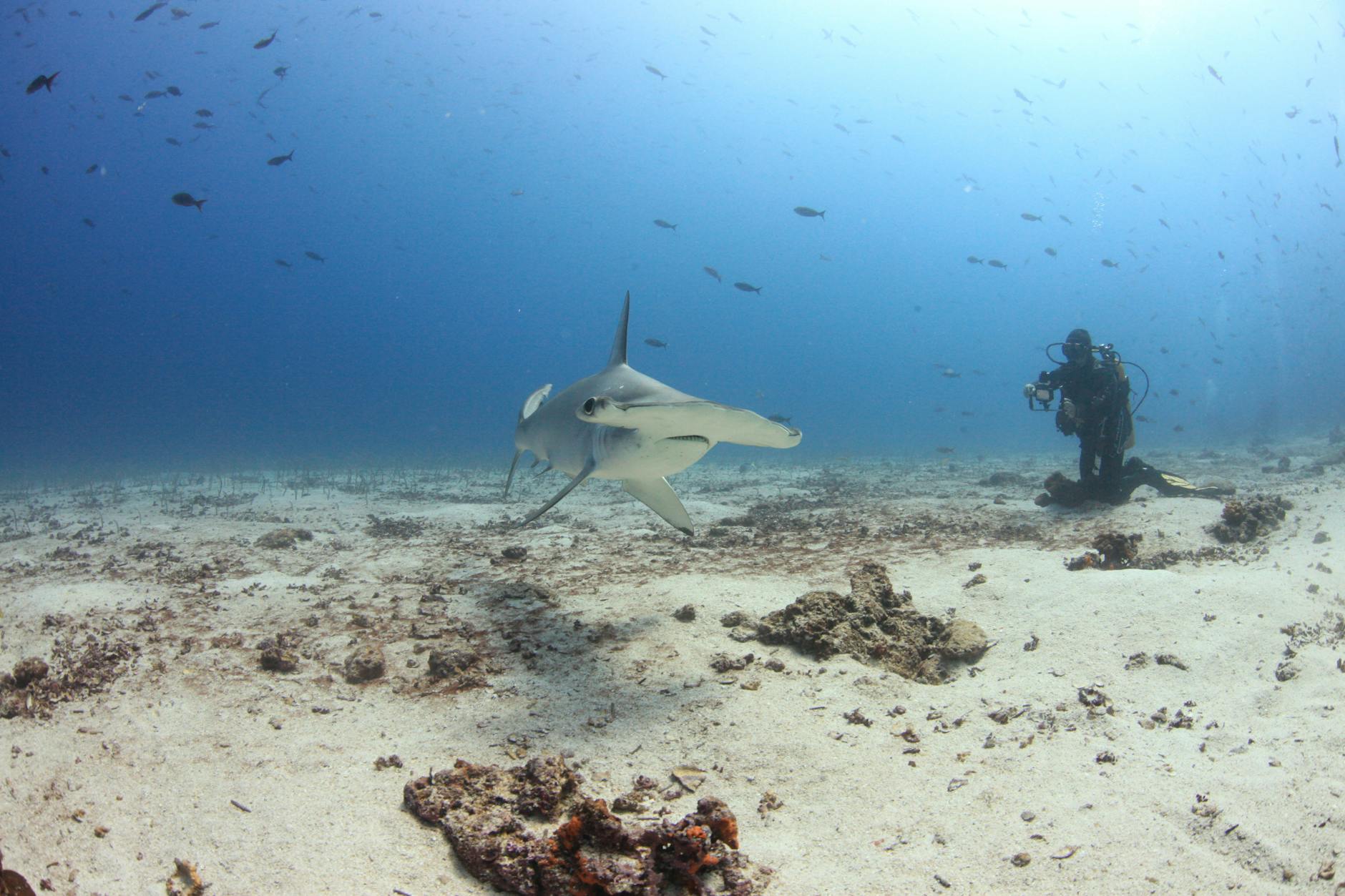
The Galapagos Islands sit at the convergence of three ocean currents and host one of the densest shark biomass concentrations on Earth, with adult female whale sharks at Darwin Island, schooling hammerheads at Wolf, and resident Galapagos sharks across the archipelago.
Part of our complete Shark Species Guide.
Common shark species you might encounter
Species commonly recorded or sighted in the region:
- Scalloped hammerhead (Sphyrna lewini) Wolf and Darwin Islands hold one of the world’s most reliable schooling hammerhead aggregations. IUCN: Critically Endangered.
- Galapagos shark (Carcharhinus galapagensis) Named for the archipelago; large requiem shark common at all major dive sites. IUCN: Least Concern.
- Whale shark (Rhincodon typus) Adult females (often pregnant, around 12 m) pass Darwin Island June to November; the only known site in the world dominated by adult whale sharks. IUCN: Endangered.
- Silky shark (Carcharhinus falciformis) Pelagic; common at Wolf and Darwin. IUCN: Vulnerable.
- Whitetip reef shark (Triaenodon obesus) Resident on most reef dives in the central archipelago. IUCN: Vulnerable.
- Tiger shark (Galeocerdo cuvier) Occasional at Darwin and Wolf. IUCN: Near Threatened.
- Blacktip shark (Carcharhinus limbatus) Coastal in the central islands. IUCN: Vulnerable.
- Horn shark (Heterodontus quoyi) Endemic Galapagos species; rare bottom shark. IUCN: Least Concern (2020 assessment).
Attack frequency and statistics
Recorded unprovoked attacks at the Galapagos are essentially zero. The archipelago is a strictly managed marine reserve and the tourism model is dive boat liveaboards rather than swim beaches, which keeps human-shark contact controlled.
Best beaches and dive sites for spotting sharks safely
Notable sites:
- Darwin Island: the world’s most reliable site for adult whale sharks, June to November.
- Wolf Island: schooling scalloped hammerheads, Galapagos sharks, silky sharks; one of the world’s premier big-fish liveaboard dives.
- Cousins Rock: the central archipelago reef dive with whitetip reef sharks, eagle rays, and turtles.
- Punta Vicente Roca: mola mola and reef sharks in cold upwelling water.
- Gordon Rocks: the channel and pinnacle dive accessible from Santa Cruz day boats; reliable hammerhead sightings.
Seasonal patterns
Adult whale sharks at Darwin run June to November (peak August to October), during the cold Humboldt Current season. Hammerhead schools at Wolf are present year round but visibility is better in the warm season (December to May). Galapagos sharks are resident year round.
Conservation status and regional organisations
The Galapagos Marine Reserve, established in 1998, covers 138,000 square km and is one of the largest fully protected areas on Earth. The 2022 expansion (the Hermandad Marine Reserve) added 60,000 square km specifically to protect the migration corridor between Galapagos and Cocos Island used by sharks and rays. The Charles Darwin Research Station runs continuous shark research.
How to stay safe
Galapagos diving is advanced; Wolf and Darwin involve strong current, hooks, and deep water. Liveaboards run strict safety protocols. The shark species present are not aggressive to divers under normal conditions; respect distance and never chase animals.
Frequently asked questions
Where can I see whale sharks in the Galapagos?
Darwin Island is the world’s most reliable site for adult whale sharks. From June to November, large (around 12 m) females, most believed to be pregnant, pass the dive site. The Galapagos Whale Shark Project has tagged dozens of individuals and is rebuilding what we know about the species.
Are there great white sharks in the Galapagos?
No confirmed records. The Galapagos sits in too warm a water column for great whites year round, and the shark fauna at the apex is dominated by Galapagos sharks, hammerheads, and tigers instead.
Why are there so many sharks at the Galapagos?
The Galapagos sits at the convergence of three major ocean currents: the warm Panama Current, the cold Humboldt Current, and the Cromwell Undercurrent. This creates massive nutrient upwelling that fuels a food web from plankton up to apex sharks. The 1998 marine reserve and 2022 expansion further protect that food web.
What is the Hermandad Marine Reserve?
The Hermandad Marine Reserve, declared by Ecuador in 2022, added 60,000 square km of protected ocean north of the existing Galapagos Marine Reserve. It was specifically designed to protect the migration corridor between Galapagos and Cocos Island in Costa Rica, used by hammerhead sharks, whale sharks, and sea turtles.
Is the Galapagos safe for diving?
Yes, when done with an experienced liveaboard. Wolf and Darwin Islands involve strong current and deep water, so the sites are best for advanced divers. Resident shark species do not pose unusual risk under normal protocols.
How many shark species live in the Galapagos?
Around 35 shark species have been documented in Galapagos waters. The most commonly encountered are scalloped hammerhead, Galapagos shark, silky shark, whitetip reef, and whale shark. The remaining species include rare deep-water and endemic forms like the Galapagos horn shark.
For more on species mentioned here, see our complete shark species guide. For attack statistics worldwide, see our shark attacks pillar, and for what is being done to protect these animals, our shark conservation hub.
By Otis Mako. Last updated 18 November 2026.
Updated 18 November 2026: updated the Galapagos bullhead shark from Data Deficient to Least Concern (assessed 2020). Source: IUCN Red List version 2025-2, as quoted by FishBase.
Got a shark photo of your own? Send it to us and we may post it here and on our Facebook page, with your name on it. Share your shark photo

Are the hammerhead schools at Wolf still as reliable as they were a few years ago? I’ve read mixed reports from people who went recently.
We had one good hammerhead dive at Wolf out of four on a liveaboard last year. The current was brutal though, so maybe that was us more than the sharks.
Is Darwin really the only place where you mostly see adult whale sharks? Everywhere else I’ve read about seems to be the younger ones.