
Manta Ray: Sharks’ Wide-Winged Filter-Feeding Cousins
6 min read
Last Updated on May 14, 2026 by Otis Mako
Manta rays are the biggest rays in the ocean, filter-feeding cartilaginous relatives of sharks with wingspans up to 7 m, complex social behaviour, and conservation status of Vulnerable (reef) to Endangered (oceanic). Manta rays are the wing-spanned giants of the ray world and close relatives of sharks (both are cartilaginous fish, class Chondrichthyes). The two species (reef manta Mobula alfredi, oceanic manta Mobula birostris) reach 5 to 7 m across, filter feed plankton, and visit cleaning stations like reef fish go to a barber shop.
Part of our guide: Shark Species.
Key facts at a glance
| Scientific names | Mobula alfredi (reef), Mobula birostris (oceanic) |
|---|---|
| Family | Mobulidae |
| Class | Chondrichthyes (cartilaginous, like sharks) |
| Wingspan | Reef up to 5.5 m, oceanic up to 7 m |
| Max weight | Around 3,000 kg for oceanic manta |
| Diet | Plankton, krill, fish eggs, small fish |
| Habitat | Tropical and warm temperate seas worldwide |
| Lifespan | Around 40 to 50 years |
| IUCN status (reef) | Vulnerable |
| IUCN status (oceanic) | Endangered |
| Brain size | Largest brain-to-body ratio of any fish |
Why a manta ray is a shark cousin
Mantas and sharks both belong to the class Chondrichthyes, the cartilaginous fish. They share the same skeletal material (cartilage rather than bone), the same skin (covered in tiny tooth-like denticles), and the same broad reproductive strategy (live birth from a small number of large pups). Rays diverged from sharks around 250 million years ago, evolving the flattened body and enlarged pectoral fins that became their hallmark.
Within rays, the manta family Mobulidae is one of the most recently evolved groups, reaching its modern body plan only around 25 million years ago. The ancestors were small benthic rays that became plankton feeders, lost the stinging tail spine (modern mantas still have a slim tail with no spine), and grew vastly larger over time.
Two species, two lifestyles
The reef manta (Mobula alfredi) is the smaller, more sociable species. Wingspan up to 5.5 m, often resident at a single set of cleaning stations and feeding grounds for years. Famous reef manta sites include Hanifaru Bay in the Maldives, Lady Elliot Island on the Great Barrier Reef, and Yap in Micronesia. Resident reef mantas can be photo-identified by their belly spot patterns, and several long term programmes (Manta Trust, MantaMatcher) track tens of thousands of individuals.
The oceanic manta (Mobula birostris) is bigger, more migratory, and more solitary. Wingspan up to 7 m and weights of 3 tonnes. Less studied because they range across whole ocean basins, often hundreds of kilometres in a week. Oceanic mantas surface less reliably than reef mantas and are harder to monitor.
How filter feeding works
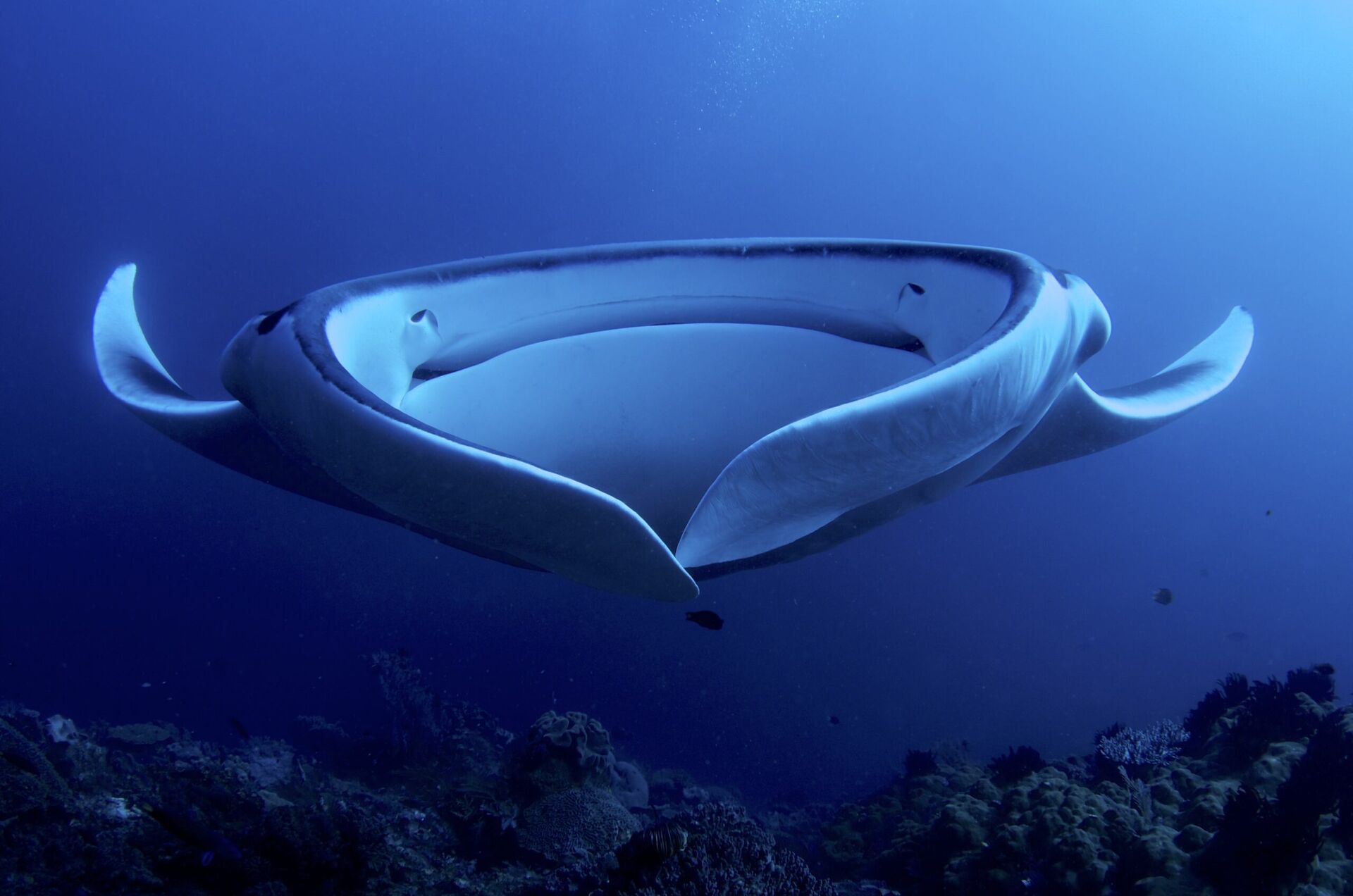
Mantas have two cephalic fins (the lobes that look like horns or paddles either side of the head). When feeding, they unroll the lobes to funnel plankton-rich water into the mouth. Modified gill rakers strain out plankton, krill, fish eggs, and small fish. A feeding manta processes around 60 kg of plankton per day.
Cooperative feeding behaviours include chain feeding (mantas line up nose to tail in a circle), cyclone feeding (a vortex of 100 plus animals at sites like Hanifaru Bay), and barrel rolling (a single animal rolls vertically through dense plankton patches). These are the kinds of group hunting behaviours associated with dolphins and orcas. Mantas are far smarter than the typical fish stereotype suggests.
Cleaning stations and intelligence
Mantas visit cleaning stations like clockwork: specific outcrops of reef where small fish (cleaner wrasse, butterflyfish) remove parasites and dead skin. A single manta may visit the same cleaning station daily for years. Some species of cleaner wrasse have co-evolved specifically with mantas.
Mantas pass mirror self-recognition tests, one of the few non-mammals that do. A 2016 experiment placed a mirror in a manta tank at the Atlantis Bahamas aquarium. Two reef mantas examined themselves repeatedly, performed unusual movements in front of the mirror (looking for cause and effect), and changed behaviour over time in ways that suggest they understood they were looking at themselves. The result is debated but it is far from a clear no.
Reproduction
Mantas have one of the slowest reproductive rates in the fish world. Females give birth to a single pup roughly every 2 to 5 years after a 12 to 13 month gestation. The pup is around 1.5 m wingspan at birth, with the mother delivering it with a high jump that helps the pup unfurl from its rolled-up shape. From there the pup feeds alone, with no parental care.
Females reach sexual maturity at around 10 years (reef) or 15 years (oceanic). Lifespan is around 40 to 50 years in the wild, possibly more. Slow growth and low fecundity are part of why both manta species are now globally listed as threatened.
Conservation
Both manta species are listed as Vulnerable (reef) and Endangered (oceanic) by the IUCN. The biggest pressure is targeted fishing for the gill rakers, which are used in Chinese traditional medicine. Mobulid gill plates sell for USD 100 to USD 250 per kilogram in southern China and Hong Kong. A single oceanic manta yields around 7 to 9 kg of dried gill rakers.
International protection has improved. CITES Appendix II covers both species since 2013, and the Convention on Migratory Species lists them on both Appendices I and II. Several countries have full bans on manta fishing (Indonesia, Maldives, Mexico, Philippines, New Zealand). Long term population recovery is slow because of the low reproductive rate, but the trend has stabilised in regions with strong protection.
Best places to see mantas
Hanifaru Bay in the Maldives is the most famous reef manta aggregation site, hosting up to 200 animals in a feeding cyclone during the south-west monsoon (June to November). Lady Elliot Island on the southern Great Barrier Reef has resident reef mantas year-round. Kona, Hawaii, runs a famous night manta dive where mantas feed on plankton attracted by lights, with reliable sightings most evenings.
Oceanic mantas are seen most reliably at Socorro Island and Isla San Benedicto in Mexico’s Revillagigedo archipelago (November to May), and at Komodo and Nusa Penida in Indonesia (year round, peak April to October). Both are liveaboard-only destinations.
Mantas as ambassadors for conservation
Manta tourism is now a multi-million dollar industry across the tropics. Diving operators, hotels, and government fisheries departments in Indonesia, the Maldives, Mexico, the Philippines, and Mozambique all build seasonal income around manta sightings. The Marine Megafauna Foundation and Manta Trust use that economic case to push for protection in countries where fishing pressure remains.
The Indonesian government banned all manta fishing in 2014 explicitly because economists calculated that a single manta was worth around USD 1 million in tourism revenue over its lifetime, versus around USD 500 if killed for gill rakers. The economic argument is straightforward and is becoming the standard tool for protecting large charismatic fish.
Related reading
For shark fans browsing for something to take home, see our store collections of shark toys.
See the IUCN Red List entry for the oceanic manta. See the Manta Trust.
Frequently asked questions
Are manta rays related to sharks?
Yes. Manta rays and sharks both belong to the class Chondrichthyes, the cartilaginous fish. They share a cartilage skeleton, denticle-covered skin, and live-bearing reproduction. Rays diverged from sharks around 250 million years ago and evolved the flattened body with enlarged pectoral fins that defines them today. Mantas are a relatively recent ray group, around 25 million years old.
How big do manta rays get?
The reef manta (Mobula alfredi) reaches a wingspan of around 5.5 m. The oceanic manta (Mobula birostris) is bigger, with wingspans up to 7 m and weights up to 3 tonnes. Females are larger than males in both species.
Do manta rays have stingers?
No. Mantas have a slim tail with no spine. Their stingless tail is one of the features that sets the manta family Mobulidae apart from other rays. They are completely harmless to humans.
How smart are manta rays?
Mantas have the largest brain-to-body ratio of any fish. They visit cleaning stations on a regular schedule, perform cooperative feeding (chain feeding, cyclone feeding), and have shown behaviour consistent with mirror self-recognition in at least one aquarium experiment. They are far more intelligent than fish stereotypes suggest.
Are manta rays endangered?
Yes. The IUCN lists the reef manta as Vulnerable and the oceanic manta as Endangered. The main threat is targeted fishing for the gill rakers, used in Chinese traditional medicine. International protection includes CITES Appendix II and the Convention on Migratory Species. Several countries have full bans on manta fishing.
What do manta rays eat?
Mantas are filter feeders. They unroll their cephalic fins to funnel plankton-rich water into the mouth, where modified gill rakers strain out plankton, krill, fish eggs, and small fish. A feeding manta processes around 60 kg of plankton per day.
Where is the best place to see manta rays?
Hanifaru Bay in the Maldives hosts the largest reef manta aggregations (June to November). Lady Elliot Island in Australia has reliable year-round reef mantas. Kona, Hawaii, runs popular night dives with manta sightings. For oceanic mantas, Socorro Island in Mexico (November to May) and Komodo in Indonesia are the most reliable sites.
How long do manta rays live?
Around 40 to 50 years in the wild, possibly longer. Females reach sexual maturity at 10 to 15 years and give birth to a single pup every 2 to 5 years after a 12 to 13 month gestation. The slow reproductive rate is why both species are sensitive to fishing pressure.
By Otis Mako. Last updated 13 May 2026.
Got a shark photo of your own? Send it to us and we may post it here and on our Facebook page, with your name on it. Share your shark photo


What’s the easiest way to tell a reef manta from an oceanic one underwater if you can’t judge size? Saw a manta in Komodo once and I still can’t say which it was.
Who is still buying the gill plates, given the bans in so many countries? It seems mad to kill something worth that much more alive.