
A Brief History Of Sharks: 450 Million Years And Counting
5 min read
Last Updated on November 24, 2026 by Otis Mako

The earliest evidence of sharks goes back around 450 million years, millions of years before the first dinosaurs. Many prehistoric sharks, like the helicoprion, evolved astonishing features to help them hunt and feed.
Most people still assume that sharks have the same kind of streamlined shape, prominent dorsal fins, and terrifying pointy teeth. But that’s far from the truth. For instance, the tasselled wobbegong shark has a broad, flat shape and looks like an old carpet. Another species, the frilled shark, looks nothing like the torpedo shape of the great white, but its teeth are just as intimidating. It looks more like an eel than a shark, and it carries around 300 trident-shaped teeth in 25 rows.
Then there are the cookie-cutter, the sawfish, the basking shark, the goblin shark, and the ninja lanternshark that glows in the dark. Sharks are too varied to categorize in basic terms. Fossil records indicate that there were up to 3,000 different shark species in the oceans at some point.
New sharks are still being discovered, and more than 500 species are alive today.
The Early Ancestors Of Modern Sharks
Fossilised shark-like scales from Late Ordovician rock show that sharks, or animals very close to them, were in the oceans about 450 million years ago.
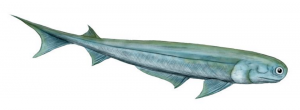
As other fish evolved, a group called acanthodians (spiny sharks) developed. These fish are now extinct, but they looked like small sharks with different numbers of fins. They shared features with both bony fish and cartilaginous fish, and sharks appear to have descended from them.
The first verified shark teeth fossils belonged to the Leonodus shark, which swam during the early Devonian period. The teeth were tiny, just 4mm, and two-pronged, but they closely resembled those of Xenacanthus, another shark that appeared millions of years later.
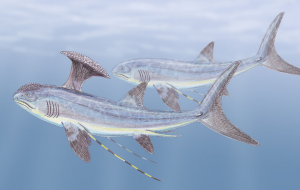
For some reason, fish diversified greatly during the Devonian period. As a result, that period is named the “Age of Fishes.” The skeleton of the extinct Cladoselache shows how much it differed from the eel-like sharks before it. Cladoselache was about 2 meters long with large eyes and a torpedo shape. It must have been a fast swimmer, because it appears to have taken its prey tail-first.
At this same time, another intimidating group of fish swam in the seas. These were the Dunkleosteus, each one about the size of a school bus. Because these fish were heavily armoured giants, they may have competed with sharks for prey. Maybe their presence was the pressure that pushed early sharks to evolve fast enough to outlast them.
A Period Of Intense Speciation In The History Of Sharks

The next clue to shark evolution can be traced to 380 million years ago through the fossilized braincase of a shark from Antarctica. Researchers deduced that it was an eel-like shark based on its head, teeth, fin, and spine. That shark is named Antarctilamna.
20 million years later, during the Carboniferous period, sharks were evolving so rapidly that it would be almost impossible to describe each species. Here are just a few examples:
- Cartilage fish (Chondrichthyans). These were the largest predators in the oceans at that time, and the group included skates, rays, and chimaeras. Chimaeras are known informally as ghost sharks, ratfish, rabbitfish, and spookfish. According to Dr. Charlie Underwood, a lecturer in Palaeontology at Birkbeck University, the more weird and wonderful sharks evolved from the chimaera branch. His research publications are listed at Birkbeck.
- The Helicoprion developed a tooth whorl, a dinner-plate sized spiral of teeth up to 40cm across that looked something like a buzzsaw attached to its lower jaw. The old teeth of other shark species fall off to be replaced by new teeth, but the Helicoprion’s did not. Rather than falling off, they stuck together at the lower jaw in a 360-degree spiral.
- The male Stethacanthus had a prominent anvil-shaped dorsal fin. No one knows for sure what this fin was used for.
- The Jurassic period saw the emergence of 12 new groups of sharks with flexible jaws. Christopher Bird of the National Oceanography Centre (NOC) at Southampton says that this feature allowed them to feed on larger prey, even prey larger than themselves.
How Did Sharks Survive The Mass Extinction Of The Cretaceous Period?
The Cretaceous period was one of the most notorious climatic times ever in the history of Earth. At the start of this period, dinosaurs flourished, flowering plants were appearing on land, and land mammals were abundant. The breakup of Pangaea, the supercontinent, was underway. Temperatures were warm and stable, and sea levels were high. But by the end of this period the climate had changed severely. There was high volcanic activity and lowered sea levels. Dinosaurs went out with a bang, and so did a staggering number of prehistoric life forms on land and in the seas.
However, sharks lived on.
Their ability to adapt quickly to the changing environment helped. After the exit of dinosaurs, a second wave of deep-sea sharks emerged. Species like the cookie-cutter and the lantern sharks became prominent after this post-crisis event, according to Mr. Bird.
They were able to explore deeper habitats, and they survived periods when the ocean lost oxygen, which killed off many larger species. Sharks sought refuge by moving deeper underwater, and some developed bioluminescence.
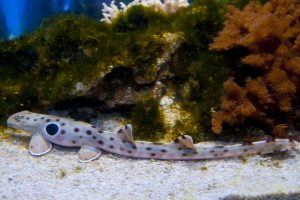
Another interesting adaptation is that of the Epaulette shark. This shark can survive for hours on little oxygen and can walk on land for short periods of time. It’s most likely these properties were triggered by dwindling sea levels.
The Rise And Fall Of The Megalodon Shark

Though sharks flourished by the end of the Cretaceous period, some of the larger species did not linger around for long. Most noticeable among them is the megalodon shark.
The megalodon measured between 13 and 17 meters (43 to 56 feet) in length, and some fossils measured close to 25 meters (82 feet). It had teeth up to 17.8 cm (7 inches) long, so large that people thought the fossilized teeth were dragon tongues for many years. Its mouth could open up to 2 meters across. It was the biggest shark that ever lived, and it dwarfs the modern great white many times over.
No one knows why it went extinct, but the most likely reason must have been a lack of sufficiently sized prey to feed its huge appetite.
What Can We Learn From The History Of Sharks?
Sharks are tenacious. They have thrived in a changing world for over 450 million years, evolving again and again to survive major upheavals in climate and the demise of many other animals, including the dinosaurs.
But they may not be able to evolve fast enough or reproduce quickly enough to survive the greatest threat to shark existence yet, which is human activity: habitat degradation, overfishing and pollution.
For now, they are still surviving, with new species still being discovered. Some of the discoveries of the last century include the ninja lanternshark and the megamouth shark, along with the walking bamboo shark, the spotted belly catshark, and the Pacific nurse shark.
Got a shark photo of your own? Send it to us and we may post it here and on our Facebook page, with your name on it. Share your shark photo




what the eat and how many calories the consume in a day