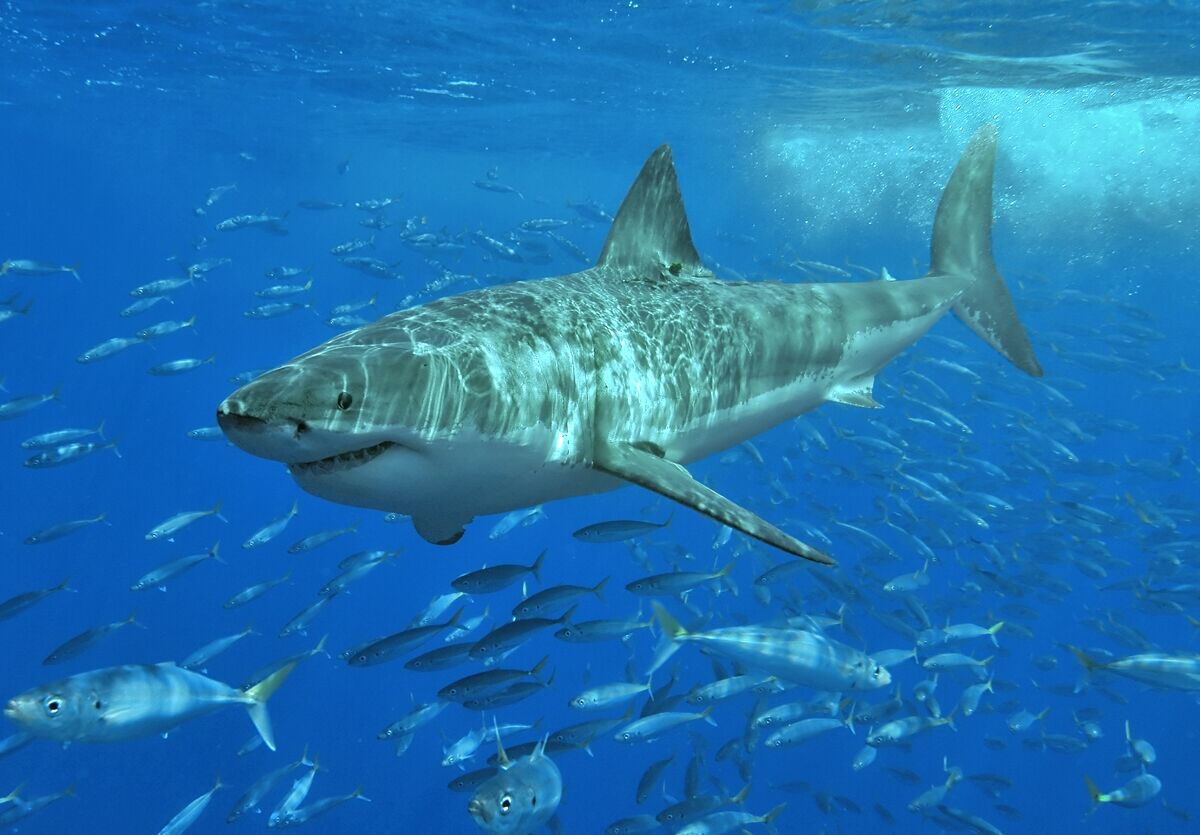
Great White Shark Deep Dive: Biology, Behaviour, Conservation in 2026
7 min read
Last Updated on November 8, 2026 by Otis Mako
The great white shark (Carcharodon carcharias) is the largest predatory fish in the ocean, with new 2020s research showing previously unknown migration patterns, vulnerability to orca predation, and surprising social structure. The most comprehensive 2026 update on the great white shark. New OCEARCH data has revealed previously unknown Atlantic migration loops. The orca predation pattern in South Africa has reshaped regional populations. And new social-structure research suggests great whites are more complex animals than the lone-predator stereotype suggests.
Part of our guide: Shark Species.
Key facts at a glance
| Scientific name | Carcharodon carcharias |
|---|---|
| Family | Lamnidae |
| Max length | Around 6 m (20 ft), most adults 4 to 5 m |
| Max weight | Around 2,000 kg (4,400 lb) |
| Body temperature | Up to 14 C warmer than surrounding water |
| Diet | Seals, sea lions, tuna, smaller sharks, dolphins, whale carrion |
| Habitat | Coastal and offshore waters of every temperate ocean |
| Lifespan | Around 70 years |
| IUCN status | Vulnerable globally |
| Recorded unprovoked attacks on humans | Around 350 with 50-plus fatalities (ISAF, all-time) |
How big great whites really get
The largest reliably measured great white was a 6.1 m female caught off Cuba in 1945, weighing around 1,900 kg. Several other specimens have approached 6 m but few are fully documented. Most adults are 4 to 5 m. Females are larger than males and tend to migrate over larger areas.
The often-cited 7+ m or 11 m great whites are misidentifications or exaggerated reports. Modern marine biology puts the realistic maximum at around 6 m. The 11 m record comes from a 19th-century report off Australia that was almost certainly a basking shark or whale shark misidentified.
Why great whites are warm-bodied
Great whites are part of the Lamnidae family (with makos, porbeagles, salmon sharks), all of which use a counter-current heat-exchange system called the rete mirabile to keep swimming muscles, brain, eyes, and stomach warmer than the surrounding water. A great white in 16 C ocean water can keep its red muscle at 24 C and its stomach at 30 C.
The heat advantage allows faster reaction times, more efficient digestion of large prey, and the ability to hunt in colder water than cold-bodied sharks could tolerate. The cost is metabolic: great whites must eat more than equivalently sized ectothermic sharks. A 1,500 kg great white needs around 4 to 5 kg of food per day on average.
Range and migration
Great whites live in every temperate ocean, with major populations off California, South Africa, southeastern Australia, the Mediterranean (small remnant), the western Atlantic (Cape Cod), Japan, and New Zealand. OCEARCH and partner programs have documented major migrations including the annual California to White Shark Cafe trip (5,000 km round), the Cape Cod to mid-Atlantic seamount cycle, and the South African to Mozambique loop.
Atlantic great whites turn out to be epic migrators. Mary Lee, tagged off Cape Cod in 2012, travelled 64,000 km over five years before her tag battery died. Nukumi, tagged off Nova Scotia in 2020, has crossed back and forth between Cape Cod and the mid-Atlantic seamounts multiple times. The picture of great whites as homebodies has been thoroughly overturned.
Diet and hunting
Adult great whites primarily eat marine mammals: seals, sea lions, and occasionally dolphins and whale carrion. Juveniles (under 3 m) eat fish: tuna, mackerel, other sharks. The transition happens around 2.5 m as the shark develops the bite strength and dive ability to take seals. The famous breaching predation strategy at Seal Island, South Africa, is the textbook example: white sharks accelerate vertically from the seabed and burst through the surface taking seals on the way down.
Other hunting tactics include patrol-and-strike at seal colonies in California (the Farallones), benthic ambush at sandy bottoms, and surface-prone for tuna and large bony fish. Most successful attacks happen in the first 5 minutes of low light (dawn and dusk), when seal visibility is poorest.
Social structure: more than the lone hunter
New research from Cape Cod and South Africa has revealed great whites have more social structure than previously thought. White sharks aggregate at known feeding sites, recognise individual conspecifics, and appear to have rank-based access to prey. A 2023 study from the Atlantic White Shark Conservancy used acoustic detection to show that returning Cape Cod white sharks favoured particular conspecifics over others, suggesting either preference or avoidance based on prior encounters.
Mating itself has never been observed in the wild. Females are believed to migrate from their feeding grounds to dedicated mating sites every 2 to 3 years. Pups are born live at around 1.2 m and head straight to nursery areas (mainly the Carolinas in the Atlantic, the southern Californian coast in the Pacific). Most pups die in their first year, but survivors grow steadily and reach maturity around 25 to 35 years.
The orca threat
Orca predation on great whites has become one of the most significant new findings in shark biology since 2017. Two specific orcas off South Africa, named Port and Starboard, have killed at least seven great whites by ramming and rolling, then extracting the liver. False Bay great whites have disappeared from the area since 2017. Similar attacks have been documented off California (the Farallones), Australia, and New Zealand.
The orca-induced disruption is now a major factor in great white population dynamics in the Cape region. Sharks have moved further offshore and east toward Mozambique. The local cage-diving industry has had to adapt. Whether this is a regional anomaly or a broader pattern is unclear; orca-shark conflict has been documented in scattered locations for decades but the South African intensity is new.
Are great whites dangerous to humans?
Yes, but rarely in the way pop culture suggests. The ISAF records around 350 unprovoked attacks attributed to great whites with 50-plus fatalities (all-time, all locations). Most attacks happen on surfers (mistaken for seals when viewed from below), spear fishermen (carrying speared fish), and divers in areas with bait or seal activity. Unprovoked attacks on swimmers in clear water are uncommon.
The annual fatality rate from great white attacks is around 1 to 5 worldwide. To put it in perspective: about 100 times more people die from bee stings each year, and about 1,000 times more die in car accidents. The reputation as the deadliest fish is mostly cultural, supported by the cinematic dominance of Jaws (1975) rather than the actual numbers.
Conservation status
The great white is listed as Vulnerable globally by the IUCN. Several regional populations are in worse shape: Mediterranean great whites are Critically Endangered, with possibly fewer than 100 mature individuals remaining. The Australian east coast population is Endangered. The Pacific California population is stable or growing. The Atlantic Cape Cod population is recovering after decades of decline.
Protection works. The Australian no-take rule (1995), the South African full protection (1991), and the US Endangered Species Act listing of north-east Pacific great whites (2013) have all contributed to regional stabilisation or recovery. CITES Appendix II covers the species globally. The remaining concerns are commercial bycatch in longline fisheries, depleting seal prey populations in some regions, and orca-driven displacement.
Watching great whites in the wild
Major operators run cage diving programs at three reliable sites: Guadalupe Island (Mexico), Gansbaai (South Africa, though declining since orca disruption), and Neptune Islands (South Australia). The most reliable single-site experience is South Australia’s Neptune Islands during the winter aggregation, with operators like Calypso Star Charters and Rodney Fox Shark Expeditions running well-established programs.
Cape Cod offers a different option: scientist-led research trips with the AWSC, plus tower-based shore watching during the seal hunting season. Bahamas and Mexico’s Isla Mujeres also have great white sightings during migration windows. Always pick operators that follow no-touch and minimal-bait codes of conduct.
Related reading
For shark fans browsing for something to take home, see our store collections of shark toys, shark books.
See the IUCN Red List entry for the great white shark. See the Atlantic White Shark Conservancy.
Frequently asked questions
How big do great white sharks really get?
The largest reliably measured great white was a 6.1 m female caught off Cuba in 1945. Most adults are 4 to 5 m. Females are larger than males. The often-cited 7+ m specimens are misidentifications or exaggerated reports. The realistic maximum is around 6 m.
Are great white sharks endangered?
Yes, listed Vulnerable globally by the IUCN. Mediterranean populations are Critically Endangered. Australian east coast populations are Endangered. Pacific California and Cape Cod populations are stable or recovering. CITES Appendix II protection covers the species globally. The main pressures are commercial bycatch and orca-driven displacement in some regions.
How dangerous are great white sharks?
Less than the reputation suggests, but real. The ISAF records around 350 unprovoked attacks attributed to great whites with 50-plus fatalities (all-time). Annual fatality rate worldwide is around 1 to 5. To put it in perspective: about 100 times more people die from bee stings each year. The cinematic image of great whites as the deadliest fish comes mostly from the 1975 film Jaws, not the data.
Why are great whites warm-blooded?
Great whites use a counter-current heat-exchange system called the rete mirabile to keep swimming muscles, brain, eyes, and stomach warmer than the surrounding water (by up to 14 C). The heat advantage allows faster reaction times, more efficient digestion of large prey, and the ability to hunt in colder water than cold-bodied sharks could tolerate. The same system is found in makos, porbeagles, and salmon sharks (the Lamnidae family).
Do orcas really kill great whites?
Yes. Documented cases off South Africa, California, Australia, and New Zealand show orca pods killing and eating great whites by ramming, rolling, and extracting the liver. The South African case (two orcas named Port and Starboard) has caused the disappearance of great whites from False Bay since 2017. This is now a major factor in regional shark population dynamics.
Where can I see great white sharks?
Major cage-diving operators run programs at Guadalupe Island (Mexico), Gansbaai (South Africa, declining since orca disruption), and Neptune Islands (South Australia). The South Australian winter aggregation is the most reliable single-site experience. Cape Cod offers research-led trips and tower-based shore watching during the seal hunting season.
How long do great white sharks live?
Around 70 years, based on radiocarbon dating of vertebrae from several specimens. Earlier estimates put their lifespan at 30 to 40 years; the older figure was based on incorrect interpretation of growth rings. Females mature at around 25 to 35 years, which is part of what makes the species so vulnerable to fishing pressure.
Do great white sharks attack humans on purpose?
Most great white attacks on humans appear to be mistaken identity. Surfers viewed from below look similar in silhouette to seals or sea lions. The shark commits to a strike, makes contact, then often releases when it tastes the human (lower fat content than expected). Repeat bites are uncommon. The lethality comes from the size of the initial bite, not from repeated attacks.
By Graziano Whiting. Last updated 13 May 2026.
Got a shark photo of your own? Send it to us and we may post it here and on our Facebook page, with your name on it. Share your shark photo