Do Sharks Get Cancer? Checking the Cartilage Myth
3 min read
Last Updated on November 19, 2026 by Otis Mako
Yes, sharks get cancer. The claim that they do not has been sold in pill form for decades, and it has never held up. The record of tumors in sharks is real, a placebo-controlled trial of shark cartilage found no benefit, and the sales pitch did its own damage to shark populations.
This post goes through what the evidence shows, one piece at a time. It builds on the short entry in our list of common shark misconceptions.
Where the myth came from
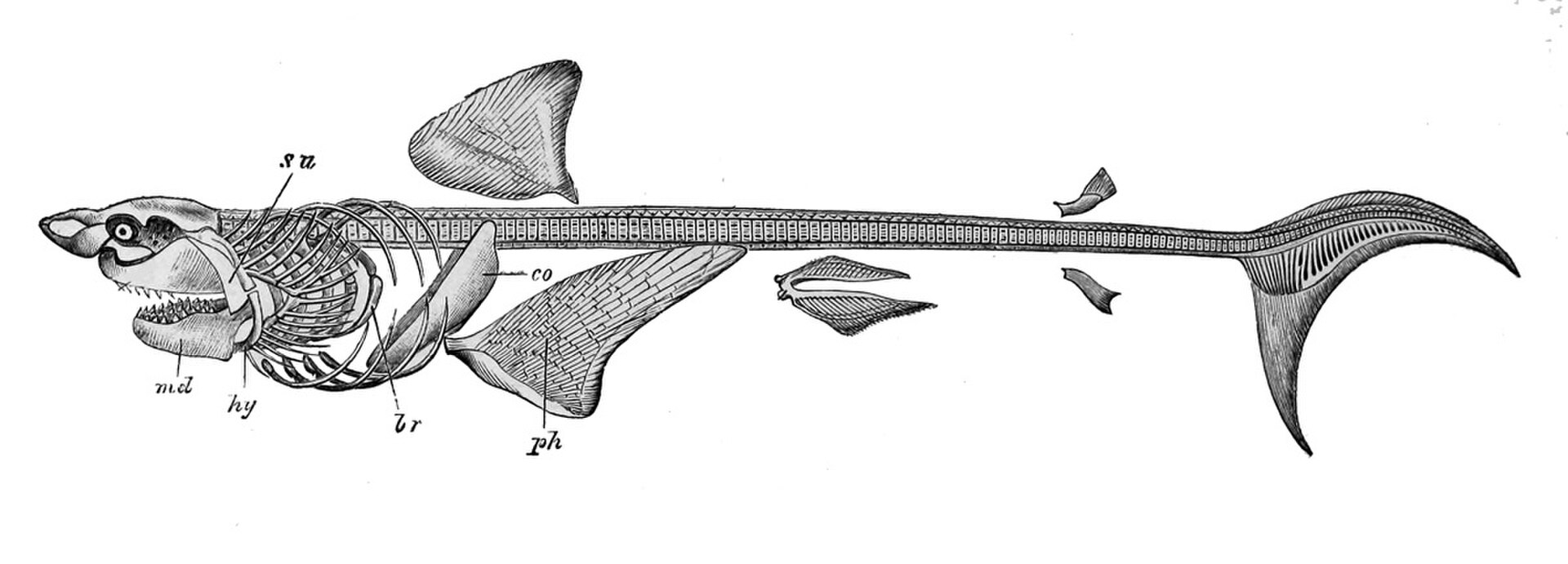
Sharks have skeletons made mostly of cartilage, not bone. The National Cancer Institute explains the logic: it was once believed that sharks do not develop cancer. Cartilage has relatively few blood vessels, and tumors need new blood vessels to grow, so the idea sounded tidy. If the animal rarely gets tumors, the thinking went, its cartilage must hold something protective.
The trouble is the first step. The premise does not survive a look at the tumor records.
What the tumor records show
In 2000, scientists from Johns Hopkins University and George Washington University reported their search of the National Cancer Institute’s Registry of Tumors in Lower Animals. Using strict diagnostic criteria, they found 40 cases of tumors in sharks and related fishes such as skates and rays. The team noted that sharks can even get chondromas, which are tumors of cartilage itself.
The records go back further than that. Shark Stewards notes that tumors have been recorded in over 20 species of sharks, skates and rays since as early as 1908.
A 2013 case made the point in a way no registry could. Researchers in Australia noticed a large tumor protruding from the mouth of a great white shark. The study appeared in the Journal of Fish Diseases. Rachel Robbins of the Fox Shark Research Foundation, a co-author, said it was a very unusual sight, as they had never before seen a great white shark with tumors. By then, Scientific American reported, scientists had documented tumors in at least 23 shark species.
One caution. The National Cancer Institute says that although malignant tumors are rare in sharks, cancers have been found in these animals. Rare in a few records is not the same as never, and nobody has shown that sharks are immune.
What the trials found
The next question is whether eating shark cartilage helps people with cancer. The National Cancer Institute reports that in a randomized trial of 83 patients with advanced breast or colon cancer, there was no difference in quality of life or survival between the shark cartilage group and the placebo group. It adds that the US Food and Drug Administration has not approved cartilage as a treatment for cancer.
The researchers behind the 2000 tumor survey were blunt. They said no proof exists that shark cartilage has positive effects on cancer, and Gary Ostrander called the idea that sharks will be a cure-all for cancer on the available data bogus.
They also stayed fair. They did not rule out that a useful treatment could come from shark cartilage or other animals someday. That is how science sounds when it is sure about the evidence in hand and open about what it has not tested.
The cost to sharks and to patients
A false claim with a product attached has consequences. A 2004 review in Cancer Research, as Scientific American summarised it, said the belief that shark cartilage can treat cancer diverts patients from effective treatments.
Sharks paid too. Shark Stewards says the cartilage trade led to a massive spike in commercial harvesting and a decline in populations in some fisheries, and that deepwater sharks and pelagic species like the blue shark were overfished as a result. Sharks are already under heavy pressure from fishing. Our guide to the most endangered sharks shows how many are in trouble, and our blue shark profile covers one of the species named above.
Put plainly, the supply side and the science point the same way. Shark Stewards sums it up in one line: using shark cartilage does not cure cancer in humans. Nothing in the tumor records or the trial says otherwise, so the product has no evidence behind it and a real cost attached.
What to take from it
A good rule for any health claim built on an animal: ask whether the animal really has the trait, then ask whether anyone has tested the product in people. Here, the answer to the first is no, and the answer to the second is a randomized trial that found no benefit.
If you want to help sharks, buying cartilage pills is the wrong way. Learning how these animals live is a better start, and our post on shark skin and its tooth-like scales is a good place to keep going.
Do you know of other shark myths that deserve a check? Add what you know in the comments.
Sources
- ScienceDaily: shark tumor registry survey, 2000
- Scientific American: Sharks Do Get Cancer, 2013
- National Cancer Institute: Cartilage (shark and bovine) PDQ
- Shark Stewards: Do Sharks Get Cancer?
Photo: Unknown author, Wikimedia Commons, Public domain, via commons.wikimedia.org.
Got a shark photo of your own? Send it to us and we may post it here and on our Facebook page, with your name on it. Share your shark photo