
Frilled Shark: Eel-Bodied, 300 Teeth, Mostly Unchanged for Millions of Years
6 min read
Last Updated on May 24, 2026 by Otis Mako
The frilled shark (Chlamydoselachus anguineus) is a deep-sea eel-bodied shark with 300 backward-pointing teeth, six gill slits, and a body plan almost unchanged from the Cretaceous. The frilled shark (Chlamydoselachus anguineus) looks more like a sea snake than a shark. It has an eel-like body up to 2 m long, six frilly gill slits, 300 trident-shaped teeth, lives at 500 to 1,500 m, and may carry pups for over three years, one of the longest gestations of any vertebrate.
Part of our guide: Shark Species.
Key facts at a glance
| Scientific name | Chlamydoselachus anguineus |
|---|---|
| Family | Chlamydoselachidae |
| Max length | Up to 2 m (6.6 ft) |
| Number of teeth | Around 300, in 25 rows |
| Diet | Cephalopods (mostly squid), small fish, smaller sharks |
| Habitat | Continental slopes worldwide, 500 to 1,500 m |
| Gestation | Estimated 42 months, one of the longest of any vertebrate |
| Lifespan | Estimated 25 years |
| IUCN status | Least Concern |
| Lineage age | Around 80 million years |
What a frilled shark actually looks like
The frilled shark does not look like a shark to most eyes. Its body is long and thin, more like a sea snake or an eel, with a single dorsal fin set far back, just in front of the tail. The mouth is at the front of the head (most sharks have an underslung mouth) and lined with 300 small teeth, each shaped like a tiny trident with three sharp points.
The name comes from the six gill slits on each side, the first pair fused under the throat into a single fleshy collar that gives a frilly look. Six gills is itself a clue: most modern sharks have five, and the frilled shark is part of the same ancient order (Hexanchiformes) as the sevengill and sixgill sharks. The whole package looks more Mesozoic than modern.
Why those teeth do their job
The teeth are the most photographed feature. Each one has three slender, curved points facing backwards. There are around 25 rows of them, totalling about 300 in a mature mouth. The geometry is built for one job: holding slippery, soft-bodied prey. Squid and small fish that bite once on a trident point cannot back out without driving the tooth deeper.
Most sharks rely on cutting teeth or crushing teeth. The frilled shark rejects both strategies in favour of a passive trap. It is closer to how a snake holds prey before swallowing whole, which fits the rest of its anatomy: long throat, no large biting force, slow predatory style.
Where the frilled shark lives
Frilled sharks have been recorded in scattered locations across the Atlantic, Pacific, and Indian Oceans, generally over continental slopes and submarine canyons. Suruga Bay in Japan, the canyons off New South Wales in Australia, and the coast of Madeira are the three places most reliably associated with the species. Almost every specimen comes from 500 to 1,500 m depth, with the deepest credible record around 1,570 m.
Like the goblin shark, the frilled shark turns up most often as bycatch in deep-water Japanese fisheries. The species was first described from a specimen caught off Sagami Bay, and Suruga Bay still produces several specimens a year, mostly dead or dying when brought to the surface.
The 42 month pregnancy
Frilled sharks have one of the longest known gestation periods of any vertebrate, estimated at around 42 months (3.5 years). The animals are ovoviviparous, meaning eggs develop inside the female and pups are born live. Embryos grow extremely slowly at deep-sea temperatures, around 1.4 cm per month, and litters are small (2 to 12 pups).
There is no breeding season. Frilled sharks at any given depth appear to mate and give birth all year round. Cold water and a stable, food-poor environment slow down every metabolic process, and the embryos simply take a long time to reach the 40 to 60 cm size at which they are born.
Diet and hunting style
Around 60 percent of stomach contents in studied specimens have been cephalopods, particularly small, soft-bodied squid. The remainder is small fish (sometimes other sharks) and occasional carrion. Strike behaviour has never been observed in the wild, but the leading hypothesis from anatomy is that frilled sharks coil and strike like a snake, using a quick forward thrust to engulf prey, then the trident teeth lock it in place.
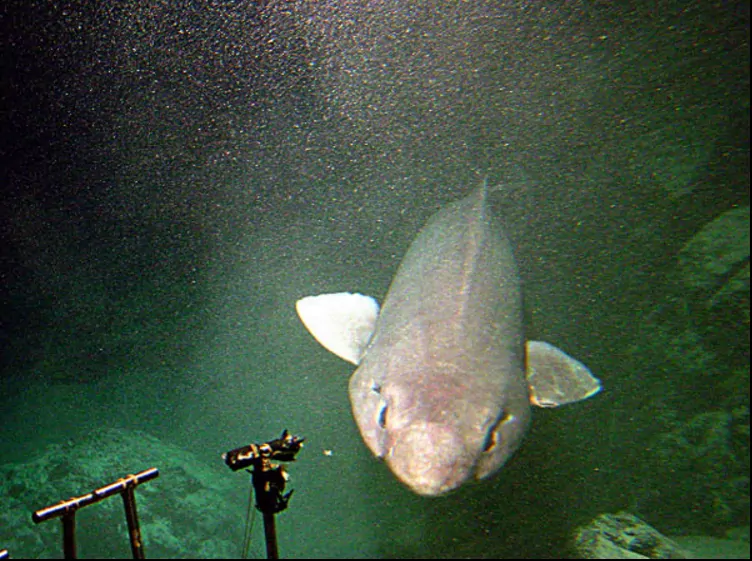
A 2007 specimen filmed alive off Awashima Island in Japan briefly showed slow, undulating movement that fits this model. The same animal died within hours of capture, consistent with the difficulty of bringing a deep-sea shark to the surface without lethal pressure damage.
How rare is a sighting
Living frilled shark sightings are exceptionally rare. The most famous case is the 2007 Awashima Island fish, which Japanese fishermen brought to the surface and which was filmed in a holding pool by the Awashima Marine Park before it died. The footage went viral and remains the most viewed living frilled shark video on the internet.
Outside Japan, photographs of dead specimens trickle in every few years from longliners off Spain, Portugal, New Zealand, and South Africa. There has never been a confirmed scuba sighting at depth. Until ROV surveys reach the right canyons during a frilled shark feeding event, that is unlikely to change.
Conservation status
The IUCN currently lists the frilled shark as Least Concern, mainly because the deep habitat puts most of the population out of reach of fishing gear. The few thousand specimens that have been documented worldwide all came from accidental capture rather than population surveys, so true abundance is poorly understood.
Concerns focus on deep-water trawling and longlining over the slope habitat. Expansion of those fisheries in West Africa, the western Mediterranean, and parts of South East Asia is a slow-moving worry. The species is on the no-go list for several deep-water fisheries in Australia and New Zealand, but enforcement varies.
Living fossil status, revisited
Like the goblin shark, the frilled shark is regularly called a living fossil. The family Chlamydoselachidae has fossils dating back around 80 million years, into the late Cretaceous, and the modern species’ anatomy retains many features visible in those fossils. Several other living species cluster nearby on the shark tree (sixgills, sevengills) but they have evolved into different body plans.
Worth noting: a second living species, Chlamydoselachus africana, was described in 2009 from specimens off southern Africa. It is slightly smaller and more slender, and it confirms that the family still has more than one surviving lineage. Living fossil is shorthand for ancient body plan, not for evolutionarily frozen: the family has been adapting all along, just slowly.
Related reading
For shark fans browsing for something to take home, see our store collections of shark books.
See the IUCN Red List entry. See the Shark Trust.
Frequently asked questions
What is a frilled shark?
The frilled shark (Chlamydoselachus anguineus) is a deep-sea shark with an eel-like body up to 2 m long, six gill slits, and around 300 backward-pointing teeth. It lives at depths of 500 to 1,500 m on continental slopes worldwide and is the better-known of two species in the ancient family Chlamydoselachidae.
Why does the frilled shark have so many teeth?
The frilled shark has around 300 teeth in roughly 25 rows. Each tooth is shaped like a tiny trident with three backward-pointing prongs. The geometry is built to trap soft-bodied prey like squid: once a tentacle or fin bites onto the prongs, it cannot back out. The shark itself does not chew or bite hard, so the teeth do the holding work passively.
How long do frilled sharks stay pregnant?
Around 42 months, or about 3.5 years. That is among the longest gestation periods of any vertebrate. The slow development reflects the cold deep-sea environment, where embryos grow only around 1.4 cm per month. Litters are small (typically 2 to 12 pups) and there is no defined breeding season.
Are frilled sharks dangerous to humans?
No. Frilled sharks live at depths well below diver range and have never been recorded attacking a human. The only known human interactions are with researchers and fishermen handling specimens caught accidentally in deep gear. Even when alive on a boat deck, the animals are slow and not aggressive.
Where can I see a frilled shark?
Living frilled sharks are essentially impossible to see. The species lives at 500 to 1,500 m and almost never survives a trip to the surface. The most reliable footage is from a single 2007 specimen at Awashima Marine Park in Japan, which lived a few hours after capture. A few museum specimens are on display in Japan, Portugal, and Australia.
Is the frilled shark really a living fossil?
Sort of. The family Chlamydoselachidae has fossils dating back around 80 million years, and the modern species retains many anatomical features visible in those fossils. The term is shorthand for ancient body plan rather than evolutionarily frozen: a second living species (Chlamydoselachus africana) was described in 2009, which shows the family has continued to diverge slowly.
How big does a frilled shark get?
Adults reach a maximum of around 2 m (6.6 ft), with females larger than males. Most encountered specimens are 1.3 to 1.7 m. Weight at full length is only around 5 kg, because the body is slender and made of low-density deep-sea flesh.
What do frilled sharks eat?
Around 60 percent of recorded stomach contents are squid and other cephalopods. The rest is small fish, including occasional smaller sharks, and carrion. Hunting behaviour has never been observed in the wild, but anatomical evidence suggests they coil and strike like a snake, then use their trident teeth to hold soft-bodied prey while swallowing it whole.
By Otis Mako. Last updated 13 May 2026.
Got a shark photo of your own? Send it to us and we may post it here and on our Facebook page, with your name on it. Share your shark photo



How does anyone even estimate a pregnancy that long for an animal nobody can watch? I’d love to know if it comes from embryo sizes in caught females or something else.
My daughter saw the Awashima clip at school and has been drawing frilled sharks as snakes with gills ever since. honestly not far off.