

Megamouth Shark: The Deep-Sea Filter Feeder With Only 270 Sightings Ever Recorded
12 min read
Last Updated on May 25, 2026 by
The megamouth shark (Megachasma pelagios) is one of three known filter-feeding sharks in the world, alongside the whale shark and the basking shark. First documented in 1976 when a US Navy research vessel accidentally tangled one off Oahu, Hawaii, this deep-sea giant has been seen by humans only around 270 times in nearly 50 years. It grows to over 7 m, swims through the open ocean from the surface to depths of more than a kilometer, and gets its name from a cavernous, soft-lipped mouth lined with rubbery filter pads.
Key facts at a glance
| Common name | Megamouth shark |
|---|---|
| Scientific name | Megachasma pelagios |
| Family | Megachasmidae (sole member) |
| Order | Lamniformes (mackerel sharks) |
| Discovered | 15 November 1976, off Kahuku, Oahu, Hawaii |
| Documented sightings (lifetime) | Around 270 worldwide |
| Max length | Up to 7.1 m (23 ft) |
| Max weight | Up to 1,215 kg (2,679 lb) |
| Diet | Krill, copepods, jellyfish, plankton, small fish |
| Habitat | Open ocean, surface to 1,000 m+, worldwide |
| Depth range | 5 m to 1,500 m (recorded) |
| IUCN status | Least Concern (data limited) |
| Danger to humans | Zero recorded attacks. Harmless filter feeder. |
The 1976 discovery: a US Navy ship that changed shark science
On 15 November 1976, the US Navy research vessel AFB-14 was conducting a parachute sea anchor test about 42 km northeast of Kahuku Point, Oahu. When the crew hauled in the sea anchor from a depth of 165 m, an enormous, dark, broad-headed shark came up with it, tangled in the parachute lines. The animal was 4.46 m long and weighed around 750 kg. It had a soft, blubbery body, a vast mouth lined with luminous-looking white tissue, and tiny hooked teeth that bore no resemblance to anything in the existing shark literature.
The shark was taken to the Naval Undersea Center in Kaneohe Bay and later transferred to ichthyologist Leighton Taylor of the Bernice P. Bishop Museum in Honolulu. Taylor and colleagues spent the next seven years describing the animal. In 1983 they published the formal description, naming it Megachasma pelagios (genus from Greek for “great yawn”, species from Greek for “of the open sea”) and erecting an entirely new family, Megachasmidae, to contain it. It was the first new shark family described in over half a century.
Why one accidental tangle reshaped shark biology
Before 1976, ichthyologists believed there were only two filter-feeding sharks alive: the whale shark and the basking shark. The megamouth doubled the family count of filter-feeding shark lineages and forced a rewrite of the order Lamniformes, which until then contained mostly fast-swimming hunters like makos, white sharks, and threshers. Finding such a large animal that had eluded every fisheries net, deep-sea trawler, and underwater camera for the entire history of biological surveying made it clear that the open ocean still hides surprises at scale.
How rare is rare? The sighting count over the decades
Through 1990, only six megamouth specimens had ever been recorded worldwide. The seventh, found in California in 1990, was attached to a satellite tag and tracked for two days, giving the first behavioral data on the species. By 2000 the cumulative count was 14. By 2010 it had risen to around 50. By 2020 the tally was approximately 220. As of the most recent surveys in 2026, the total stands at around 270 documented encounters across nearly 50 years.
The numbers are climbing for two reasons. First, deep-water gillnet and trawl fisheries operate in more locations than ever before, so accidental catches are more likely. Second, the global community of citizen scientists and fishery observers is now equipped with phone cameras and instant identification networks like the Florida Museum’s megamouth shark sightings tracker, which logs and confirms reports. Most encounters happen by accident: tuna and swordfish longlines, set nets off Taiwan and Japan, beach strandings after storms.
Sighting hotspots
- Taiwan and Japan: By far the most encounters, particularly off Hualien County, Taiwan, where commercial fisheries pull up 1 to 5 megamouths in some years.
- Philippines: Donsol and the Bohol Sea record occasional bycatch and strandings.
- Pacific coast of the United States and Mexico: California, Hawaii, Baja California.
- Australia: Western Australia, southeast Queensland.
- Brazil and Senegal: Atlantic sightings remain rare and scattered.
- Indonesia: Bali strandings have produced several confirmed records.
Anatomy: built for the open ocean and for filtering
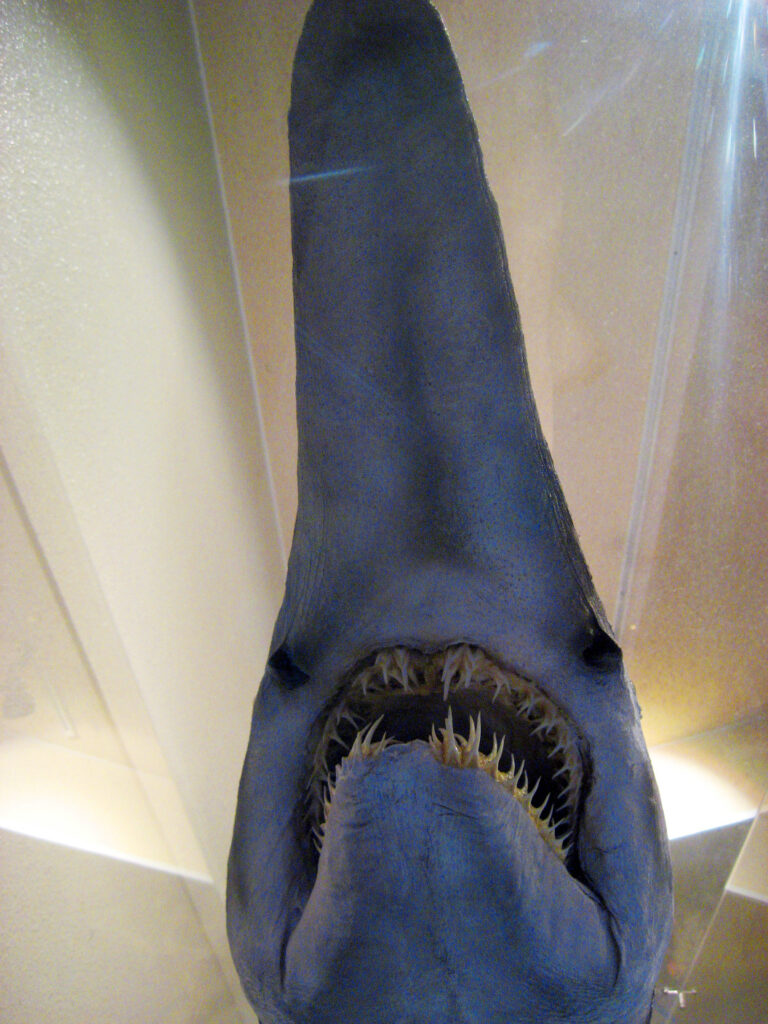
The megamouth shark looks like nothing else. The body is soft and flabby, more like a deep-sea fish than a typical shark. The head is broad and round-fronted, the mouth set at the very tip rather than under the snout as in most sharks. Inside the cavernous mouth, the upper jaw alone can be 80 cm wide in an adult, lined with a silvery-white pad of rubbery tissue thought to reflect the dim deep-water light.
The teeth are tiny, hooked, and arranged in around 50 rows in each jaw. They are not used for biting prey but probably help trap the fine layer of plankton-thick water as the shark closes its mouth. Long gill rakers (cartilage filaments along the inner edge of each gill arch) act as the actual filter, just as in basking sharks and whale sharks. Together these structures let the megamouth strain krill and small jellies from the water at every gulp.
Body details worth knowing
- Skin: Dark gray-brown above, paler below. Loose and rubbery, with weak dermal denticles.
- Eyes: Small but with a tapetum lucidum (reflective layer) suited to low-light vision.
- Fins: Soft and rounded. The caudal (tail) fin is asymmetric and not very powerful, suggesting slow cruising rather than fast swimming.
- Mouth lining: Pale silvery-white interior. Early reports suggested it might be bioluminescent and attract prey, but modern study favors a simple reflective surface that increases the visibility of bait near the mouth.
- Liver: Very large and oil-rich, providing buoyancy in deep water (a Lamniformes trait shared with basking sharks).
Diet and the slow-motion vacuum approach
The megamouth shark is a slow, deliberate filter feeder. Where the whale shark cruises just below the surface skimming plankton, and the basking shark sweeps coastal waters open-mouthed at the surface, the megamouth feeds in the deep scattering layer (also called the DSL), the dense band of krill, copepods, and small fish that forms in the upper 200 to 1,000 m of the open ocean during the day.
Stomach contents from specimens have included krill (the most common item), small jellies, copepods, and occasional small fish. There is no evidence that the megamouth is an active hunter. It probably swims with its mouth open at speeds of 1 to 2 km/h, letting water and plankton flow over the gill rakers, then closes its mouth and pushes the water back out through the gills. A single “gulp” may filter a cubic meter of water.
Diurnal vertical migration: a daily commute of half a kilometer
The 1990 California specimen (Megamouth Number 6) was the first one tagged. Researcher Donald Nelson attached an acoustic transmitter and tracked it for over two days. The data revealed a remarkable pattern. By day the shark stayed at depths between 120 m and 165 m. At dusk it rose into the upper 12 to 25 m, and at dawn it dropped back down.
This pattern is called diel vertical migration or DVM, and it follows the daily movement of the deep scattering layer. Plankton and krill rise toward the surface at night to feed in cooler, plankton-rich water, then sink during the day to avoid predators. The megamouth, like the deep-diving cookiecutter shark and many oceanic fish, simply tracks the food. Tagging studies in subsequent decades have confirmed the same pattern in megamouths off Taiwan and Indonesia. Some individuals dive deeper than 1,500 m during cold periods or in tropical waters where the DSL settles lower.
Reproduction: a near-total mystery
Megamouth reproduction is one of the least understood aspects of any shark. No live pregnant female has ever been examined, and no mating has been observed. From the few specimens autopsied, scientists believe megamouths are ovoviviparous, meaning eggs hatch inside the mother and pups develop until birth. Estimated pup count: 1 to 6 per litter. Pups are large, possibly 1 m or more at birth, similar to other Lamniformes.
One particularly interesting find: in 2007, a megamouth caught off the Philippines had embryonic development consistent with intrauterine cannibalism (oophagy or adelphophagy), in which developing embryos consume unfertilized eggs or smaller siblings inside the womb. This is well documented in sand tiger sharks and other Lamniformes, and the Philippines specimen suggested megamouths may follow the same strategy.
Behavior: what little we know
The megamouth seems to spend most of its life alone, drifting through the open ocean. Aggregations have not been documented. It tolerates a wide temperature range, from around 6 degrees Celsius in deep cold water to 26 degrees Celsius in tropical surface layers, suggesting strong physiological flexibility. Swimming is slow and steady, with little fast-burst capability.
Megamouths share their water column with predators that may occasionally take them. Necropsies have found bite wounds and cookiecutter shark scars on multiple specimens. A famous 2018 incident off the Philippines documented sperm whales pursuing what observers believe was a megamouth. Smaller predators like cookiecutters routinely take plug-shaped bites out of megamouths the same way they bite tuna, dolphins, and whales. For more on those tiny deep-sea ambushers, see our cookiecutter shark species profile.
Conservation status and threats
The IUCN currently lists the megamouth shark as Least Concern, but the assessment carries a “data limited” caveat. Because the species lives at depth and is so rarely encountered, no reliable population estimate exists. The biggest threats are accidental bycatch in commercial longlines and gillnets, and possible disruption to the deep scattering layer from climate-driven changes to plankton distribution.
Taiwan is the only country where targeted megamouth fishing has been recorded. After 14 megamouths were caught in early 2020 alone, the Taiwanese Fisheries Agency banned the species’ capture and trade in 2020, then refined the policy in 2024 to require immediate live release of any megamouth caught accidentally. Conservationists hope similar protections spread to Japan, Indonesia, and the Philippines, where most other bycatch occurs. For broader filter-feeder conservation context, our basking shark profile covers a closely parallel story.
What helps protect megamouths
- Live release policies in countries where bycatch occurs (Taiwan model)
- Mandatory observer programs on deep-water longline and gillnet vessels
- Citizen reporting through the Florida Museum’s megamouth tracker
- Continued tagging of any specimens recovered alive (ongoing in California, Taiwan, Australia)
- Reduced microplastic load in the oceanic plankton (the megamouth’s actual food supply)
Famous megamouth records
- Number 1, 1976, Oahu: The original 4.46 m male, tangled in a Navy sea anchor.
- Number 6, 1990, Dana Point, California: First tagged megamouth. Tracked for 50 hours, revealing diel vertical migration.
- Number 19, 1998, off Cagayan de Oro, Philippines: First megamouth seen feeding in the wild. Photographs showed it cruising open-mouthed through krill.
- Number 50, 2003, Sumatra, Indonesia: First female with developing embryos examined in detail.
- Number 100, 2014, off Owase, Japan: Caught by tuna longline. Photographs and dissection footage went viral on Japanese news.
- 2020, multiple, Hualien, Taiwan: 14 megamouths caught in early 2020, triggering Taiwan’s ban on capture and trade.
How to tell a megamouth from other filter feeders
- vs whale shark: The whale shark is far larger (up to 18 m), with distinctive white spots and a flat-topped head. Megamouths are unspotted, smaller, and have a more rounded, blunt head.
- vs basking shark: Baskers reach 10 m and live in cooler, coastal waters. They have a conical, pointed snout. Megamouths have a much broader, blunt mouth that reaches the tip of the head.
- vs other deep-sea sharks: Most deep-sea sharks are small or slender (Greenland shark, sleeper shark, frilled shark). The megamouth’s enormous mouth and round head are unmistakable.
The megamouth and what it tells us about the deep ocean
The megamouth shark is more than a curiosity. Its existence proved that a 7 m animal could live in the most heavily fished ocean on Earth, in waters near major shipping lanes, and elude detection for the entire industrial age. Marine biologists treat it as an indicator species. If a megamouth strands on a Philippines beach with plastic in its stomach, that is news about the deep scattering layer. If catch frequencies rise in Taiwan, that is news about deep-water fisheries effort. If the eastern Pacific stops producing sightings, that may reflect a regime change in the plankton.
For divers and ocean enthusiasts, the megamouth is the holy grail. No diver has ever observed a live megamouth in its natural habitat from anything other than a fishing line or a salvage boat. Submersible operators in Monterey Bay and off Japan keep cameras rolling specifically in case one drifts past. As more deep-water ROVs and AUVs come online, the first sustained live observation may not be far off.
Related species and further reading
- Basking shark species profile
- Cookiecutter shark species profile
- Bigeye thresher shark
- Tasselled wobbegong
- Shark tagging: understanding the risks involved
If the megamouth lit a deep-sea fire under you, the store has a strong section on non-fiction shark books and a broader shark books collection covering filter feeders, deep-water surveys, and the science of finding new species in the open ocean.
What is the megamouth shark?
The megamouth shark (Megachasma pelagios) is a deep-sea filter feeder that grows to 7 m or more and is one of only three known filter-feeding sharks in the world, alongside the whale shark and basking shark. It was unknown to science until 1976, when a US Navy ship accidentally tangled one off Oahu, Hawaii. Since then, only about 270 megamouths have ever been documented worldwide. The species feeds on krill, copepods, and small jellies in the open ocean, follows daily depth migrations between 12 m at night and 1,500 m by day, and remains one of the rarest and least understood large animals on Earth.
How was the megamouth shark discovered?
On 15 November 1976, the US Navy research vessel AFB-14 was running a parachute sea anchor test about 42 km northeast of Oahu, Hawaii. When the crew pulled the sea anchor back up from 165 m depth, an enormous 4.46 m shark came up tangled in the lines. The animal did not match any known species, and ichthyologist Leighton Taylor of the Bishop Museum spent the next seven years describing it. In 1983 Taylor and colleagues formally named it Megachasma pelagios, erecting an entirely new shark family (Megachasmidae) to contain it. It was the first new shark family described in over 50 years.
How rare is the megamouth shark?
Extremely rare in observation, though we cannot say with confidence how rare in absolute numbers. As of 2026, only around 270 megamouth sharks have ever been documented since the 1976 discovery. The cumulative count was 14 by 2000, around 50 by 2010, and around 220 by 2020. Sightings are climbing not because the population is growing but because more boats with cameras and more fishery observer programs are intercepting them. Taiwan accounts for roughly a third of all global sightings, followed by Japan, the Philippines, and California.
Is the megamouth shark dangerous?
No. The megamouth shark has never been recorded attacking a human and presents zero danger. It is a slow filter feeder with rubbery, hooked teeth that are not used for biting prey. Its mouth is built for sieving plankton out of the water, similar to whale sharks and basking sharks. The handful of humans who have touched a live megamouth (researchers handling tagged specimens or fishermen helping with live release) report a docile, slow-moving animal. The bigger danger goes the other way: human bycatch is the main threat to the species.
What does the megamouth shark eat?
Krill, copepods, small jellies, and occasionally small fish. Stomach contents from specimens show that euphausiid krill make up the largest single fraction of the diet. The megamouth feeds by swimming slowly through the deep scattering layer (the dense band of plankton and small animals in the upper 200 to 1,000 m of the ocean) with its mouth open, letting plankton-rich water flow over its long gill rakers, then expelling the filtered water through the gills. A single gulp can filter around a cubic meter of water.
Why does the megamouth shark migrate up and down each day?
The megamouth shark follows the deep scattering layer (DSL), the band of zooplankton and small fish that rises toward the surface at night and sinks back during the day. This pattern, called diel vertical migration or DVM, lets the plankton avoid daytime visual predators while still reaching the food-rich surface at night. The first tagged megamouth (1990, off California) was tracked between 120 to 165 m by day and 12 to 25 m at night. Subsequent tagging off Taiwan and Indonesia has confirmed the same pattern, with some individuals diving to 1,500 m during the day.
How big does a megamouth shark get?
The largest reliably measured megamouth shark was 7.1 m (23 ft) long, caught off Owase, Japan in 2014. Most adults are between 4 and 5.5 m, and the original 1976 specimen was 4.46 m. Weight scales steeply with length, and the largest specimens have weighed over 1,200 kg. Females tend to be larger than males, which is typical for Lamniformes sharks. Growth rate, age at maturity, and lifespan remain mostly unknown, although comparisons with the basking shark suggest 25 years or more in the wild.
Where can I see a megamouth shark?
Unfortunately, you cannot reliably see a megamouth anywhere. No diver has observed a live megamouth in its natural habitat from a recreational dive. The closest you can come is to view preserved specimens at one of a handful of museums worldwide: the Bishop Museum (Honolulu), the Pingtung Marine Biology Museum (Taiwan), the Western Australian Museum (Perth), and the Marine Science Institute in Bolinao (Philippines). Several Japanese and Taiwanese specimens have been preserved for public display. Sightings of live wild megamouths remain a holy grail for deep-sea biologists.
By Carey Baird. Last updated 14 May 2026. Estimated reading time: 11 minutes.
Got a shark photo of your own? Send it to us and we may post it here and on our Facebook page, with your name on it. Share your shark photo


I hope it doesn’t go extinct . Great info!
the megamouth is cool