
Basking Shark: The Worlds Second-Largest Fish, Plankton Feeder, and Why You Might See One Off Cornwall
10 min read
Last Updated on November 24, 2026 by Otis Mako
The basking shark (Cetorhinus maximus) is the second-largest fish on Earth, reaching 10 m (33 ft) and 5,200 kg. Despite its size, it eats nothing but tiny zooplankton, filtered passively at the surface as it cruises with mouth wide open. It is globally distributed in cool temperate seas, has been heavily fished for its liver oil and fins, and was reclassified as Endangered by the IUCN in 2019. The UK's south-west coast, particularly Cornwall and the Isle of Man, hosts one of the most reliable summer aggregations on the planet.
Key facts at a glance
| Common name | Basking shark |
|---|---|
| Scientific name | Cetorhinus maximus |
| Family | Cetorhinidae (sole living member) |
| Max length | Up to 10 m (33 ft) verified, historic reports near 12 m |
| Max weight | 5,200 kg (11,460 lb) |
| Diet | Zooplankton, primarily copepods, filtered at the surface |
| Habitat | Cool temperate to subpolar seas, surface to 1,200 m |
| Lifespan | Estimated 50 years or more |
| IUCN status | Endangered (assessment updated 2019) |
| Risk to humans | None recorded. Passive surface filter feeder, no teeth large enough to threaten people. |
What a basking shark looks like
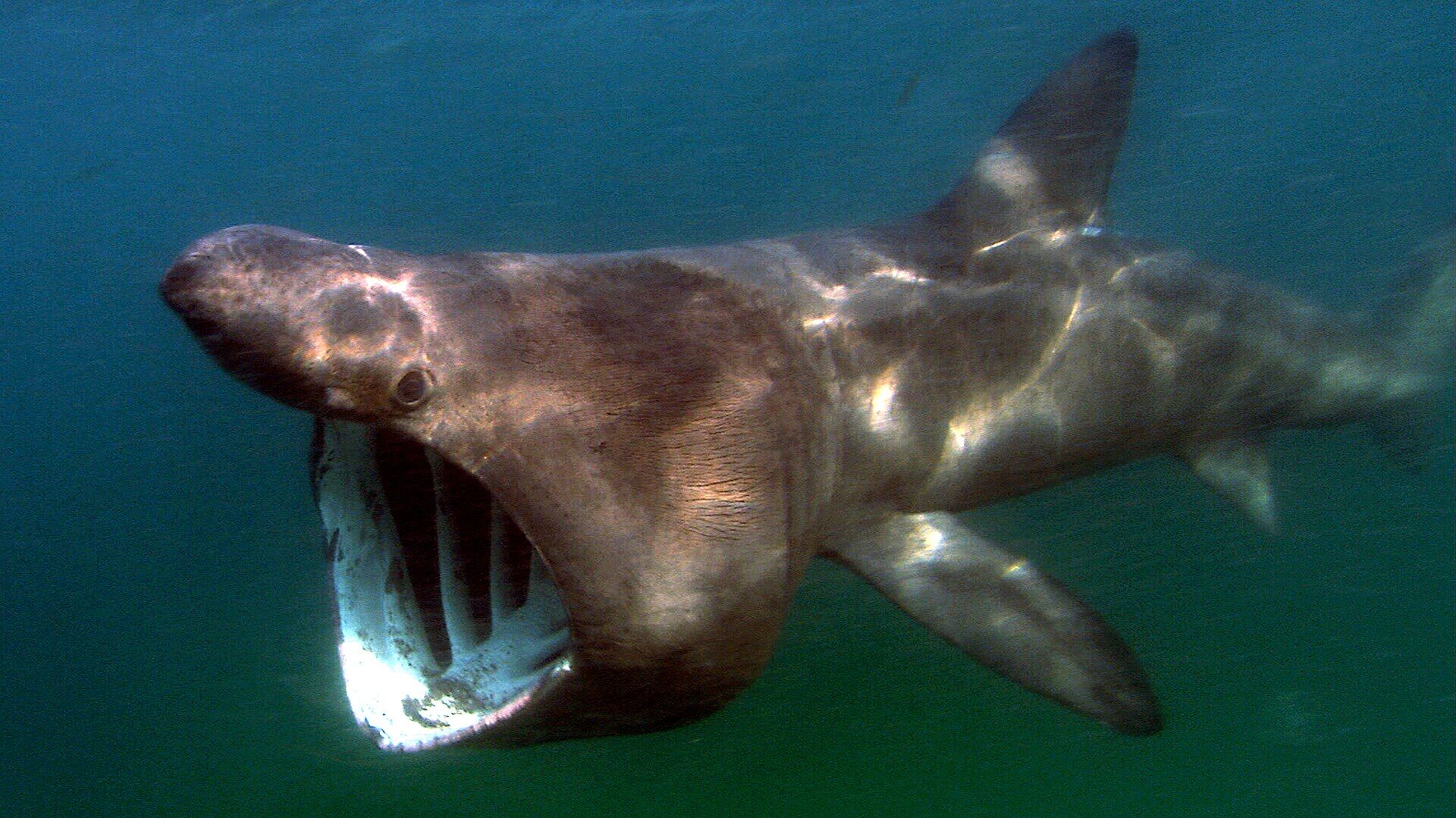
Imagine a torpedo as long as a public bus, dark grey to brownish on top with mottled white underneath, swimming slowly at the surface with its head fully out of the water and its mouth gaping open. The mouth is the giveaway: it can stretch a metre wide, ringed by hundreds of tiny hooked teeth that play no role in feeding, and lined inside with five enormous gill slits that nearly encircle the head. The dorsal fin alone can stand over a metre out of the water. The tail is the lunate, crescent shape of a fast pelagic shark, even though basking sharks rarely use it for speed.
At a distance, basking sharks are sometimes confused with great whites because the dorsal fin profile is similar. The give-away is behaviour. A great white swims hard and is rarely seen with its dorsal at the surface for long. A basking shark cruises, slowly, often for hours, with the dorsal lazily cutting the surface and a second fin (the upper lobe of the tail) showing 1 to 2 m behind it. They are also often in small loose groups, a behaviour great whites do not show.
Diet: how the second-largest fish eats the smallest thing in the sea
Basking sharks are obligate ram filter feeders. The shark swims forward with its mouth open at about 1 metre per second, water rushes in, and the gill rakers (long, comb-like bristles arranged along the gill arches) strain out the plankton. The dominant prey is calanoid copepods, particularly Calanus finmarchicus, a 4 mm crustacean that swarms in cold-water blooms in spring and summer. A single feeding bout can pass over 1,800 tonnes of water per hour across the rakers.
That is not enough food to feed an animal that size all year. Where basking sharks spend the winter, and what they eat during it, was a mystery until satellite tagging in the 2000s started showing them descending to depths of 600 to 1,200 m and migrating to thermally productive areas off the African coast, the mid-Atlantic, and the Caribbean shelf edge. The current consensus: they continue to filter feed at depth on deeper plankton communities, and possibly shed the gill rakers in winter and regrow them in spring, an unusual moulting strategy unique to this species.
What is in the filter
- Copepods (mainly Calanus finmarchicus): 70 to 90 percent of summer diet by mass
- Krill (mainly Meganyctiphanes norvegica): a regional supplement off Scotland and Norway
- Larval fish and crustacean larvae: occasional, especially during spring blooms
- Squid paralarvae: recorded in stomach contents during offshore tracking
Range and global distribution
Basking sharks are circumglobal in cool temperate and sub-polar seas, broadly between 30 and 70 degrees of latitude in both hemispheres. They follow seasonal plankton blooms. In the North Atlantic, that means a summer push north into UK, Irish, Norwegian, and Newfoundland waters, then a winter retreat to deeper Atlantic shelf-edge waters or south toward the Azores and the African shelf. In the North Pacific they show similar patterns from California and British Columbia north to Alaska. The Southern Hemisphere population is more dispersed, with records from New Zealand, southern Australia, southern Africa, and Patagonia.
Best places to see one
- Cornwall and Devon, UK: May to August, especially around Land's End, the Lizard Peninsula, and the Isles of Scilly. The most reliable shore-side sightings on Earth.
- Isle of Man: June to August, with a long history of small-boat surveys.
- West coast of Scotland and the Hebrides: similar months, with the Manx Basking Shark Watch and Scottish Natural Heritage running citizen-science programmes.
- Ireland, especially Donegal and Cork: May to July.
- New England and Atlantic Canada: late summer into autumn.
- Monterey Bay, California: occasionally, less reliably since the Pacific population crash of the 1950s.
Reproduction and lifecycle
Basking shark reproduction is among the least well documented of any large fish. Females are ovoviviparous, meaning eggs develop inside the body and pups are born live. Gestation is thought to be very long, possibly two to three years, which would be one of the longest of any vertebrate. Litters are estimated at around 6 pups, each born 1.5 to 2 m long, ready to feed for themselves. Sexual maturity is not reached until around 18 years (males) or 20-plus years (females), and reproduction may only happen every 2 to 4 years thereafter.
That combination, late maturity, long gestation, and low litter size, is the textbook profile of an animal that cannot recover quickly from heavy fishing. It is exactly why the species' 20th-century population crash, driven by a liver-oil fishery, has been so slow to reverse.
Behaviour: why they are not really lazy
The Victorian name comes from their habit of cruising at the surface in apparent sunbathing posture. They are not basking. They are feeding in the top layer of water where calanoid copepods are densest in summer. Drone footage from the last decade has shown basking sharks engaging in much more active behaviour than the old picture: high-speed migrations between feeding grounds, occasional breaches that briefly clear the water (recorded as recently as 2018 off Donegal), and torus-shaped courtship formations of 20-plus animals circling head-to-tail.
Why does a 5-tonne plankton feeder breach? The leading hypothesis: parasite removal, courtship display, or simply because, in a torus of 20 other sharks, you have to take your turn at the top of the pile. The behaviour is rare, has been filmed only a handful of times, and remains a working puzzle.
Are basking sharks dangerous
No, not to swimmers. The Florida Museum's International Shark Attack File records zero unprovoked attacks. The teeth are small and not used for feeding. The animal's only ways of inflicting harm are accidental: a swimmer or kayaker getting struck by the tail of a 5-tonne shark turning at the surface, or a small craft being capsized by a startled fish. Both have happened occasionally to fishing boats, which is why UK marine guidance recommends keeping 100 m of distance and never approaching from the front.
Conservation: from liver oil to a slow recovery
From the 16th to the 20th century, basking sharks were the target of a major Atlantic liver-oil fishery. A single shark could yield over a tonne of liver, prized for lamp fuel and later for vitamin A extraction and industrial lubricants. Hunts off Achill Island, Ireland, killed over 12,000 sharks in the 1950s and 1960s. The Soviet, Norwegian, and Scottish fleets each took thousands more. By the 1980s, the once-abundant North Atlantic and North Pacific populations had crashed by an estimated 80 to 90 percent.
The species was added to CITES Appendix II in 2002, listed under EU and UK protection legislation, and reclassified by the IUCN from Vulnerable to Endangered in 2019 after a global re-assessment. The North Pacific subpopulation is listed separately as Endangered. The Mediterranean subpopulation is Critically Endangered with very few remaining records.
Threats today are subtler: incidental capture in pelagic longlines, gillnet entanglement, ship strikes (a known cause of death for surface-feeding basking sharks in shipping lanes), and climate-driven shifts in copepod distribution. The Shark Trust's long-running Basking Shark Project coordinates citizen sightings and has provided most of the population trend data outside formal scientific surveys.
Fun and surprising basking shark facts
- The basking shark's liver makes up around 25 percent of its total body weight, the highest ratio of any shark, and it functions partly as a buoyancy organ.
- Despite the size, basking sharks can dive to 1,200 m and tolerate water just above freezing.
- They have the smallest brain-to-body ratio of any shark, which is part of why early naturalists assumed they were dim. Modern behaviour studies suggest the opposite: they navigate ocean basins reliably and engage in coordinated social behaviour.
- The 2003 carcass of a 7 m basking shark off New Zealand was briefly identified as a plesiosaur until DNA analysis confirmed otherwise. The decomposing posture of the species is the source of multiple sea-monster claims in the historic record.
- Basking shark gill rakers were once used in traditional Chinese medicine and command high prices, which has driven a small targeted fishery into the 21st century despite global protection.
How to see a basking shark responsibly
Cornwall's south coast is the most accessible viewing spot in the world. The best months are late May through August. Pick a calm, sunny morning, and watch from a coastal path or a small responsible operator. If you are in a boat, the UK Shark Trust guidance is straightforward: do not approach within 100 m, never get in front of a basking shark, do not swim toward one, and if the shark approaches you, stay still and let it pass. They are protected wildlife under the Wildlife and Countryside Act, and disturbance can carry fines.
If you want to learn about other large filter feeders, our piece on the megamouth shark covers the only other large planktivorous shark in the order Lamniformes. The third member of the trio, the whale shark, is the only fish larger than the basking.
Related species and further reading
- Megamouth shark species profile
- Hammerhead shark complete profile
- Blue shark species profile
- Bigeye thresher shark
- Shark tagging and the risks involved
If you love big peaceful sharks, the store has a steady supply of basking shark plushes and toys and a basking-shark-friendly run of shark books including the standard UK field guides.
How big does a basking shark get?
The largest reliably measured basking sharks reach 10 m (33 ft) and around 5,200 kg (11,460 lb), making it the second-largest fish on Earth after the whale shark. Historic reports include sharks possibly approaching 12 m, but those are not verified to modern standards. Most adults are 6 to 8 m. Females tend to be larger than males. Newborn pups are already 1.5 to 2 m, an unusually large size at birth that is necessary because basking shark pups are independent from their first day.
What do basking sharks eat?
Zooplankton, mainly copepods. The dominant prey across most of the species' range is the calanoid copepod Calanus finmarchicus, a 4 mm crustacean that swarms in cool-water blooms each spring and summer. Basking sharks supplement with krill (especially off Scotland and Norway), larval fish, and crustacean larvae. They are obligate ram filter feeders, meaning they must swim forward at about 1 m per second with mouth open to strain food across their gill rakers. A single feeding bout can pass over 1,800 tonnes of water per hour through the gills.
Where can I see a basking shark in the UK?
The most reliable shore-side sightings on the planet are along Cornwall and Devon's coastline from May to August, particularly around Land's End, the Lizard Peninsula, and the Isles of Scilly. The Isle of Man, the Hebrides, and the west coast of Ireland are also strong bets in early summer. Pick a calm, sunny morning, watch from a coastal path or join a responsible boat operator, and follow Shark Trust guidance: do not approach within 100 m, do not swim toward the animal, and let any close encounter unfold on the shark's terms.
Are basking sharks dangerous?
No. The Florida Museum's International Shark Attack File records zero unprovoked attacks. Basking sharks are obligate plankton feeders with tiny teeth that play no role in feeding. The only risks are accidental: a startled shark's tail can capsize a small boat, and ship strikes have killed surface-feeding individuals. UK guidance recommends staying 100 m back and never approaching from the front. They are protected under the Wildlife and Countryside Act, and disturbance can carry penalties.
Why are basking sharks endangered?
From the 16th to the 20th century, they were the target of a major Atlantic liver-oil fishery. A single shark could yield over a tonne of vitamin-A-rich liver oil. Hunts off Achill Island, Ireland, killed over 12,000 sharks in the 1950s and 1960s, and Soviet, Norwegian, and Scottish fleets each took thousands more. By the 1980s, North Atlantic and North Pacific populations had crashed by an estimated 80 to 90 percent. The species was reclassified by the IUCN from Vulnerable to Endangered in 2019. Continued threats include longline bycatch, gillnet entanglement, ship strikes, and climate-driven changes in copepod distribution.
How fast can a basking shark swim?
Cruising speed during feeding is around 1 m per second (3.6 km/h or 2.2 mph), the right pace for ram filter feeding. They can swim much faster in short bursts, with tagged individuals recording brief speeds of 5 to 7 km/h during migration. The cruising pace is so steady that early naturalists assumed the animal was lazy, when in fact it is doing the calorie-positive work of straining hundreds of cubic metres of water across its gill rakers every minute.
Do basking sharks have teeth?
Yes, but tiny ones. The mouth is ringed by hundreds of small, hooked teeth, none of which are large enough to harm humans or to play any role in feeding. The teeth are vestigial, a holdover from the shared lamniform ancestry with great whites and makos. Feeding is done entirely by passive ram filtration across the gill rakers, the long comb-like bristles that line the gill arches and act as the actual food sieve. Each raker is several centimetres long and the array can be over a metre across each gill slit.
Are basking sharks the same as whale sharks?
No. Despite both being huge filter feeders, basking sharks (Cetorhinus maximus, order Lamniformes) and whale sharks (Rhincodon typus, order Orectolobiformes) are only distantly related. Whale sharks are larger (up to 18 m), live in warm tropical seas, and are spotted patterned. Basking sharks are second-largest, live in cool temperate seas, and are uniformly dark grey or brown. Their evolutionary closest living relatives are the great whites and makos in the order Lamniformes, not the whale sharks at all. The plankton-feeding lifestyle evolved independently in each group.
By Carey Baird. Last updated 14 May 2026. Estimated reading time: 12 minutes.
Got a shark photo of your own? Send it to us and we may post it here and on our Facebook page, with your name on it. Share your shark photo
thank you so much for this amazing site and all the shark information
We walked the coast path near the Lizard last summer hoping for a fin and saw nothing but gannets. Is there a time of day that works better, or is it pure luck with the plankton?
Calm sunny mornings worked for us. We saw two off Cornwall a couple of years back, about an hour after the sea went flat, slow fins with the tail tip trailing behind.