
Shark Attacked a 10 Year-Old Boy in Bahamas
3 min read
Last Updated on May 24, 2026 by Otis Mako

A 10-year-old boy was bitten by a shark during a controlled shark-tank experience at the Atlantis resort on Paradise Island in the Bahamas. The incident, on Monday 15 January 2024, was the first of its kind at the resort’s shark attraction since it opened the experience in 2006. It is a rare event, and it raises useful questions about how shark tourism is run and how safe it really is.
What happened at Atlantis
The boy, from Maryland, was taking part in a guided in-water excursion at the Atlantis Paradise Island resort. The attraction, run by an operator called Blue Adventures, lets a small group of guests walk through a shark enclosure for around 15 to 20 minutes. The resort says the tank holds about 15 sharks, the largest roughly 8 feet long, and that no more than 5 guests are allowed in at once, accompanied by three chaperones.
A bystander filming near the pool captured the aftermath, with staff in blue shirts shouting “Run” repeatedly amid the commotion. The boy was bitten on his right leg, taken to hospital, and underwent surgery. He was well enough to fly home to the United States two days later to continue recovering. The operator, expressing that it was “deeply saddened,” said a dive instructor and dive guide were in the water with the guest and responded immediately to provide medical attention. The species of shark involved was not officially confirmed, and the Walk with Sharks experience was closed pending investigation.
The sharks in the tank
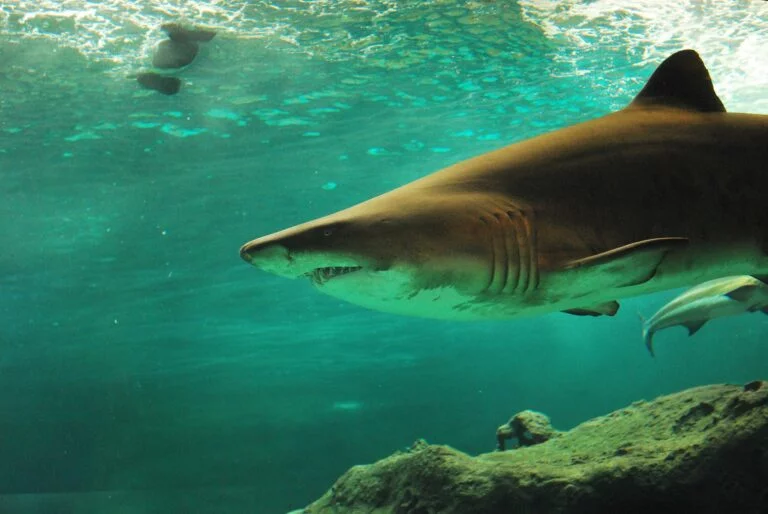
The Atlantis attraction features Caribbean reef sharks and nurse sharks, two species common throughout the Bahamas and considered low-risk to people.
The Caribbean reef shark, Carcharhinus perezi, is a sleek, grey requiem shark that grows to around 2.5 to 3 metres. It is the most commonly encountered reef shark in the Caribbean and is generally not aggressive toward humans, although it is a capable predator and is the species most often used in baited shark dives in the region.
The nurse shark, Ginglymostoma cirratum, is a slow, docile, bottom-dwelling shark that often rests motionless on the seabed by day. It reaches around 3 metres and feeds by suction, hoovering up crustaceans, molluscs, and small fish. Nurse sharks are usually placid, but they are well known for biting when they feel cornered, grabbed, or stepped on, and their bite is tenacious. Many of the rare nurse shark bites on record involve a person touching or disturbing the animal.
How safe are shark-tank experiences
Shark encounter attractions are popular at resorts and aquariums worldwide, and serious incidents are genuinely uncommon, as the resort’s clean record since 2006 shows. The sharks used are deliberately chosen for their docile temperament. Even so, these are wild predators in a confined space, not props, and a few principles matter:
- Never touch, chase, or corner a shark. Most captive shark bites are defensive reactions to being grabbed or startled.
- Follow the guides exactly. Trained dive staff know the individual animals and their moods.
- Move calmly and slowly. Sudden, splashy movement can trigger a shark’s predatory or defensive instincts.
- Consider age and confidence. A confined enclosure can be overwhelming for a young child, which can lead to the kind of sudden movement that unsettles an animal.
An incident like this is a reminder that “controlled” does not mean risk-free, and that operators and guests both share responsibility for keeping these experiences safe for people and sharks alike.
The Bahamas as a shark destination
The Bahamas is one of the world’s premier destinations for seeing sharks in the wild. In 2011 the country declared its entire 600,000-square-kilometre territorial waters a shark sanctuary, banning commercial shark fishing and the shark fin trade. That protection has helped the Bahamas maintain healthy populations of reef sharks, tiger sharks, hammerheads, and more, and shark tourism is now a significant part of the national economy.
Despite all the sharks and all the visitors, attacks are remarkably rare. According to the International Shark Attack File maintained by the Florida Museum of Natural History, there have been only a few dozen confirmed unprovoked shark bites in the Bahamas across its entire recorded history stretching back centuries. This resort-tank bite came not long after a separate tragedy in which a paddleboarder was killed by a shark in Bahamian waters, but such serious events remain the exception against millions of safe ocean visits.
Keeping perspective
The bite on the young boy was frightening, and his recovery is the thing that matters most. But it is also a single rare incident at an attraction with an 18-year clean record. Sharks are not the man-eating monsters of film. Worldwide there are usually fewer than 10 fatal unprovoked shark bites in a typical year, while humans kill tens of millions of sharks annually. For more on understanding shark behaviour, read our guide on how to avoid a shark attack.
Part of our guide: Shark Attacks Guide.
Got a shark photo of your own? Send it to us and we may post it here and on our Facebook page, with your name on it. Share your shark photo




We did a shark tank walk with our kids at an aquarium years ago and the guides were strict about keeping hands in. Still, ten seems young for a pool with sharks that size.