
Is there a Greenland shark in the Caribbean?
3 min read
Last Updated on May 18, 2026 by

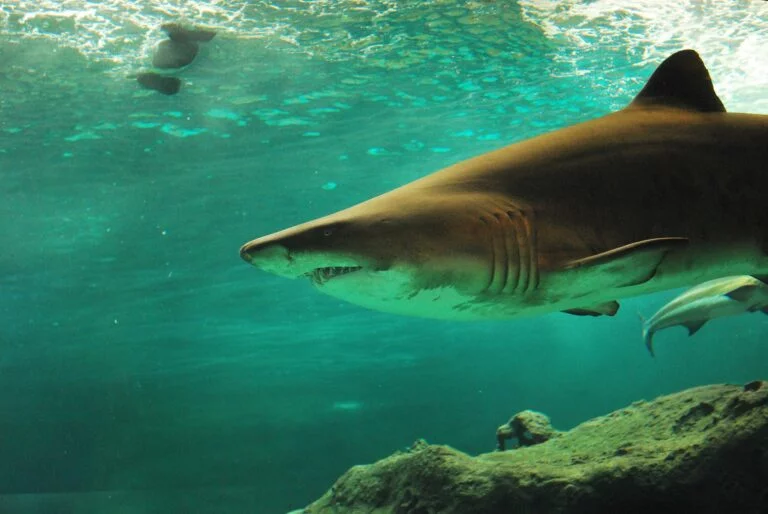
A shark that belongs in the freezing Arctic appears to have turned up in the warm waters of the Caribbean. In April 2022, researchers tagging tiger sharks at Glover’s Reef in Belize pulled up an 11-foot, blue-eyed animal that looked unmistakably like a Greenland shark. If the identification holds, it is one of the strangest shark sightings on record, and a reminder of how little we know about the deep ocean.
The Belize discovery
The encounter happened during routine fieldwork. A team from Florida International University, working with local fishers, was tagging tiger sharks at Glover’s Reef, one of three coral atolls off the coast of Belize. Instead of the expected tiger shark, their line brought up something altogether different: a slow, heavy-bodied shark with small, milky blue eyes and the ancient appearance of a deep-sea sleeper shark. Before the team could attach a satellite tag, a storm rolled in, and they released the animal.
Devanshi Kasana, the PhD candidate who first saw it, initially wondered if it might be a sixgill shark. She sent photographs to her advisor, Demian Chapman, who suggested it could be a Greenland shark. After consulting other shark experts, the team reached a careful conclusion: the animal might be a Greenland shark, or possibly a hybrid between a Greenland shark and a Pacific sleeper shark, the two species being closely related members of the sleeper shark family.
What is a Greenland shark
The Greenland shark, Somniosus microcephalus, belongs to the family Somniosidae, the sleeper sharks. The name fits. These are slow, sluggish animals that move through the water at a cruising speed of barely more than 1 mile per hour, conserving energy in a cold, food-scarce environment. They typically grow to 4 or 5 metres and live in the deep, frigid waters of the North Atlantic and Arctic.
The Greenland shark is most famous for its extraordinary lifespan. A landmark 2016 study published in the journal Science used radiocarbon dating of the lens of the eye to estimate ages, and concluded that Greenland sharks can live for at least 250 years, and possibly up to 400. That makes the species the longest-lived vertebrate known to science. A Greenland shark alive today could plausibly have been born before the Napoleonic Wars.
A diet of carcasses and toxic flesh
Greenland sharks are opportunistic feeders. They eat fish and squid, but they are also well documented as scavengers, and the remains of seals, reindeer, horses, and even polar bears have been found in their stomachs. They have never been recorded attacking a living human.
Their flesh carries a built-in defence. Greenland shark meat contains high concentrations of trimethylamine N-oxide, a compound that helps the shark cope with deep-sea pressure and cold but is toxic to humans, producing symptoms similar to extreme drunkenness if eaten fresh. Despite this, the meat is the basis of a traditional Icelandic dish called hakarl, made by burying and fermenting the flesh for weeks and then hanging it to dry, a process that breaks the toxin down enough to make it edible.
Many Greenland sharks also host a parasitic copepod that attaches to the eye, which can leave the animal partially or fully blind. Given their cold, dark habitat and their reliance on smell, vision matters far less to them than it would to a reef shark.
Could a cold-water shark really live in the Caribbean
It sounds impossible, but it is not. The key is depth. While the surface of the Caribbean is tropical, the sea floor is not. The Caribbean reaches depths of around 9,500 feet, and the water that far down is permanently cold, only a few degrees above freezing. A sleeper shark could, in principle, live in that deep cold layer without ever experiencing the warm surface at all.
Sleeper sharks have been recorded at lower latitudes before, always in deep water. So the Belize animal may not be an Arctic stray at all. It may be evidence of a poorly understood deep-water population that scientists simply have not had the tools to study. The deep sea remains the least explored habitat on the planet, and discoveries like this show how much is still hidden.
Why the find matters
This single encounter raises real questions. How many sleeper sharks live in tropical deep water? Are they Greenland sharks, Pacific sleeper sharks, hybrids, or an undescribed population? Fishing is prohibited within 2 miles of all three Belizean atolls, which gives sharks there genuine protection and improves the odds of future sightings. The research team hopes to find the animal again and fit it with a satellite tag, which would be the first hard data on where such a shark goes.
Whatever the Belize shark turns out to be, the encounter is a useful reminder that conservation depends on knowledge, and our knowledge of the deep ocean is still thin. You cannot protect what you have not yet found. For a deeper look at this remarkable animal, see our Greenland shark species profile, and our tiger shark profile covers the species the researchers were actually there to study.
Got a shark photo of your own? Send it to us and we may post it here and on our Facebook page, with your name on it. Share your shark photo




How deep would the line have to be for a sleeper shark to take it near a reef like that? I’d pictured tiger shark gear being set fairly shallow.