
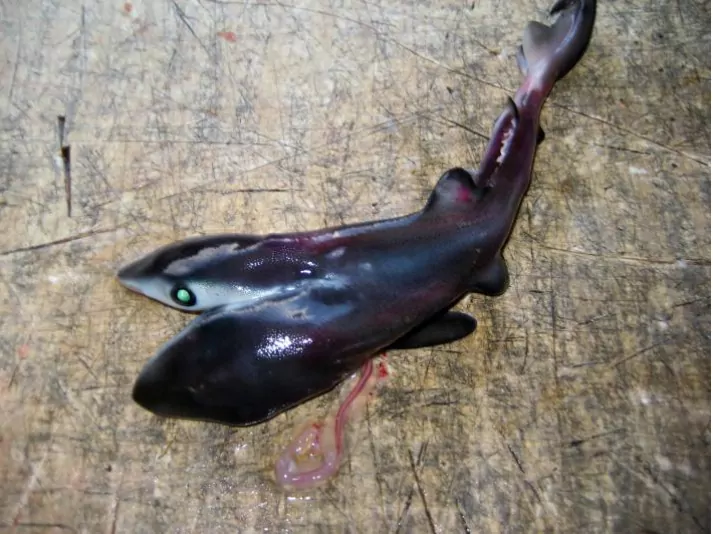
The Rise Of The Two-Headed Sharks – Why is This Happening?
3 min read
Last Updated on July 27, 2026 by Otis Mako
Since 2008, Two-Headed Sharks have been popping up and experts have been trying to figure out the problem.
Though two-headed sharks may sound like something from one of those B-list movie productions, they are real. More of these mutant fish are turning up, especially over the last few years.
Nobody has pinned down what is causing it. The candidates researchers keep coming back to are genetic disorders, chemical pollution, viral infection, and inbreeding in overfished populations.
Recent Two-Headed Shark Discoveries
Fishermen off the coast of Florida found a two-headed bull shark fetus.
The trend among sharks appears to have started in 2008, when a fisherman, Christian Johnson, caught a two-headed blue shark embryo in the Indian Ocean off Australia.
Years later, a 2011 study led by Felipe Galván-Magaña detailed the discovery of two-headed sharks from the blue shark species. The specimens were caught in the Gulf of California and around northwestern Mexico.
So far, blue sharks take the lead for producing the most recorded newborn two-headed sharks and embryos. The study concluded that this is due to the fact that blue sharks carry so many babies: often up to 50 pups at a time.
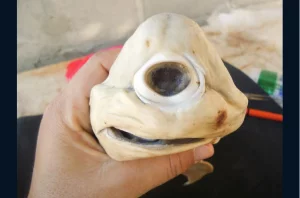
Galván-Magaña also reported seeing other mutated sharks, including a one-eyed ‘cyclops’ shark caught off the coast of Mexico in 2011. This shark had just one functioning eye positioned at the front of its head. Such conditions can be traced to a congenital abnormality known as ‘cyclopia’ and it occurs in both humans and animals.
More recently, a team of Spanish researchers including Professor Valentín Sans-Coma (University of Malaga) spotted the embryo of an Atlantic sawtail catshark which had two heads. This was the first recorded occurrence of two-headed sharks among oviparous shark species, the ones that lay eggs. They published their findings in the Journal of Fish Biology.
Nicolas Ehemann, a marine scientist, examined two more cases: a smalleye smooth-hound shark and a blue shark. Both fish were found in the same waters off Venezuela’s Margarita Island, and both were the first reported cases of two-headed sharks from the Caribbean Sea.
Some Quick Facts About Two-Headed Sharks And Other Two-Headed Animals
- The condition is referred to as polycephaly, derived from the Greek word poly (many) and kephale (head). Two-headed animals are called bicephalic or dicephalic.
- Normally, each head has its own brain but shares control of other organs and limbs with the other head(s).
- Such animals hardly ever live beyond a few months after birth. But a few do.
- The brains contend with each other for control, so the animal tends to move around in a dizzy or disoriented manner.
- In some animals, the heads may regard the other head(s) as an enemy. In snakes, one head could attack and even try to swallow the other one.
The video below is by Discovery News and it shows some instances of two-headed sharks and other animals with similar mutations.
What’s Causing The Increase In Two-Headed Sharks?
Though extremely rare, the multiple-headed mutation in animals has been documented since the 1800s. There have been two-headed goats, sheep and snakes, and two-faced kittens. Among sharks the records start in 2008, and the numbers seem to be rising.
In the study by Professor Sans-Coma and others, the two-headed catshark was lab-grown. It had not been exposed to infections, chemicals, or any source of radiation, so the researchers concluded that a genetic disorder was the most plausible cause in that instance.
Sharks in the wild face a very different environment. Other possible causes for the mutation include:
- viral infections,
- metabolic disorders,
- pollution, chemical and otherwise,
- inbreeding from a gene pool thinned by overfishing, which would raise the rate of genetic abnormalities.
Two-headed sharks are rare, and they die very shortly after birth, which is the main reason nobody has been able to study them properly.
Bring sharks home
Love what you read? Browse our shark merchandise store for gear inspired by sharks:
Every purchase supports more shark content on this site.
Got a shark photo of your own? Send it to us and we may post it here and on our Facebook page, with your name on it. Share your shark photo



All the nuclear testing in the Ocean happening since 1950s, plus the constant input of radiated water since Fukushima 2011.
I thought this only happened in B-list movies!