Why Sharks Roll Their Eyes Back: Nictitating Membrane Explained
5 min read
Last Updated on July 27, 2026 by Otis Mako
The nictitating membrane is a third translucent eyelid that protects a shark’s eyes during a strike, found in most requiem sharks but absent in some lamniforms like the great white, which rolls its eyes back instead. Most sharks have a translucent third eyelid (the nictitating membrane) that closes across the eye during a bite to protect it from thrashing prey. Lamniforms like the great white shark lack this membrane and instead roll their eyes back into the head, which is why their eyes appear black just before a strike.
Part of our guide: Shark Species.
What is a nictitating membrane
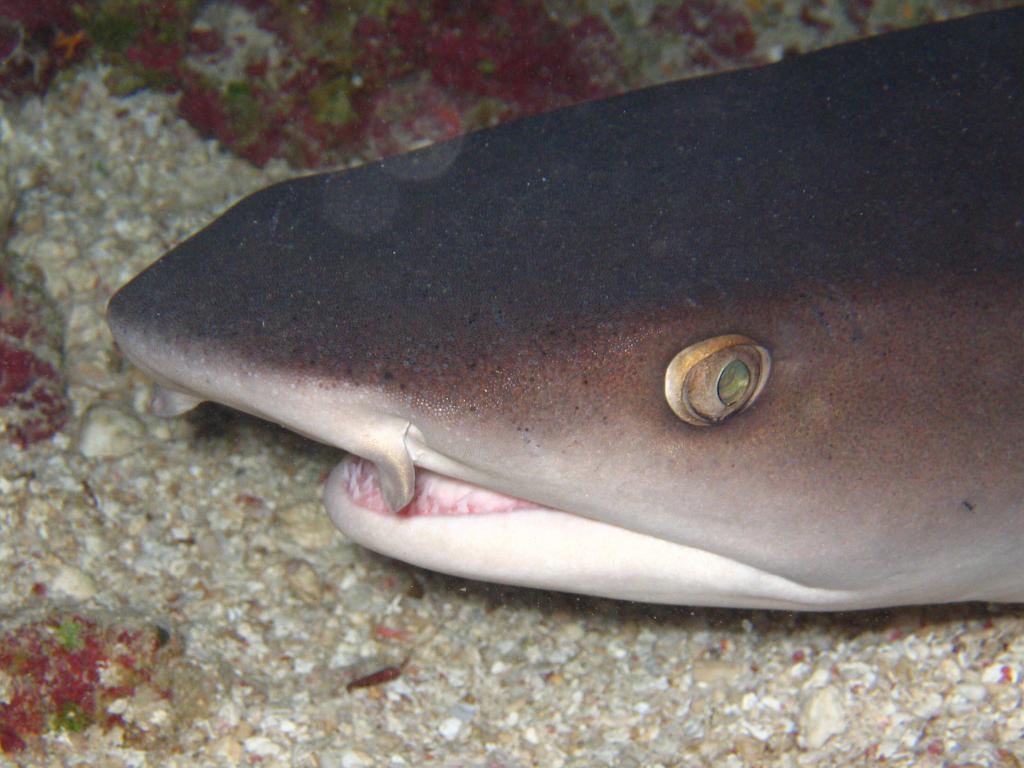
A nictitating membrane is a translucent third eyelid that closes horizontally across the eye, sliding from the inner corner to the outer corner. It is found in many vertebrates including reptiles, birds, and some mammals (cats, camels, polar bears). In sharks, it is part of the standard requiem shark anatomy.
The function is straightforward. During a strike, the eye is one of the most vulnerable parts of the head. Thrashing fish, stingray barbs, and seal claws can all damage it. The membrane slides across at the moment of contact to provide a tough protective cover that still lets some light through, so the shark is not completely blind during the strike.
Which sharks have one
The nictitating membrane is one of the defining features of the order Carcharhiniformes, the ground sharks. That covers bull sharks, tiger sharks, hammerheads, lemon sharks, oceanic whitetip, blacktip, spinner and blue sharks, almost every requiem shark family, and the catsharks. It is the default among the most diverse shark lineages.
Members of the order Lamniformes (great white, mako, salmon shark, porbeagle, basking, megamouth, thresher) do not have one. They protect the eye a different way, by rotating it backward into the socket so the eyeball is turned away from the strike zone and the tougher rear of the eye takes any damage. The other shark orders, including the sixgills and sevengills, lack a nictitating membrane too.
How the membrane works during a bite
The closure is a reflex rather than a decision. The membrane comes across as the shark commits to the strike, fast enough to be in place before the teeth make contact, and it stays there until the bite is finished.
Vision is reduced but not lost during that window, which is one reason electroreception via the ampullae of Lorenzini matters so much in the final moments of a strike. The shark is guiding the last part of the bite by the electrical fields of its prey rather than by sight.
Why great whites roll their eyes back instead
Lamniforms have larger, more spherical eyes than requiem sharks, and no sliding membrane. Instead the eyeball rotates backward into the socket, driven by the extraocular muscles.
The result is the famous black-eyed look of a striking great white. As the eye rolls back, the white sclera at the rear of the eyeball faces outward, then the eye disappears into the socket. From a boat or from the surface the eye looks jet black or simply missing during the final moment of the strike. It is one of the most photographed features of great whites and did a lot for their fearsome reputation.
Other vulnerabilities sharks protect
Eyes are not the only sensitive area at risk during a bite. The snout takes the brunt of any prey thrashing, and shark skin is covered in dermal denticles, tooth-like scales that are much harder than skin and spread the load without tearing. Between the denticles and whichever eye-protection system the lineage uses, the head can absorb a fight.
Watching for the membrane in the wild
Divers who spend time with requiem sharks (bull, lemon, tiger) sometimes see the nictitating membrane close partway as a shark approaches something it is interested in. The translucent grey film slides briefly across the eye, then retracts. In a dive context that usually means the shark is investigating, not biting.
Even so, treat it as a cue to give the animal room. A shark close enough for you to read its eyelid is closer than you want it, and backing off slowly is the right response.
The membrane in human medicine
Humans have a vestigial nictitating membrane: the small pink fleshy bump at the inner corner of the eye, called the plica semilunaris. It does not function as a third eyelid, but it is the evolutionary remnant of the same structure that sharks and other vertebrates use.
Related reading
For shark fans browsing for something to take home, see our store collections of shark books.
See the Shark Trust. See the Florida Museum shark biology.
Frequently asked questions
What is a nictitating membrane?
A nictitating membrane is a translucent third eyelid that closes horizontally across the eye, found in many vertebrates including most sharks. In sharks it protects the eye during a strike on prey, and it stays in place for the duration of the bite.
Why do great whites roll their eyes back when biting?
Great whites and other lamniform sharks do not have a nictitating membrane. Instead they rotate the eye backward into the socket using the extraocular muscles, which hides it from thrashing prey. The famous black-eyed look of a striking great white is the white sclera or the empty socket showing where the eye used to be.
Which sharks have a nictitating membrane?
The ground sharks, order Carcharhiniformes: bull sharks, tiger sharks, hammerheads, lemon sharks, oceanic whitetip, blacktip, spinner, blue shark, catsharks and most other requiem species. The lamniforms (great white, mako, salmon shark, basking, megamouth, thresher) do not have one and use the eye-roll instead.
How fast does the nictitating membrane close?
Fast enough to be shut before the teeth make contact. The closure is reflexive, deployed as part of the strike rather than timed by the shark, and it holds until the bite is complete.
Can sharks see while the membrane is closed?
Partially. The nictitating membrane is translucent, so some light still passes through. The shark is not completely blind, but vision is reduced. This is why electroreception via the ampullae of Lorenzini takes over for the final strike: the shark cannot rely on vision in the moments just before tooth contact.
Do humans have a nictitating membrane?
We have a vestigial one. The small pink fleshy bump at the inner corner of the eye, called the plica semilunaris, is the evolutionary remnant of a functional nictitating membrane. It does not move or function as a third eyelid in humans.
Why do sharks need to protect their eyes during a bite?
Prey thrashes. Fish flap their tails and fins, stingrays whip their barbed tails, seals scratch with sharp claws. Without eye protection, sharks would risk an eye at almost every meal. The nictitating membrane, or the eye-roll in lamniforms, lets a shark commit fully to a strike without exposing the eye.
Is the eye-roll the same as the nictitating membrane?
No, they are two different solutions to the same problem. The nictitating membrane is a sliding translucent eyelid found in requiem sharks. The eye-roll is a rotation of the eyeball into the socket, found in lamniform sharks. Both protect the eye during a bite, but they evolved separately.
By Otis Mako. Last updated 13 May 2026.
Got a shark photo of your own? Send it to us and we may post it here and on our Facebook page, with your name on it. Share your shark photo