Greenland Shark found in Cornwall, England!
4 min read
Last Updated on May 18, 2026 by

A Greenland shark, one of the most mysterious animals in the sea, washed up dead at Newlyn in Cornwall in March 2022. That matters because this is a deep, cold-water species almost never seen anywhere near England, and an individual this size may have been alive for centuries. Here is what happened, and why a single stranded carcass is a genuine scientific event.
Did you know there is a species of shark, the Greenland shark, that can live for over two centuries? While most sharks live around 30 years, the Greenland shark (Somniosus microcephalus) lives far longer, and finding one to study has always been rare and difficult.
What happened at Newlyn
The carcass was first spotted dead on the shore at Newlyn Harbour, a working fishing port near Penzance on the south coast of Cornwall, at the far southwest tip of England. Before experts could reach it, the tide carried the body back out to sea. Two days later it was relocated by Cornwall’s Marine Strandings Network, the volunteer organisation that has recorded marine wildlife strandings across Cornwall and the Isles of Scilly for more than 25 years. The team described themselves as speechless when they realised what they were looking at. The animal was identified as a female, and her sheer size led observers to estimate she could be anywhere from 300 to 500 years old, though that figure would only be confirmed once a vet pathologist examined the body.


The longest-living vertebrate on Earth
The Greenland shark holds a remarkable record: it is the longest-lived vertebrate animal known to science. A landmark study published in the journal Science in 2016 used radiocarbon dating of the proteins in the lens of the eye to estimate the ages of Greenland sharks. The results suggested individuals living for at least 272 years, with the largest sharks possibly reaching 400 years or more. To put that in perspective, a Greenland shark caught today could in theory have been swimming the North Atlantic before the United States existed as a country.
That extreme longevity comes from an extraordinarily slow pace of life. Greenland sharks grow at roughly one centimetre per year. They are not thought to reach sexual maturity until they are around 100 to 150 years old, which is older than almost any other animal. Slow growth, late maturity and few young mean the species recovers very poorly from any losses, and it is currently listed as Vulnerable on the IUCN Red List.
Where Greenland sharks really live
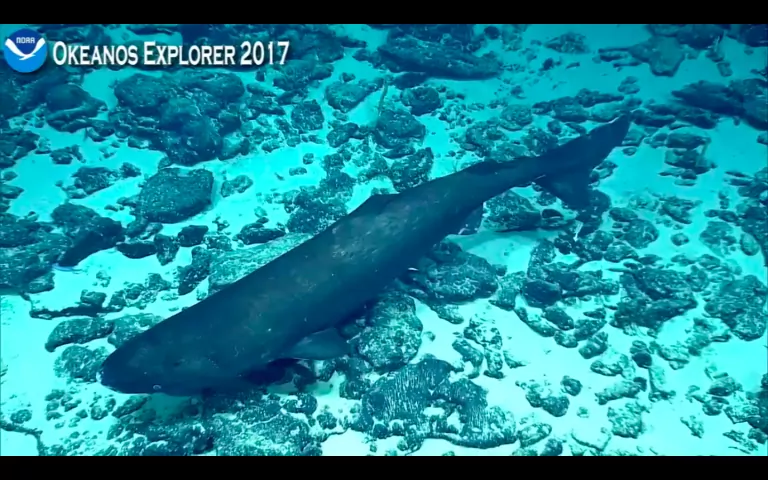
Greenland sharks are creatures of the cold and the dark. They are found in the frigid waters of the North Atlantic and Arctic, often at great depth, and have been recorded well over a kilometre down. They are slow swimmers, sometimes nicknamed “sleeper sharks”, and they scavenge as readily as they hunt: the remains of seals, fish and even land mammals have been found in their stomachs. Their flesh contains a toxin, trimethylamine oxide, which is why fresh Greenland shark meat is poisonous and must be specially treated before it can be eaten. Because they live in such cold, deep places, you are not going to meet one while swimming off a beach.
Why a single stranded shark is so valuable
Everyone would have preferred to find this shark alive, but even a carcass is a scientific gift. These animals are so hard to observe in the wild that strandings are sometimes the best chance researchers get to study their anatomy, diet, parasites and reproduction up close. The last Greenland shark recorded in British waters before this one had washed up nine years earlier, in Northumberland, on England’s northeast coast. That gap shows how exceptional the Cornwall find was. Volunteer stranding networks like Cornwall’s exist precisely to make sure that when a rare animal does come ashore, the data is not lost.
How scientists work out a shark’s age
Ageing a Greenland shark is itself a puzzle worth understanding. Most fish are aged by counting growth rings in hard structures such as ear bones or vertebrae, the way you count tree rings. Greenland sharks do not have usefully banded hard tissues, so that method fails. The 2016 breakthrough was to use the eye lens instead. The lens forms in layers from the centre outward and its core is laid down before birth, so the proteins at the very middle are as old as the animal. By measuring radiocarbon in that core tissue, and matching it against known historical spikes from twentieth-century nuclear bomb testing, researchers could estimate when each shark was born. It is a clever piece of detective work, and it is why we can say with any confidence that a large female like the Cornwall shark could be three or more centuries old.
What strandings tell us
Marine strandings, the wash-up of dead or stranded sea animals, are monitored around the world because they act as an early-warning system for the health of the ocean. Patterns in strandings can flag disease outbreaks, pollution, entanglement in fishing gear, or shifts in where animals travel. A southern outlier like a Greenland shark in Cornwall also raises a question worth asking: was it simply a lost individual, or a hint that cold-water species are turning up in unexpected places. If you ever find a stranded marine animal, the right move is never to touch it but to report it to the local stranding network or coastguard.
To learn more about this astonishing animal, including its full size, range and behaviour, read our complete Greenland shark species profile.
Got a shark photo of your own? Send it to us and we may post it here and on our Facebook page, with your name on it. Share your shark photo