
“Sailor” the Labrador Kisses a Whale Shark in Australia
3 min read
Last Updated on July 27, 2026 by
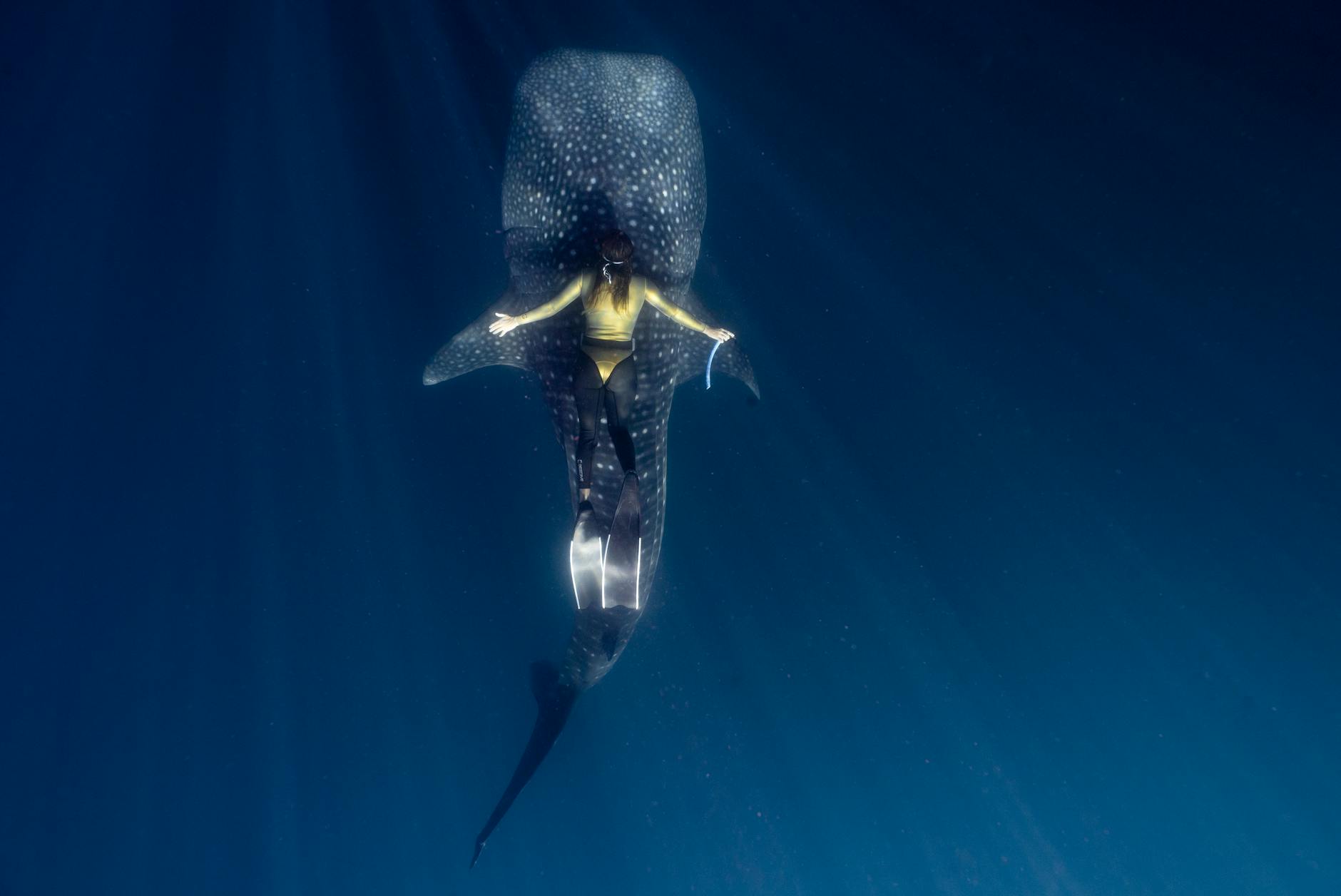
A Labrador called Sailor became briefly famous for kissing a 22-foot whale shark off the coast of Australia. The clip, filmed by diver Jade Pursell in September 2021 and shared on TikTok, shows the giant fish surfacing again and again next to her boat to inspect the dog. It is a charming moment, and a good look at how curious the world’s largest fish is.
How the Labrador kissed the whale shark
On 23 September 2021, Jade Pursell, a 28-year-old diver, was exploring a reef in northwest Australia with a friend. Her eight-year-old Labrador Retriever, Sailor, was waiting on the boat. Shortly into the dive, a 22-foot whale shark appeared. It showed little interest in the divers and seemed far more curious about the dog at the surface.
The whale shark kept rising slowly toward the boat, edging closer with each pass. Sailor, rather than being frightened, leaned over to get a better look. After several face-to-face approaches the two finally met, and the dog sniffed and kissed the whale shark on the nose. Pursell later said she was shouting at Sailor not to touch the shark, worried the dog might jump in or that the animal might react. Whale sharks are harmless filter feeders, but she did not want to risk either of them. Once the video went up on TikTok, it spread quickly. Sailor may well be the only dog in the world that can claim to have kissed a whale shark.

Why a whale shark approaches a boat
A whale shark, Rhincodon typus, is the largest fish on Earth, reaching lengths of around 12 metres and weights estimated at 15 tonnes or more. Despite the size it poses no threat to people or pets. It is a filter feeder, swimming with its mouth wide open to strain plankton, krill, fish eggs, and small fish from the water. Its mouth can be more than a metre across, yet its throat is narrow and its tiny teeth are not used for feeding at all.
Whale sharks are inquisitive animals, and individuals at well-known sites often investigate boats, divers, and unfamiliar shapes. With no reason to fear a dog and no instinct to hunt one, this shark was taking a slow, harmless look at something new in its world.
Where to see whale sharks in Australia
Northwest Australia is one of the most reliable places on the planet to encounter whale sharks. The standout site is Ningaloo Reef in Western Australia, a UNESCO World Heritage area stretching about 260 kilometres along the coast near the town of Exmouth. Whale sharks gather there every year, drawn by mass coral spawning and the plankton blooms that follow. The main season runs roughly from March to August, and operators out of Exmouth and Coral Bay run swim-with-whale-shark tours under strict permit conditions during that window.
Encounters in Australia are tightly regulated for the animals’ protection. Swimmers are generally required to stay at least 3 metres from the body and 4 metres from the tail, and touching is not allowed. Those rules exist because whale sharks, for all their calm, are still wild animals that can be stressed by crowding or contact.
A gentle giant under threat
The species is listed as Endangered on the IUCN Red List. Populations have declined over recent decades due to ship strikes, entanglement in fishing gear, and targeted hunting in some regions. Whale sharks are also slow to recover: they are thought to take around 25 to 30 years to reach maturity and may live 70 years or more, so lost individuals are not quickly replaced.
If you want to know more about the species Sailor met, our roundup of whale shark facts goes deeper, and you can also read about how to adopt a whale shark symbolically to support conservation work.
How researchers tell whale sharks apart
One reason scientists can track the health of populations at sites like Ningaloo is that every whale shark carries a unique pattern of white spots and stripes across its grey skin. The arrangement is as individual as a human fingerprint and does not change as the animal grows. Researchers photograph the area just behind the gills and feed the images into a global database, where pattern-recognition software, originally adapted from astronomy code used to map stars, matches each shark. This citizen-science approach means a holiday snapshot from a tourist can genuinely contribute to research. Encounters like Jade Pursell’s, properly logged, add real data points.
Watch the video below to see Sailor the Labrador kiss the whale shark from the boat.
Got a shark photo of your own? Send it to us and we may post it here and on our Facebook page, with your name on it. Share your shark photo


