7 of the Most Endangered Sharks on the IUCN Red List
3 min read
Last Updated on November 9, 2026 by Otis Mako
All seven sharks and rays below are listed Critically Endangered on the IUCN Red List, the highest risk category short of Extinct in the Wild. A 2021 global review found 391 of 1,199 shark, ray and chimaera species threatened, 32.6 percent, and estimated 37.5 percent once Data Deficient species are allowed for (Dulvy et al., Current Biology, 2021). The seven were chosen because they show the different ways a shark population collapses. Last updated 9 November 2026.
Part of our guide: Shark Conservation.
This is a selection rather than a ranking. We could not get a current count of Critically Endangered sharks from the Red List, so we do not give one. The fin trade drives some of these declines. Habitat loss drives others. Slow reproduction is what stops any of them recovering quickly once the pressure comes off.
The seven at a glance
Each row gives the status in the Red List entry, the date it was assessed and a link. We opened four of the entries directly on 9 November 2026, in Red List version 2026-1. For the other three we could not open the entry, so the row cites FishBase, which quotes Red List version 2025-2.
| Species | IUCN category and criteria | Last assessed | Source |
|---|---|---|---|
| Scalloped hammerhead (Sphyrna lewini) | Critically Endangered, A2bd | 2018 | IUCN Red List |
| Great hammerhead (Sphyrna mokarran) | Critically Endangered, A2bd | 9 November 2018, published 2019 | IUCN Red List |
| Smalltooth sawfish (Pristis pectinata) | Critically Endangered, A2cd | 9 March 2022 | FishBase, quoting Red List version 2025-2 |
| Oceanic whitetip (Carcharhinus longimanus) | Critically Endangered, A2bd | 2018 | IUCN Red List |
| Angelshark (Squatina squatina) | Critically Endangered, A2bcd | 2017 | IUCN Red List |
| Pondicherry shark (Carcharhinus hemiodon) | Critically Endangered, C2a(i) | 28 September 2020 | FishBase, quoting Red List version 2025-2 |
| Ganges shark (Glyphis gangeticus) | Critically Endangered, A2cd; C2a(i) | 22 January 2021 | FishBase, quoting Red List version 2025-2 |
1. Scalloped hammerhead (Sphyrna lewini)
Critically Endangered globally. Long fin rays make hammerhead fins premium in the fin trade, and the species also dies as bycatch on coastal longlines and in gillnets. It is listed on CITES Appendix II (NOAA Fisheries). NOAA puts its lifespan at up to 30 years, and slow reproduction means a depleted population takes a long time to rebuild even if fishing stops entirely.
2. Great hammerhead (Sphyrna mokarran)
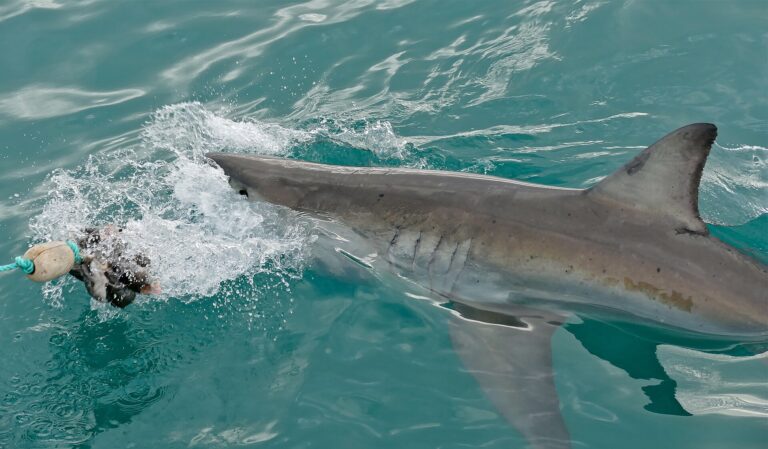
Critically Endangered globally, under criteria A2bd, last assessed on 9 November 2018 and published in 2019 (IUCN Red List). Great hammerheads also fight hard on the line and often die after release, which makes catch-and-release recreational fishing a real mortality source rather than a neutral one.
3. Smalltooth sawfish (Pristis pectinata)
A ray rather than a shark, included here because it shows what a coastal decline looks like. In the United States it was historically found from North Carolina to Texas and is now generally found only in Florida’s coastal waters (NOAA Fisheries). The rostrum that gives the animal its name is also what entangles it in nets.
4. Oceanic whitetip (Carcharhinus longimanus)
Now Critically Endangered (IUCN Red List). NOAA Fisheries says its main threat is bycatch in commercial fisheries combined with demand for its fins, and that it is frequently caught in longline, purse seine and gillnet fisheries worldwide. A shark can be common and still collapse quickly when it dies as a byproduct of a fishery nobody is asking to stop.
5. Angelshark (Squatina squatina)
Critically Endangered (IUCN Red List). The Red List entry marks it as possibly extinct in Germany, the Netherlands, Norway and Sweden, and still extant in places including the Canary Islands. A flat, bottom-dwelling ambush predator, which puts it directly in the path of trawl gear.
6. Pondicherry shark (Carcharhinus hemiodon)
Critically Endangered (FishBase, quoting the Red List), and described by FishBase as little known. A species this poorly recorded is hard to protect, because there is no baseline to measure a recovery against.
7. Ganges shark (Glyphis gangeticus)
Critically Endangered, restricted to rivers and estuaries in India and Bangladesh. River sharks face pressures ocean sharks do not: dams, water extraction, pollution and heavy inshore net fishing, all concentrated in the small stretch of water the species can actually live in.
What actually moves the numbers
Overfishing is the one threat common to all 391 threatened species in the 2021 review (Dulvy et al.). Worldwide, 80 to 100 million sharks are killed each year, about 25 million of them threatened species (Worm et al. 2024, via Live Science). Shark attacks on people are not a factor in any of these assessments.
The interventions with evidence behind them are catch limits with observers on boats, gear changes that cut bycatch, and CITES trade controls with customs enforcement attached. Protected areas help where they are enforced and do nothing where they are not.
If you want to act on this, support enforcement as well as awareness.
Checking the current status yourself
Red List statuses move as new assessments are published. The IUCN Red List is searchable by species, and the IUCN Shark Specialist Group publishes the assessments behind the shark and ray listings.
Last updated 9 November 2026.
Got a shark photo of your own? Send it to us and we may post it here and on our Facebook page, with your name on it. Share your shark photo